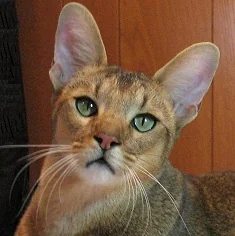
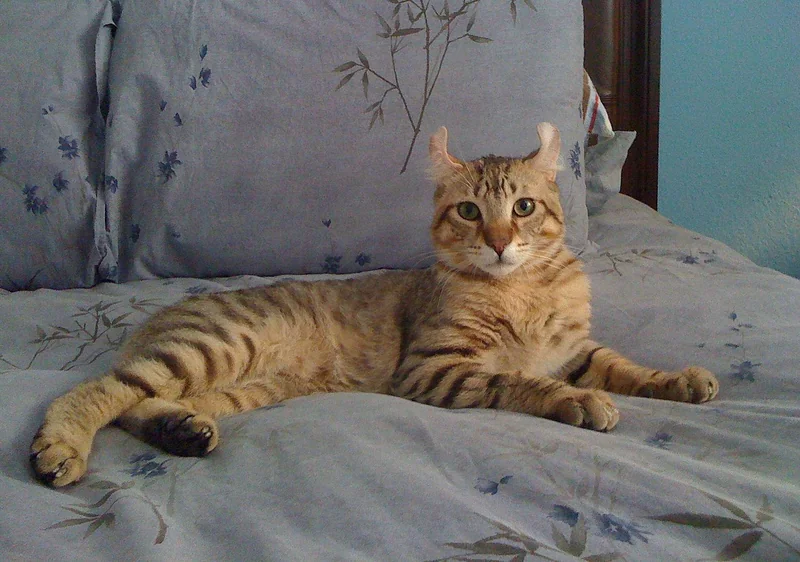
Felis catus × Leopardus geoffroyi
Safari
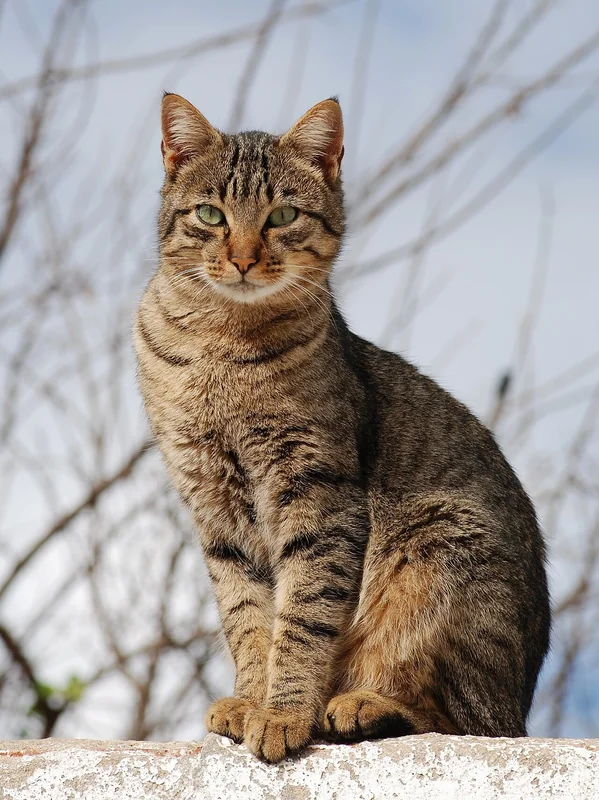 Featured photosafari.jpg
The Safari is a rare experimental cat breed produced from crosses between Geoffroy's cat (Leopardus geoffroyi), a small South American wild cat, and domestic cats. First produced at Colorado State University in the 1970s for feline leukemia research, the Safari has a spotted wild-type coat pattern similar to a small ocelot. The breed is extremely rare and not recognized by CFA, TICA, GCCF, or FIFe; occasional specimens appear in private collection or exotic pet contexts in the United States.
Quick facts
- Origin country
- United States
- Origin period
- First produced 1970s, Colorado State University; private breeding from 1980s
- Coat type
- Short
- Coat colors
- Spotted tabby with bold black spots on warm brown background, Lighter undersides, Pale facial markings
- Size category
- Large
- Average lifespan
- 10-14 years
- Recognition
- —
Origin
The Safari cat originated at Colorado State University in the early 1970s, where researchers crossed Geoffroy's cats with domestic cats as part of comparative immunology and feline leukemia studies. Geoffroy's cat (Leopardus geoffroyi) is a small wild felid from South America with 36 chromosomes, compared to the domestic cat's 38. The chromosome difference means that F1 hybrids (first generation) are typically sterile; achieving fertile offspring requires backcrossing over multiple generations. After the research context ended, some breeders in the United States continued to produce Safari cats for private ownership, maintaining small populations in the 1980s and afterward.
Rarity and Status
The Safari is one of the rarest hybrid cats in existence. The chromosome incompatibility between Geoffroy's cat and the domestic cat makes producing fertile hybrid descendants extremely difficult and time-consuming. The number of Safari cats living as of 2026 is estimated at fewer than 100 worldwide. No major cat registry recognizes the Safari as a breed. The legality of owning Safari cats varies by jurisdiction; in some US states and countries, ownership of F1 and F2 hybrids with wild cats requires permits. The Safari is not to be confused with other wild-hybrid breeds such as the Savannah (Serval cross) or the Chausie (Jungle Cat cross).
Appearance
The Safari has a large, muscular body reflecting both the domestic and wild cat ancestry. The coat is short, dense, and features bold black spots on a warm brown to golden background, similar to a miniature ocelot pattern. The face may show pale facial lines and a spotted or streaked pattern around the muzzle and forehead. The ears are medium-sized and may show the beginning of ear tufts. The tail has a spotted or ringed pattern. The overall impression is of a powerfully built cat with a strikingly wild appearance, substantially larger than a typical domestic cat.
Sources & further reading (2)
- encyclopedia — accessed 2026-05-07
- encyclopedia — accessed 2026-05-07
Frequently asked questions
Is the Safari cat legal to own?
Legality varies significantly by location. In the United States, F1 hybrids (first-generation Geoffroy's cat-domestic crosses) are typically subject to exotic animal regulations. Some US states prohibit ownership of wild-cat hybrids of any generation; others permit higher-generation (F3 and beyond) hybrids as domestic pets. Outside the US, regulations differ by country. Potential owners should consult local wildlife and exotic animal laws before considering a Safari cat.
How does the Safari compare to the Savannah cat?
Both the Safari and Savannah are wild-cat hybrids, but with different wild ancestors. The Savannah is derived from the African Serval (Leptailurus serval); the Safari is derived from Geoffroy's cat (Leopardus geoffroyi). The Savannah is TICA-recognized and much more commonly available; the Safari is unrecognized and extremely rare. The chromosome incompatibility in the Safari-domestic cross makes it harder to produce fertile offspring than in the Savannah program.
Why was the Safari first bred?
The Safari was first produced at Colorado State University in the 1970s as a research model for feline leukemia. Researchers crossed Geoffroy's cats with domestic cats to produce animals that combined wild immunological traits with domestic cat manageability for laboratory study. The research breeding program preceded any consideration of the Safari as a companion animal or show breed.