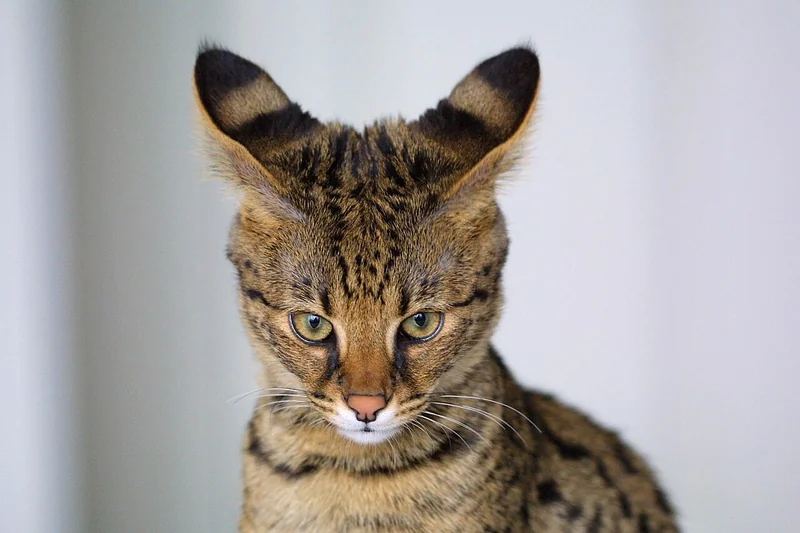
The Savannah is a hybrid domestic cat breed developed from crosses between the African serval (Leptailurus serval) and domestic cats. The first documented cross was made in 1986 by Judee Frank, producing a female kitten named Savannah. Patrick Kelly and Joyce Sroufe established the formal breeding programme in the 1990s and submitted the breed to TICA; championship status was granted in 2012. CFA does not recognize the Savannah. The standard describes a tall, lean, long-legged cat with large rounded ears and a spotted coat.
Quick facts
- Origin country
- United States
- Origin period
- 1986 first cross (serval × domestic, Judee Frank); TICA championship 2012
- Coat type
- Short
- Coat colors
- Brown Spotted Tabby, Silver Spotted Tabby, Black, Black Smoke
- Size category
- Large
- Average lifespan
- 12-20 years
- Recognition
- TICA 2012
Origin
The first documented African serval x domestic cat cross was made in 1986 by Judee Frank, producing a hybrid female kitten named Savannah. Patrick Kelly purchased a Savannah female from Frank in 1989 and partnered with Joyce Sroufe to develop the breed systematically. Sroufe authored the breed standard submitted to TICA in 1996. Subsequent crosses used Egyptian Mau, Oriental Shorthair, Domestic Shorthair, and other breeds to establish the domestic breeding population. Filial generation is tracked from the serval ancestor: F1 (direct serval cross), F2, F3, and so on.
Recognition
TICA accepted the Savannah for registration in 2001 and granted full championship status in 2012 — the standard pathway from new breed to championship taking eleven years for this breed. CFA does not recognize the Savannah due to wild-cat ancestry. GCCF and FIFe have not published Savannah standards. F4 and later-generation Savannahs are considered fully domestic by TICA for show and registration.
Standard
The TICA standard describes a tall, lean, long-legged cat with a long neck, small head relative to body size, and large rounded ears set close together atop the head. The coat is short, dense, and spotted — random dark spots on a gold, silver, smoke, or black base. The tail is of medium length with black rings and a black tip. The neck is long. The cheeks display a distinctive 'tear duct' or 'cheetah bar' dark line running from the inner eye corner. Size varies dramatically by filial generation; F1 and F2 males are substantially larger than later-generation cats.
Sources & further reading (3)
- tica-standard — accessed 2026-04-30
- encyclopedia — accessed 2026-04-30
- breed-club — accessed 2026-04-30
Frequently asked questions
Is the Savannah considered a wild or domestic cat?
F4 and later-generation Savannahs are considered fully domestic by TICA for show and registration purposes. Earlier generations (F1-F3) are subject to size, temperament, and legal restrictions that vary by jurisdiction; several U.S. states and countries prohibit or restrict ownership of F1-F3 Savannahs. CFA does not grant any generation of Savannah championship status.
When did the Savannah achieve championship status?
TICA granted the Savannah full championship status in 2012, eleven years after accepting the breed for registration in 2001. The breed was first submitted to TICA for consideration in 1996 via Joyce Sroufe's breed standard. CFA does not recognize the Savannah.
How large is a Savannah?
Size varies dramatically by filial generation. F1 males (direct serval cross) may weigh up to 11 kilograms, while later-generation cats (F4 and beyond) typically weigh 3.5 to 7 kilograms. The Savannah is among the tallest domestic cat breeds in terms of leg length and overall height, even at later generations, owing to the serval's inherently long-limbed frame.