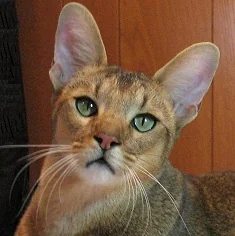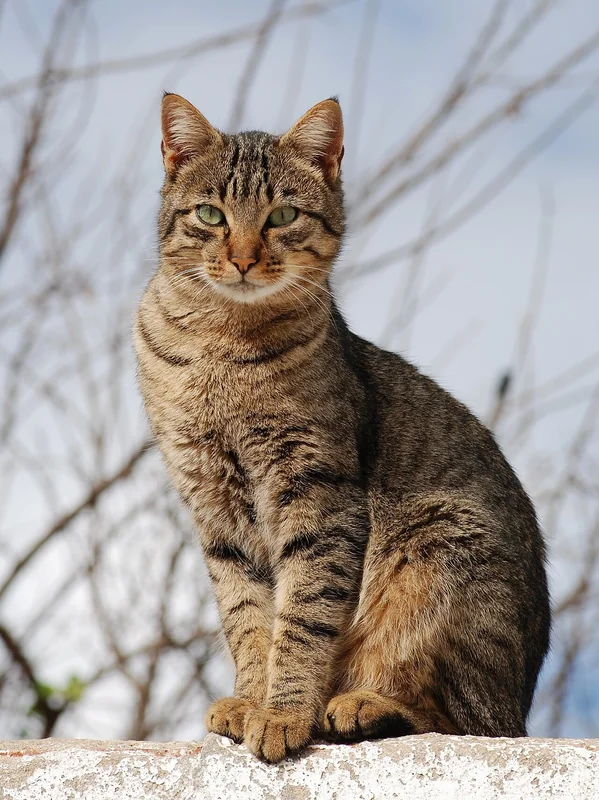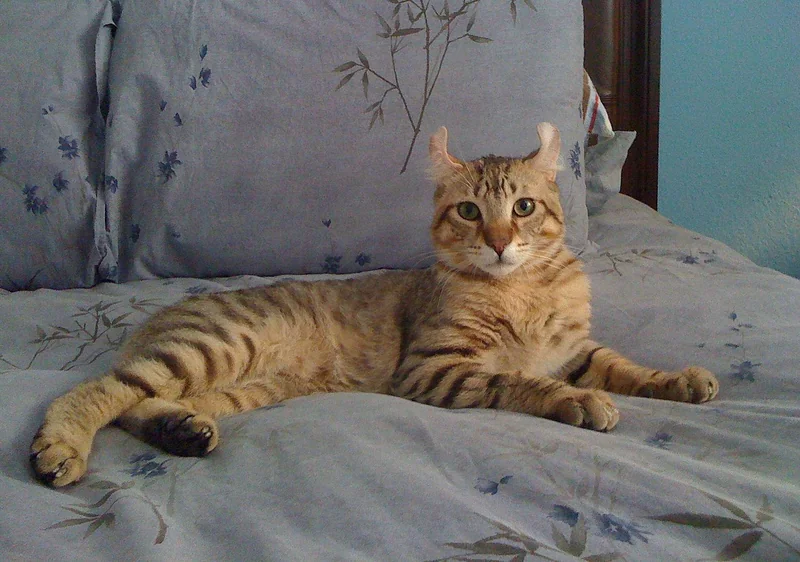
The Highlander is an experimental breed combining bobtail, curled-ear, and polydactyl genetics derived from Desert Lynx and Jungle Curl foundation lines. The breed was developed by Joe Childers in 2004 with the goal of creating a domestic cat resembling a wild Lynx. TICA accepted the Highlander for preliminary registration in 2008. CFA, GCCF, and FIFe do not recognize the breed. The standard describes a large, muscular cat with a short tail, curled-back ears, and a wild-cat appearance.
Quick facts
- Origin country
- United States
- Origin period
- 2004 Desert Lynx x Jungle Curl cross developed by Joe Childers; TICA preliminary 2008
- Coat type
- Short
- Coat colors
- All spotted, marbled, and solid colours recognized; pointed colours also accepted
- Size category
- Large
- Average lifespan
- 10-15 years
- Recognition
- TICA 2008
Origin
Joe Childers began developing the Highlander in 2004 by combining Desert Lynx and Jungle Curl foundation lines. Both foundation breeds are TICA-affiliated experimental breeds carrying combinations of bobtail, curled-ear, polydactyl, and spotted-coat genes from non-wild domestic foundation crosses; despite their wild-evoking names, both Desert Lynx and Jungle Curl are fully domestic per their TICA standards. The Highlander combines a bobtail gene, the American Curl's ear-curl gene (Cu), and a heavily spotted coat. The breed name references the resemblance to wild lynx of mountainous regions.
Recognition
TICA accepted the Highlander for preliminary registration in 2008, placing it in the new-breed category on the path toward championship. CFA, GCCF, and FIFe have not published Highlander standards. The Rare and Exotic Feline Registry (REFR) recognizes a parallel breed under the name Highland Lynx with very similar characteristics; the Highlander and Highland Lynx are sometimes treated as the same breed under different registries.
Standard
The TICA standard describes a large, muscular, athletic cat with substantial bone and a long body. The head is moderately wedge-shaped with full cheeks. The defining characteristics are the short bobtail (one-third to one-half normal tail length, kinked or curved), the curled-back ears in the American Curl style, and the heavily spotted or marbled coat. Polydactyly is permitted in the Highlander standard — up to seven toes. All colours and patterns including pointed are recognized. The breed's overall silhouette is intended to evoke a wild lynx in miniature.
Sources & further reading (3)
- tica-standard — accessed 2026-04-30
- encyclopedia — accessed 2026-04-30
- encyclopedia — accessed 2026-04-30
Frequently asked questions
Is the Highlander a wild-cat hybrid?
No. The Highlander is a fully domestic breed despite its wild lynx-like appearance. Both foundation breeds (Desert Lynx and Jungle Curl) are fully domestic TICA-affiliated experimental breeds with no recent wild-cat genetics. The wild appearance is achieved through selective breeding of bobtail, curled-ear, polydactyl, and spotted-coat domestic mutations.
When was the Highlander recognized?
TICA accepted the Highlander for preliminary registration in 2008. CFA, GCCF, and FIFe have not published Highlander standards. The breed has not advanced to championship.
Is the Highlander the same as the Highland Lynx?
The Highlander and Highland Lynx are very similar breeds with overlapping foundation lines. The Highlander is the TICA-registered name; the Highland Lynx is the REFR-registered name. Many breeders treat the two as the same breed under different registry names. The TICA Highlander standard does not formally accept Highland Lynx pedigree, but the underlying genetics and breed type are very similar.