Felis catus
Russian Blue
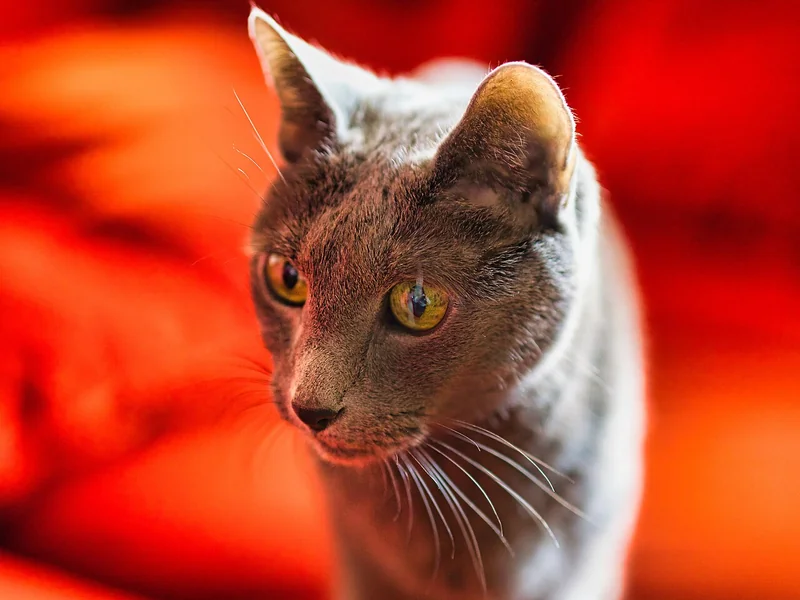 Featured photorussian-blue.jpg
The Russian Blue is a short-haired breed originating from the Archangel Islands of northern Russia, where it is known as the Archangel Cat. The breed was first exhibited at the 1871 Crystal Palace cat show in London. CFA admitted the Russian Blue among its founding breeds in 1906; GCCF registered the breed in 1912; FIFe included it in its 1949 founding standards; and TICA recognized it at its 1979 founding. The standard describes a fine-boned, elegant cat with a distinctive blue-grey double coat and vivid green eyes.
Quick facts
- Origin country
- Russia (Archangel Islands)
- Origin period
- Late 19th century; first exhibited UK 1871 Crystal Palace show
- Coat type
- Short
- Coat colors
- Blue (blue-grey — the only recognized colour)
- Size category
- Medium
- Average lifespan
- 15-20 years
- Recognition
- CFA 1906 · TICA 1979 · GCCF 1912 · FIFe 1949
Origin
Blue-grey cats from the Russian port city of Arkhangelsk (Archangel) were brought to Britain by sailors during the 19th century. The breed was first exhibited in London at the 1871 Crystal Palace cat show — the founding event of the British cat fancy — under the designation Archangel Cat. The early show form had a stockier build; 1950s and 1960s British breeders admitted controlled Siamese outcrosses to restore depleted post-war population numbers, which also shifted the head type toward the modern long wedge.
Recognition
The Cat Fanciers' Association admitted the Russian Blue among its founding breed group in 1906. The Governing Council of the Cat Fancy registered the breed in 1912. The Fédération Internationale Féline included it in its founding standards in 1949. The International Cat Association recognized the Russian Blue at its 1979 founding. All four major registries maintain a current standard; CFA and TICA recognize a single blue colour division only.
Standard
The CFA standard describes a fine-boned, long, and graceful cat with a long neck, flat skull, and a wedge-shaped head. The eyes are vivid green — a defining characteristic; CFA specifies 'as green as possible, vivid and intense in colour'. The coat is short, dense, and double — the blue outer coat has silver-tipped guard hairs that produce a silvery sheen. The only recognized colour is blue (the blue-grey dilute). The TICA standard is substantially similar; FIFe and GCCF standards describe a slightly different head type.
Sources & further reading (3)
- registry-breed-profile — accessed 2026-04-30
- encyclopedia — accessed 2026-04-30
- gccf-registry — accessed 2026-04-30
Frequently asked questions
Is the Russian Blue always blue in colour?
Yes. The CFA, TICA, GCCF, and FIFe standards recognize only a single blue (blue-grey) colour for the Russian Blue. The blue outer coat has silver-tipped guard hairs that give the coat a distinctive silvery sheen. Related breeds such as the Russian White and Russian Black are recognized by some Australian and New Zealand registries but are not accepted by the four major international bodies under the Russian Blue designation.
When was the Russian Blue first shown?
The Russian Blue was first exhibited at the 1871 Crystal Palace cat show in London, under the designation Archangel Cat. The Cat Fanciers' Association admitted the breed in 1906 and the Governing Council of the Cat Fancy registered it in 1912, making it one of the earliest breeds on both the CFA and GCCF registers.
What is the Russian Blue's typical lifespan?
Breed-club records and veterinary insurance datasets report an average lifespan of 15 to 20 years for the Russian Blue — among the longest-lived recognized breeds. The figure is consistent across CFA, TICA, and GCCF parent-club surveys.