Felis catus
Pixie-Bob
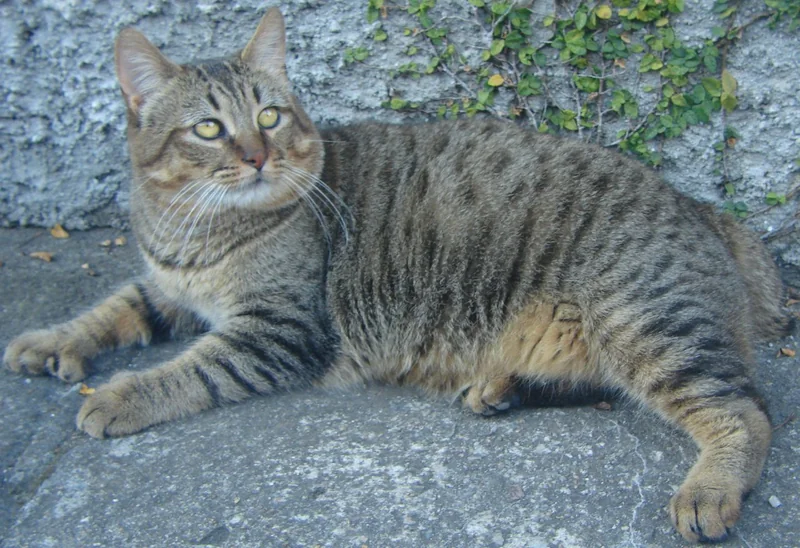 Featured photopixie-bob.jpg
The Pixie-Bob is a domestic cat breed developed in Washington State from 1985 by Carol Ann Brewer from naturally bobtailed cats. The breed was named for Pixie, a female from Brewer's original litter. Despite the breed's bobcat-like appearance, TICA confirms the Pixie-Bob as a fully domestic cat breed. TICA granted championship status in 1998. CFA, GCCF, and FIFe have not published Pixie-Bob standards. The standard describes a large, muscular, bobcat-resembling cat with a naturally short tail.
Quick facts
- Origin country
- United States (Washington State)
- Origin period
- 1985 (Carol Ann Brewer); TICA championship 1998
- Coat type
- Short
- Coat colors
- Brown Spotted Tabby (the only accepted pattern; tawny to reddish-brown spots)
- Size category
- Medium
- Average lifespan
- 13-15 years
- Recognition
- TICA 1998
Origin
Carol Ann Brewer of Washington State began the Pixie-Bob programme in 1985 after acquiring a naturally short-tailed polydactyl male and crossing him with a domestic queen. The resulting female kitten Pixie became the breed's namesake and foundation female. Brewer developed and codified the Pixie-Bob standard, submitting it to TICA in the early 1990s. Despite the breed's marked resemblance to the North American bobcat, TICA confirms the Pixie-Bob as a fully domestic cat breed with no documented wild-cat genetics.
Recognition
TICA accepted the Pixie-Bob for registration in 1994 and granted full championship status in 1998. CFA, GCCF, and FIFe have not published Pixie-Bob standards. The TICA standard for the Pixie-Bob is notable for explicitly accepting polydactyly — up to seven toes — as a breed characteristic, making it the only major registry to permit polydactyly in a championship class for this breed.
Standard
The TICA standard describes a large, heavily boned cat with a muscular, pear-shaped body and a naturally short tail ranging from 1 to 4 inches in length. The head is medium-sized and pear-shaped with a strongly bowed profile, prominent brow, and tufted ears. The coat is short to medium, wooly in texture, and may stand away from the body. The only accepted pattern is brown spotted tabby on a tawny to reddish-brown or red ground; the spots are random and broken rather than regular. Polydactyly (up to seven toes per foot) is accepted under the TICA standard.
Sources & further reading (3)
- tica-standard — accessed 2026-04-30
- encyclopedia — accessed 2026-04-30
- breed-club — accessed 2026-04-30
Frequently asked questions
Is the Pixie-Bob a domestic cat?
Yes. TICA confirms the Pixie-Bob as a fully domestic cat breed with no documented wild-cat or bobcat genetics. The breed's bobcat-like appearance — including the short tail, tufted ears, spotted coat, and heavy bone — results from selective breeding among natural domestic variants, not from hybridization with wild cats.
Why does the TICA standard accept polydactyly in the Pixie-Bob?
Polydactyly (extra toes — up to seven per foot) appeared naturally in the foundation stock of the Pixie-Bob and became associated with the breed's identity from its early development. TICA accepts polydactyly as a permissible breed characteristic — the only major registry championship standard to do so. CFA and other registries do not recognize the Pixie-Bob.
When was the Pixie-Bob recognized?
TICA accepted the Pixie-Bob for registration in 1994 and granted full championship status in 1998. CFA, GCCF, and FIFe have not published Pixie-Bob standards as of the mid-2020s.