Felis catus
Mekong Bobtail
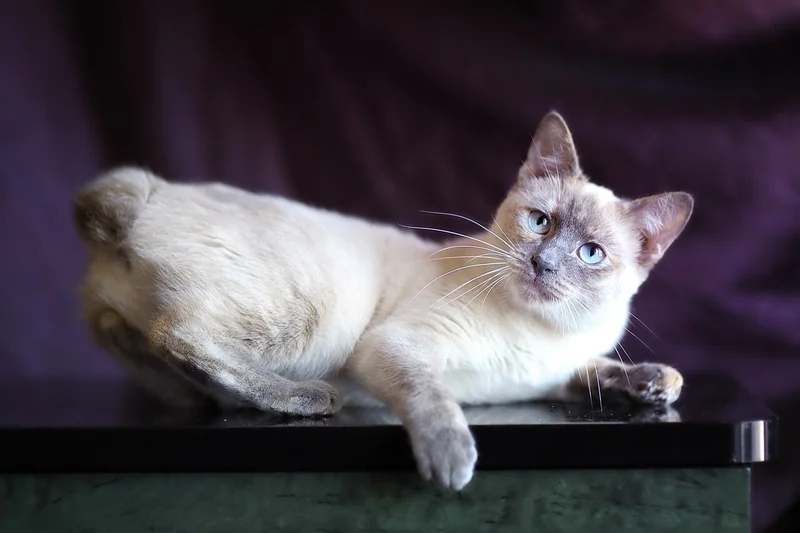 Featured photomekong-bobtail.jpg
The Mekong Bobtail is a natural breed from the Mekong River basin of Southeast Asia, where bobtailed cats have been kept for centuries in Thailand, Burma, Laos, Vietnam, Cambodia, and China. The breed is documented in the Tamra Maew manuscripts. Bobtailed cats were gifted to Tsar Nicholas II of Russia in 1897 and to other European royalty. The World Cat Federation recognized the breed in 2004. CFA, TICA, GCCF, and FIFe have not published standards. The standard describes a medium-sized, pointed cat with a short, kinked tail.
Quick facts
- Origin country
- Southeast Asia (Mekong river basin)
- Origin period
- Ancient Southeast Asian breed; gifted to Tsar Nicholas II 1897; WCF recognition 2004
- Coat type
- Short
- Coat colors
- All Siamese point colours recognized: Seal Point, Blue Point, Chocolate Point, Lilac Point, Red Point, Cream Point, Tortoiseshell Point, Tabby Point variants
- Size category
- Medium
- Average lifespan
- 15-18 years
- Recognition
- —
Origin
Bobtailed cats of the Mekong River basin are documented in the Thai Tamra Maew manuscripts alongside the Siamese, Korat, and Khao Manee. In 1897, bobtailed cats were included in a diplomatic gift of Siamese cats to Tsar Nicholas II of Russia. Russian breeders established the modern breed programme from these and later imports, standardizing the breed as the Mekong Bobtail — named for the Mekong River that flows through much of the breed's native range.
Recognition
The World Cat Federation (WCF) recognized the Mekong Bobtail in 2004. The CFA, TICA, GCCF, and FIFe had not published Mekong Bobtail standards as of the mid-2020s. The breed is shown primarily through WCF-affiliated shows in Europe and Russia. The WCF is an international registry independent of CFA, TICA, FIFe, and GCCF.
Standard
The WCF standard describes a medium-sized, long-bodied, slender cat of Oriental type with a pointed conformation. The defining characteristic is the short bobtail: a flexible, kinked tail of at least three vertebrae but not more than one-third of the length of a normal tail — described as forming a unique pom-pom shape for each individual. The coat is short, fine, and close-lying. All traditional Siamese point colours are recognized: seal, blue, chocolate, lilac, red, cream, tortoiseshell, and tabby (lynx) point variants. The eye colour is vivid blue.
Sources & further reading (3)
- encyclopedia — accessed 2026-04-30
- registry-standard — accessed 2026-04-30
- encyclopedia — accessed 2026-04-30
Frequently asked questions
How is the Mekong Bobtail tail defined?
The WCF standard specifies a short, flexible, kinked tail of at least three vertebrae but not more than one-third of normal tail length, forming a pom-pom shape unique to each individual. The exact kink pattern differs between individuals; no two Mekong Bobtails have identical tails. The mutation is distinct from the Japanese Bobtail and Kurilian Bobtail genes.
Is the Mekong Bobtail recognized by CFA or TICA?
No. CFA, TICA, GCCF, and FIFe had not published Mekong Bobtail standards as of the mid-2020s. The breed is recognized by the World Cat Federation (WCF), an international registry independent of the four major bodies, and is shown through WCF-affiliated events primarily in Europe and Russia.
When was the Mekong Bobtail gifted to European royalty?
In 1897, bobtailed cats were included in a diplomatic gift of Siamese cats presented to Tsar Nicholas II of Russia by the King of Siam. This gift is the earliest documented record of the breed's introduction to Europe and is cited in WCF breed club documentation as the foundation of the European Mekong Bobtail population.