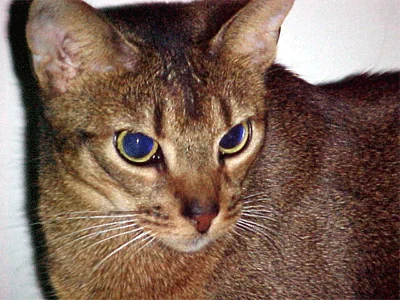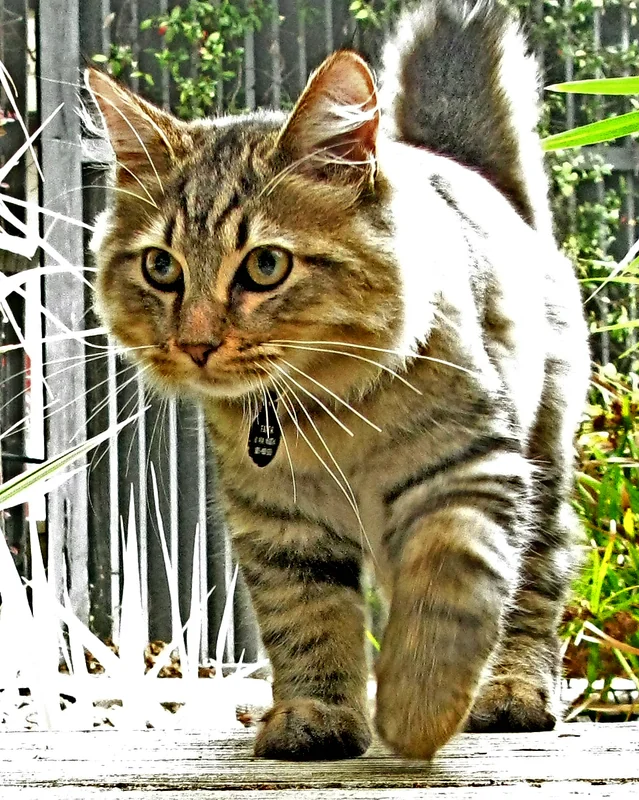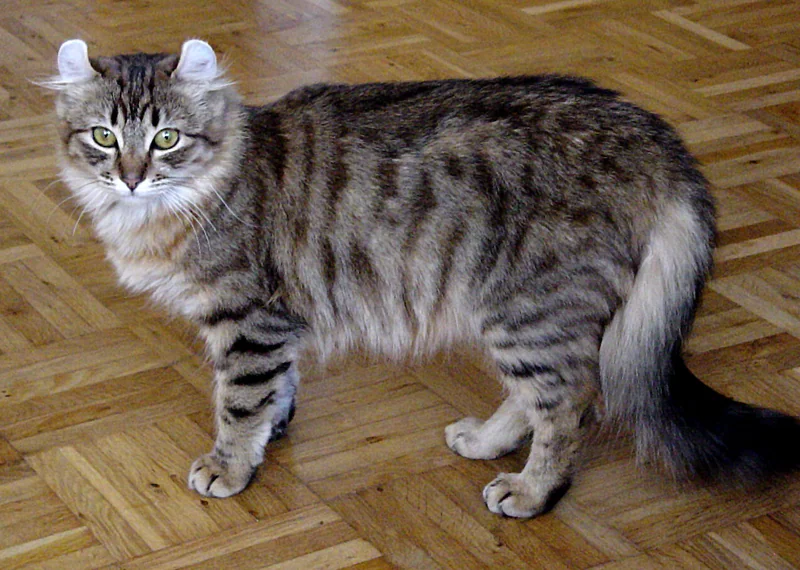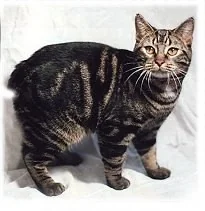
The Manx is a natural tailless breed from the Isle of Man, where the dominant Manx gene (M) has been present in the island's cat population for centuries. The breed was exhibited at the 1871 Crystal Palace cat show and is among the founding breeds of the CFA (1906) and GCCF (1901). TICA recognized the Manx at its 1979 founding; FIFe at its 1949 founding. The standard describes a compact, rounded cat with a tailless or stub-tailed rump.
Quick facts
- Origin country
- Isle of Man
- Origin period
- Natural island taillessness mutation; exhibited Crystal Palace 1871; CFA recognition 1906
- Coat type
- Short
- Coat colors
- All colours and patterns recognized (excluding chocolate, lavender, and Himalayan pattern under CFA)
- Size category
- Medium
- Average lifespan
- 8-14 years
- Recognition
- CFA 1906 · TICA 1979 · GCCF 1901 · FIFe 1949
Origin
The tailless cats of the Isle of Man are documented from the 17th century. The dominant Manx gene (M) produces a spectrum of tail lengths: Rumpy (completely tailless, no coccygeal vertebrae), Rumpy Riser (a few fused vertebrae producing a small rise), Stumpy (a short, often kinked tail), and Longy (nearly full tail). The Manx was exhibited at Harrison Weir's 1871 Crystal Palace cat show — one of the founding events of the British cat fancy — and is among the oldest recognized breeds in the Western cat fancy.
Recognition
The Governing Council of the Cat Fancy recognized the Manx in 1901. The Cat Fanciers' Association admitted the Manx among its founding breeds in 1906. The Fédération Internationale Féline included the Manx in its 1949 founding standards. The International Cat Association recognized it at its 1979 founding. All four major international registries maintain current Manx standards. The longhaired variety is recognized as the Cymric by CFA and as the Manx Longhair by some other registries.
Standard
The CFA standard describes a compact, well-rounded cat with a broad chest, short back, and a round rump that is higher than the shoulders — described as 'appearing as a ball' in profile. The head is round and large with prominent cheeks. The hind legs are notably longer than the front, producing the distinctive Manx gait. Only fully tailless (Rumpy) or Rumpy Riser cats are accepted in CFA championship competition. The coat is short, dense, and double. All colours and patterns are accepted except chocolate, lavender, and Himalayan pattern in the CFA standard.
Sources & further reading (3)
- registry-breed-profile — accessed 2026-04-30
- encyclopedia — accessed 2026-04-30
- gccf-registry — accessed 2026-04-30
Frequently asked questions
Why are some Manx cats completely tailless and others have stubs?
The dominant Manx gene (M) causes spinal abnormalities that affect the coccygeal vertebrae. Cats with one copy of the gene (M/m — heterozygous) express a spectrum of tail lengths: Rumpy (no tail), Rumpy Riser (a few fused vertebrae), Stumpy (a short stub), and Longy (near-full tail). Cats with two copies (M/M — homozygous) do not survive to birth. Only Rumpy and Rumpy Riser cats are shown in CFA championship competition.
When was the Manx recognized?
The GCCF recognized the Manx in 1901. CFA admitted the Manx among its founding breeds in 1906. FIFe included it in its 1949 founding standards. TICA recognized the breed at its 1979 founding. The Manx is one of the oldest formally recognized breeds in the cat fancy.
What is the difference between the Manx and the Cymric?
The Cymric is the longhaired variety of the Manx, recognized as a separate breed by CFA since 1994 and by TICA. Both carry the same Manx gene (M) and the same taillessness spectrum. The Cymric differs only in coat length — it has a long, dense, double coat with a ruff. Some registries, including some GCCF-affiliated bodies, classify the Cymric as the Manx Longhair rather than as a separate breed.