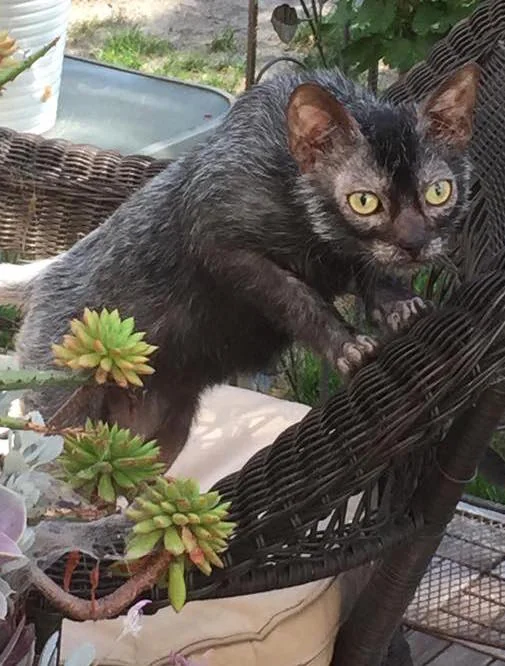
The Lykoi (Greek for 'wolf') is a domestic breed defined by a natural recessive mutation that produces a partial-coat phenotype resembling a werewolf — sparse hair across the body, no undercoat, and bald patches around the eyes, muzzle, ears, and chin. The mutation was first documented by Patti Thomas in 2010 in Tennessee from feral cat litters. Veterinary geneticist Dr. Johnny Gobble confirmed the mutation. TICA granted championship status in 2017. The standard describes a medium-sized cat with a sparse roan-patterned coat.
Quick facts
- Origin country
- United States
- Origin period
- 2010 natural werewolf-coat mutation (Patti Thomas); TICA championship 2017
- Coat type
- Short
- Coat colors
- Black Roan (the only recognized colour — black and white guard hairs producing a wolf-grey appearance with bald facial mask, ears, and chin)
- Size category
- Medium
- Average lifespan
- 12-15 years
- Recognition
- TICA 2017
Origin
Werewolf-coated kittens — with sparse, partially hairless coats — were observed in feral cat colonies across the United States from at least the 1980s, but were initially treated as health conditions. In 2010 Patti Thomas of Virginia documented two unrelated litters of werewolf-coated kittens born to feral domestic queens in Tennessee. Veterinary geneticist Dr. Johnny Gobble investigated the cats, confirmed the partial-coat phenotype as a natural recessive mutation rather than a disease, and established the formal breeding programme. Genetic testing confirmed no relation to the Sphynx (recessive hr) or Donskoy (dominant Hbl) hairless genes.
Recognition
TICA accepted the Lykoi for registration in 2012 and granted full championship status in 2017 — one of the most rapid championship recognitions in TICA history. CFA, GCCF, and FIFe have not published Lykoi standards. The breed name is Greek for 'wolves' (lykoi), chosen for the werewolf-like coat appearance.
Standard
The TICA standard describes a medium-sized, semi-foreign, athletic cat with a moderate wedge head and large rounded ears. The defining characteristic is the partial coat: sparse black and white guard hairs across the body producing a wolf-grey roan appearance, with bald patches around the eyes, muzzle, ears, and chin (the 'mask'). The coat is short and sparse, lacking an undercoat entirely. Lykoi may molt and regrow the partial coat seasonally. Black Roan is the only colour recognized for championship competition; other colour expressions are registered as colour variants but not shown.
Sources & further reading (3)
- tica-standard — accessed 2026-04-30
- encyclopedia — accessed 2026-04-30
- breed-club — accessed 2026-04-30
Frequently asked questions
What is a Lykoi's werewolf coat?
The Lykoi carries a natural recessive mutation that produces a sparse, partially hairless coat with no undercoat. The body has sparse black and white guard hairs producing a wolf-grey roan appearance; the face shows bald patches around the eyes, muzzle, ears, and chin (the 'mask'). Lykois may molt and regrow the partial coat seasonally — the only domestic cat breed with this molting cycle.
When was the Lykoi recognized?
TICA accepted the Lykoi for registration in 2012 and granted full championship status in 2017 — one of the most rapid championship recognitions in TICA history. CFA, GCCF, and FIFe have not published Lykoi standards.
Is the Lykoi mutation related to the Sphynx hairless gene?
No. Genetic testing has confirmed the Lykoi mutation is unrelated to the Sphynx recessive hr gene or the Donskoy dominant Hbl gene. The Lykoi mutation is a separate natural recessive mutation that produces a partial-coat phenotype with a normal complement of guard hair follicles but a missing undercoat.