Felis catus
Japanese Bobtail Longhair
 Featured photojapanese-bobtail-longhair.jpg
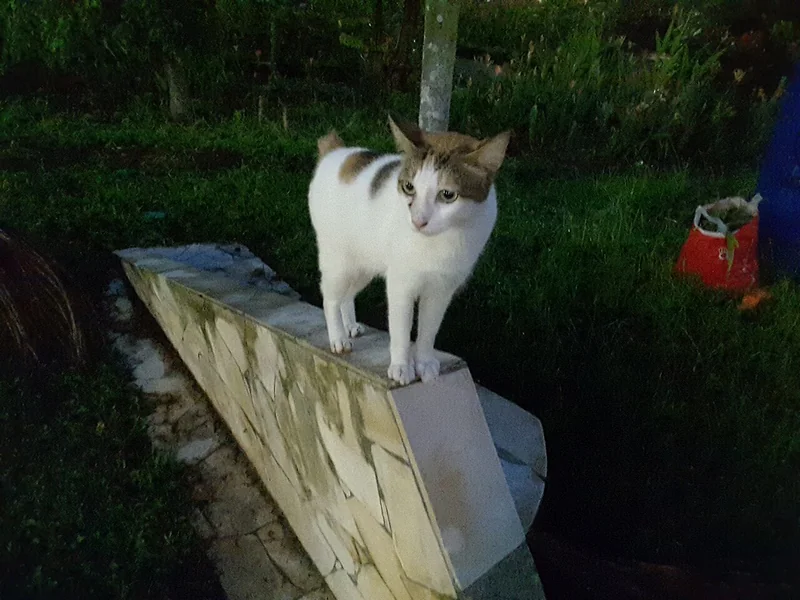
The Japanese Bobtail Longhair is TICA's registration for the semi-longhaired form of the Japanese Bobtail. Both the shorthaired and longhaired forms share the distinctive short, kinked, pom-pom tail and triangular head. Long-coated Japanese Bobtails are documented in Japanese artistic and historical records. TICA accepted both forms simultaneously when it recognized the Japanese Bobtail, maintaining separate show classes for the two coat lengths.
Quick facts
- Origin country
- Japan
- Origin period
- Ancient Japanese breed; TICA recognition of longhaired form alongside shorthaired
- Coat type
- Long
- Coat colors
- Mi-ke (tri-color: white, red/orange, black), Bicolor, Solid (black, white, red, blue, cream), All colors except pointed and agouti-ticked
- Size category
- Medium
- Average lifespan
- 9-15 years
- Recognition
- CFA 1976 · TICA 1976
Origin
The Japanese Bobtail is an ancient breed present in Japan for over a millennium. The bobtail mutation is distinct from the Manx and other bobtail mutations; it is caused by a different gene (or genes) and produces a short, kinked tail that forms a pom-pom or chrysanthemum when fluffed. Long-coated Japanese Bobtails have existed throughout the breed's history as the recessive long-hair gene was part of the natural Japanese cat population. American breeder Elizabeth Freret is credited with bringing Japanese Bobtails to the United States in 1968 and developing the breeding program that led to CFA and TICA recognition in 1976.
The Tail
The Japanese Bobtail's distinctive tail is genetically unique among bobtail breeds. The tail is short (typically 7-10 cm) and composed of one or more kinked or curved vertebrae that give it a natural pom-pom or chrysanthemum appearance when the tail hairs are fluffed out. In the longhaired form, the tail hair is fuller and the pom-pom effect is more pronounced. The tail conformation is homozygous in the population: unlike the Manx bobtail gene (which causes embryonic lethality in the homozygous form), the Japanese Bobtail mutation is non-lethal in homozygotes, and all Japanese Bobtails display the trait.
Appearance
The Japanese Bobtail Longhair is a medium-sized cat with a distinctly triangular, long-profile head; high cheekbones; large, oval eyes set at a slight angle; large ears carried upright and at a slight forward tilt; and a long, lean body. The coat is semi-long to long, silky, and with minimal undercoat, meaning it lies flat without the heavy, cottony density of a full longhair. The lack of heavy undercoat makes the coat less prone to matting than many long-coated breeds. The tail is the breed's defining feature: short, kinked, and fluffed into a pom-pom.
Sources & further reading (2)
- registry-breed-profile — accessed 2026-05-07
- encyclopedia — accessed 2026-05-07
Frequently asked questions
Is the Japanese Bobtail Longhair a different breed from the Japanese Bobtail?
The Japanese Bobtail Longhair is the same breed as the Japanese Bobtail but with a semi-long coat. TICA and CFA register both coat lengths within the Japanese Bobtail breed in separate show classes. The shorthaired Japanese Bobtail is more common in shows, but the longhaired form is historically documented in Japan and is equally authentic to the breed.
Is the Japanese Bobtail tail mutation the same as the Manx?
No. The Japanese Bobtail tail mutation is genetically distinct from the Manx mutation. The Manx mutation (M gene) is a dominant that causes lethal embryonic effects in homozygous form; it shortens or eliminates the tail. The Japanese Bobtail tail mutation is different, causes a kinked short tail rather than absent tail, and is not associated with the Manx's spinal health concerns. All Japanese Bobtails display the short tail.
What is Mi-ke coloring?
Mi-ke (literally 'three fur' in Japanese) refers to the tri-color pattern of white, red/orange, and black. This coloring is historically the most prized Japanese Bobtail color in Japan, associated with good fortune. The famous maneki-neko (beckoning cat) figurines that appear in many East Asian businesses are typically depicted in the mi-ke pattern and are modeled on the Japanese Bobtail.