Felis catus
Balinese
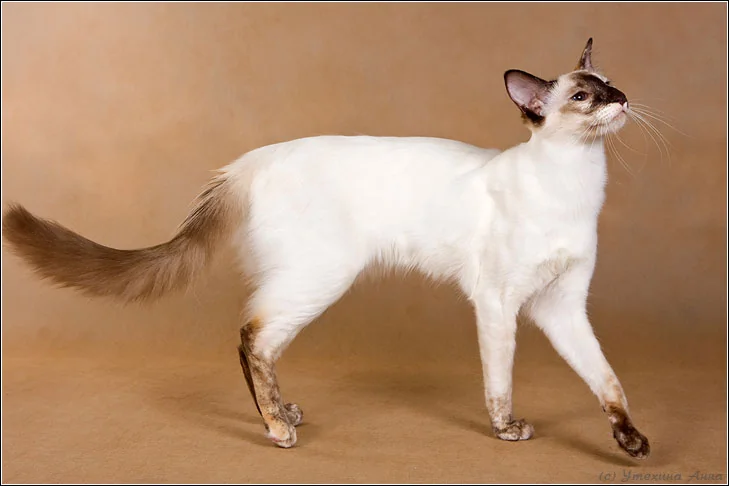 Featured photobalinese.jpg
The Balinese is a long-haired breed that originated as a natural recessive mutation in Siamese litters. Long-haired Siamese kittens appeared sporadically through the 1920s-1940s; breeders Helen Smith and Sylvia Holland developed them into a separate breed in the 1950s. CFA granted championship status in 1961; TICA at its 1979 founding; and FIFe in 1983. GCCF does not maintain a separate Balinese register. The standard describes a cat conforming to the Siamese standard in all respects except coat length.
Quick facts
- Origin country
- United States
- Origin period
- 1950s natural long-haired Siamese mutation; CFA championship 1961
- Coat type
- Long
- Coat colors
- Seal Point, Blue Point, Chocolate Point, Lilac Point, And extended colours as Javanese in CFA: Red, Cream, Tortoiseshell, and Lynx Point variants
- Size category
- Medium
- Average lifespan
- 9-15 years
- Recognition
- CFA 1961 · TICA 1979 · FIFe 1983
Origin
Long-haired Siamese kittens — carrying the recessive longhair gene (l) — appeared in Siamese litters sporadically from the 1920s. American breeders Helen Smith and Sylvia Holland collected these kittens and developed a formal breed programme in the 1950s. Smith coined the name Balinese, comparing the grace of the long-coated cats to the dancers of Bali. The breed has no geographic or genetic connection to Bali or Indonesia; it is a North American breed development from Siamese stock.
Recognition
CFA granted the Balinese championship status in 1961. TICA recognized the breed at its 1979 founding. FIFe published its standard in 1983. GCCF does not maintain a separate Balinese breed register. CFA recognizes only the four traditional point colours (seal, blue, chocolate, lilac) in the Balinese division; extended colours (red, cream, tortoiseshell, lynx point) are shown as the Javanese in CFA.
Standard
The CFA standard describes a Balinese as conforming to the Siamese standard in all respects except coat length. The body is long, tubular, and well-muscled; the head is a long tapering wedge with large pointed ears; the eyes are deep vivid blue and almond-shaped. The coat is medium-long, fine, and silky — not as long or dense as the Persian or Norwegian Forest Cat. The tail is a long, plumed, fine plume. Point colours restricted in CFA are seal, blue, chocolate, and lilac. TICA and FIFe recognize a broader colour range under the Balinese name.
Sources & further reading (3)
- registry-breed-profile — accessed 2026-04-30
- encyclopedia — accessed 2026-04-30
- fife-standard — accessed 2026-04-30
Frequently asked questions
Is the Balinese from Bali?
No. The Balinese has no connection to Bali or Indonesia. The name was coined by American breeder Helen Smith, who compared the grace of the long-coated cats to the dancers of Bali. The breed originated in the United States from natural long-haired Siamese kittens that appeared in registered Siamese litters during the 1920s-1950s.
When was the Balinese recognized?
CFA granted championship status in 1961. TICA recognized the Balinese at its 1979 founding. FIFe published its standard in 1983. The GCCF does not maintain a separate Balinese register.
What is the difference between the Balinese and the Javanese?
In CFA nomenclature, the Balinese covers the four traditional Siamese point colours (seal, blue, chocolate, lilac) in the long-haired Siamese body type. Extended point colours — red, cream, tortoiseshell, and all lynx-point variants — are classified as the Javanese in CFA. TICA and FIFe use the Balinese name for all point colours in the long-haired Siamese body type, without the Javanese subdivision.