Felis catus
Highland Fold
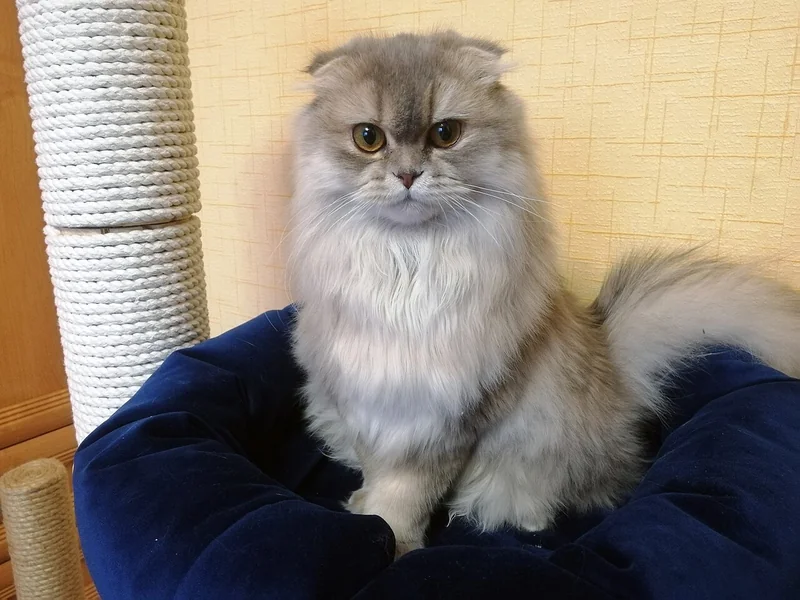 Featured photohighland-fold.jpg
The Highland Fold is the long-coated variant of the Scottish Fold, sharing the same folded-ear mutation that originated on a Scottish farm in 1961. The semi-long, plush coat and folded ears distinguish it from the shorthaired Scottish Fold. TICA recognizes the Highland Fold and Highland Straight as the longhaired divisions of the Scottish breed family. As with all Fold-derived cats, all ethical Highland Fold breeding requires pairing a fold cat with a straight-eared Highland Straight to prevent homozygous skeletal disease.
Quick facts
- Origin country
- Scotland
- Origin period
- Longhaired form documented from 1970s; TICA recognition alongside Scottish Fold family
- Coat type
- Long
- Coat colors
- All colors and patterns accepted, Tabby, Solid, Bicolor, Colorpoint
- Size category
- Medium
- Average lifespan
- 11-15 years
- Recognition
- TICA 1994
Origin
The Highland Fold's history is inseparable from that of the Scottish Fold. The folded-ear mutation arose spontaneously in 1961 on a farm in Perthshire. The founding breeding lines included both shorthaired and longhaired cats, as the long-hair gene is recessive and was present silently in some founder stock. Long-coated kittens with folded ears were noticed in early breeding programs and were eventually registered separately. TICA formalized the Highland Fold and Highland Straight as the longhaired divisions of the Scottish/Highland family.
Genetics and Health
The Highland Fold carries the same TRPV4-gene fold mutation as the Scottish Fold. Cats homozygous for the Fd gene (two copies) develop osteochondrodysplasia regardless of coat length. Responsible Highland Fold breeding therefore requires mating a folded-ear Highland Fold with a straight-eared Highland Straight (or Scottish Straight). The resulting litter contains approximately 50 percent folded and 50 percent straight-eared kittens. The semi-long coat gene is independent of the fold gene and does not affect the skeletal health considerations.
Appearance
The Highland Fold standard mirrors the Scottish Fold in all respects except coat length. The head is large, round, and cushion-like; the face is plush with full cheeks; the ears fold forward and downward, lying close to the rounded skull. Eyes are large, round, and wide-open in an expression of alertness. The semi-long coat is dense and plush with a thick undercoat; it does not flow as flat as a longhaired Oriental but stands away from the body slightly. The tail is of medium length with a full, plume-like tip. All colors and patterns are accepted.
Sources & further reading (2)
- registry-breed-profile — accessed 2026-05-07
- encyclopedia — accessed 2026-05-07
Frequently asked questions
What is the difference between a Highland Fold and a Scottish Fold?
The Highland Fold is the longhaired version of the Scottish Fold; both carry the same folded-ear mutation and share the same breed origin in 1961 Scotland. The Scottish Fold has a short, dense coat; the Highland Fold has a semi-long, plush coat. TICA registers them as separate breed divisions within the same family.
Why must Highland Folds be bred with Highland Straights?
Cats homozygous for the fold gene (two copies of the Fd mutation) develop osteochondrodysplasia, a painful degenerative bone condition affecting all cartilage. To prevent producing homozygous kittens, every Fold cat must be bred with a straight-eared partner. The Highland Straight is the straight-eared, longhaired counterpart used in these pairings.
Are Highland Folds recognized by GCCF?
GCCF does not recognize Scottish Fold or Highland Fold breeds due to welfare concerns about the Fd mutation's association with skeletal disease. GCCF's position is that recognizing the breed would encourage breeding that risks producing cats with painful skeletal conditions. TICA and some other registries recognize the breeds with the requirement that ethical breeders always pair Fold with Straight.