Felis catus
Havana Brown
 Featured photohavana-brown.jpg
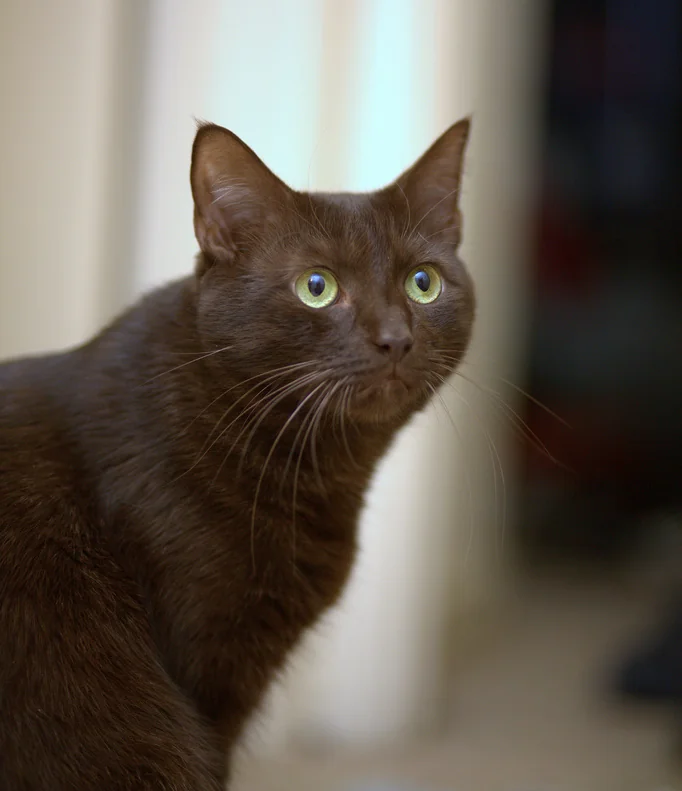
The Havana Brown is a warm-chocolate-coated breed developed in the United Kingdom in the 1950s from Siamese and black domestic crosses. Breeders including Baroness von Ullmann and groups affiliated with the Siamese Cat Club produced consistent warm-brown kittens with vivid green eyes. CFA recognized the Havana Brown in 1959; TICA at its 1979 founding. GCCF recognized a related but diverged type as the Havana. The standard describes a medium-sized cat with a mahogany-brown coat and a distinctive rectangular muzzle.
Quick facts
- Origin country
- United Kingdom
- Origin period
- 1950s UK (Siamese × black domestic crosses; Baroness von Ullmann); CFA recognition 1959
- Coat type
- Short
- Coat colors
- Rich warm mahogany brown (the only recognized colour; often described as resembling a ripe chestnut), Lilac (lavender-grey — recognized by TICA but not CFA)
- Size category
- Medium
- Average lifespan
- 10-15 years
- Recognition
- CFA 1959 · TICA 1979
Origin
British breeders in the 1950s, including Baroness Emma von Ullmann, crossed Siamese with black domestic and Russian Blue cats to produce warm-brown kittens. The first such cat was registered with the GCCF in 1952 under the name Chestnut Foreign Shorthair. American breeders received the early imports and developed a North American line; CFA recognized the Havana Brown in 1959. The UK and North American populations subsequently diverged in head shape and conformation.
Recognition
CFA recognized the Havana Brown in 1959 based on the early North American imports. The International Cat Association recognized the breed at its 1979 founding. The GCCF recognizes a related but distinctly different type as the Havana — conforming to a more moderate, less foreign head type. FIFe has not published a Havana Brown standard. The CFA and TICA standards maintain the original, more foreign North American type.
Standard
The CFA standard describes a medium-sized, semi-foreign cat with a firm, muscular body. The head is distinctive: longer than wide, with a pronounced stop from forehead to muzzle and a rectangular, blunt-ended muzzle described as 'the distinctive characteristic' of the breed — a feature absent from the related Oriental Shorthair. The coat is short to medium, smooth, and mahogany-brown — a rich, warm chocolate colour; the CFA standard specifies 'a rich, warm, even mahogany brown throughout'. The eyes are vivid green. Only rich warm mahogany brown is recognized under the CFA standard; TICA also accepts lilac.
Sources & further reading (3)
- registry-breed-profile — accessed 2026-04-30
- encyclopedia — accessed 2026-04-30
- tica-standard — accessed 2026-04-30
Frequently asked questions
Is the Havana Brown related to the Havana cigar?
The breed name Havana Brown was adopted based on the coat colour's resemblance to the warm brown of a Havana cigar or tobacco leaf, not to a direct Cuban cat origin. The breed's actual origin is from British Siamese-black domestic crosses in the 1950s. The name was formalized by American breeders when CFA recognized the breed in 1959.
When was the Havana Brown recognized?
CFA recognized the Havana Brown in 1959. TICA recognized the breed at its 1979 founding. The GCCF recognizes a related type as the Havana under its own standard. FIFe has not published a standard.
How does the Havana Brown differ from the Oriental Shorthair?
The Havana Brown has a distinctive rectangular muzzle — longer than wide and blunt-ended — that is absent from the Oriental Shorthair and the Siamese. This rectangular muzzle is described in the CFA standard as 'the distinctive characteristic' of the Havana Brown, setting it apart structurally from other Siamese-derived breeds. The Havana Brown is also maintained in only one or two colours, while the Oriental Shorthair is recognized in over 300 colour combinations.