Felis catus
European Burmese
 Featured photoeuropean-burmese.jpg
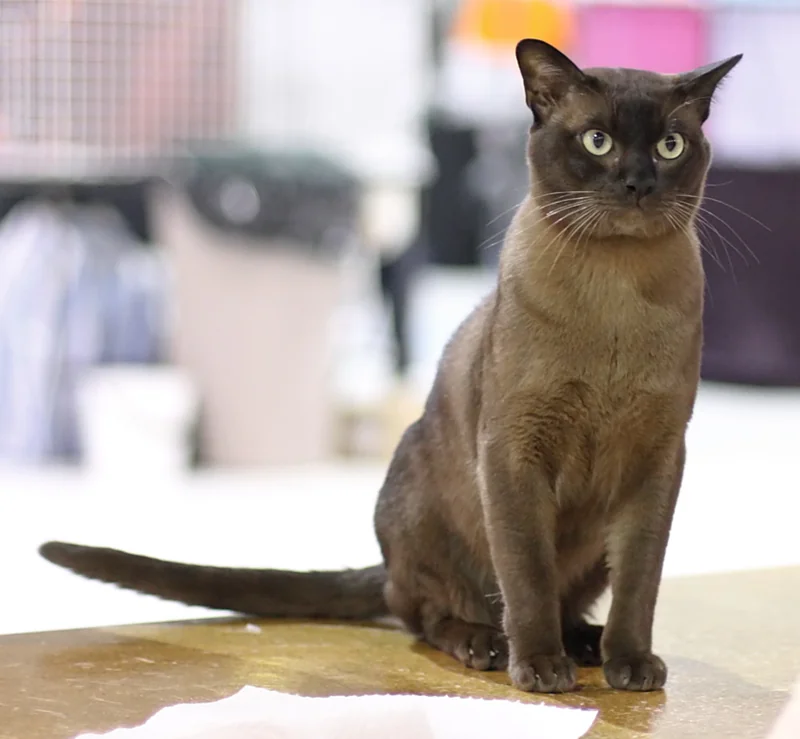
The European Burmese is the British and European line of the Burmese breed, distinct from the American CFA Burmese in head shape, conformation, and accepted colour range. The European Burmese has a more moderate, slightly wedge-shaped head with a longer profile, while the American Burmese has a more rounded, cobby head. FIFe recognized the European Burmese at its 1949 founding; GCCF in 1952; CFA recognized the European Burmese as a separate breed from the American Burmese in 1979. The standard accepts a broader colour range including red, cream, and tortoiseshell variants.
Quick facts
- Origin country
- United Kingdom
- Origin period
- British Burmese line developed from 1949 imports; FIFe recognition 1949 separate from American Burmese
- Coat type
- Short
- Coat colors
- Brown (Sable), Chocolate (Champagne), Blue, Lilac (Platinum), Red, Cream, Brown Tortoiseshell, Chocolate Tortoiseshell, Blue Tortoiseshell, Lilac Tortoiseshell
- Size category
- Medium
- Average lifespan
- 15-25 years
- Recognition
- CFA 1979 · GCCF 1952 · FIFe 1949
Origin
The European Burmese descends from the same Wong Mau foundation (1930) as the American Burmese, but British and European breeders developed a distinct head and body type from imports beginning in 1949. The British Burmese line was codified by GCCF in 1952 and registered by FIFe at its 1949 founding under the moderate-foreign type. The American CFA Burmese line developed in parallel toward a more rounded, cobby head and body.
Recognition
FIFe recognized the European Burmese at its 1949 founding. The Governing Council of the Cat Fancy recognized the breed in 1952. The Cat Fanciers' Association recognized the European Burmese as a separate breed from the American Burmese in 1979 to acknowledge the divergence in conformation and colour range. The two breeds — American Burmese and European Burmese — are now shown separately in CFA championship competition.
Standard
The CFA and FIFe standards describe a medium-sized, well-muscled cat of moderate-foreign type with a slightly wedge-shaped head, longer profile than the American Burmese, full cheeks, and almond-shaped golden eyes. The coat is short, fine, and close-lying with a glossy sheen. Ten colours are recognized: brown (sable), chocolate (champagne), blue, lilac (platinum), red, cream, and four tortoiseshell variants. The colour range is broader than the American Burmese's four-colour standard, reflecting the European acceptance of red and cream colour-bearing genes.
Sources & further reading (3)
- registry-breed-profile — accessed 2026-04-30
- encyclopedia — accessed 2026-04-30
- gccf-registry — accessed 2026-04-30
Frequently asked questions
What is the difference between European and American Burmese?
The European Burmese has a moderate-foreign type with a slightly wedge-shaped head and longer profile. The American Burmese has a more rounded, cobby head with full cheeks and a shorter profile. The European standard accepts ten colours including red, cream, and tortoiseshell variants; the American CFA standard accepts only four colours (sable, champagne, blue, platinum). CFA recognizes the two as separate breeds since 1979.
When was the European Burmese recognized?
FIFe recognized the European Burmese at its 1949 founding. GCCF recognized the breed in 1952. CFA recognized the European Burmese as separate from the American Burmese in 1979.
Why do the European and American Burmese share Wong Mau as foundation?
Both lines descend from Wong Mau, the original 1930 import by Dr. Joseph Thompson that founded the Burmese breed in San Francisco. American breeders developed the line toward a rounder, cobbier type from the 1930s onward; British and European breeders received imports from 1949 onward and developed a more moderate type. The two lines have remained genetically related but stylistically distinct since.