Felis catus
Exotic Shorthair
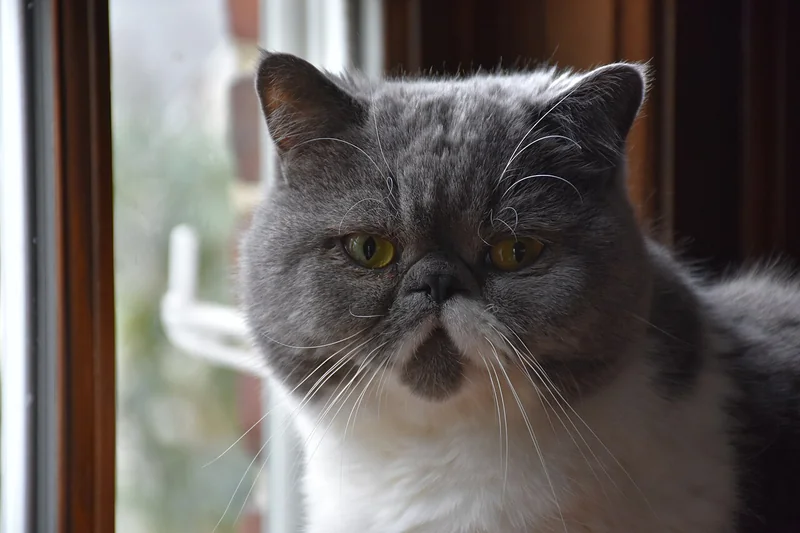 Featured photoexotic-shorthair.jpg
The Exotic Shorthair is a short-coated breed that shares the Persian's body type and conformation but carries a short, plush coat. The breed originated from crosses between American Shorthairs and Persians in the 1950s and 1960s. CFA recognized the Exotic Shorthair in 1967; TICA at its 1979 founding; GCCF in 1984; and FIFe in 1986. The standard describes a cobby, heavy-boned cat with a round brachycephalic head identical to the Persian standard except for coat length.
Quick facts
- Origin country
- United States
- Origin period
- 1950s–1960s (Persian × American Shorthair crosses); CFA recognition 1967
- Coat type
- Short
- Coat colors
- All Persian colour divisions: solid, silver and golden, shaded and smoke, tabby, particolour, bicolour, and Himalayan (colour point)
- Size category
- Medium
- Average lifespan
- 8-15 years
- Recognition
- CFA 1967 · TICA 1979 · GCCF 1984 · FIFe 1986
Origin
American Shorthair breeders in the 1950s crossed their cats with Persians to import the Persian's rounded conformation and silver colouration into the American Shorthair gene pool. The resulting hybrid kittens with short, plush coats attracted attention from judges and fanciers. CFA judge Jane Martinke recognized the hybrid type's distinctiveness and proposed a new breed standard for the Exotic Shorthair. The breed was admitted to CFA championship in 1967. The permitted outcross to Persian was retained to maintain the flat-faced, cobby Persian type in the Exotic lines.
Recognition
CFA recognized the Exotic Shorthair in 1967. The International Cat Association recognized the breed at its 1979 founding. The Governing Council of the Cat Fancy recognized the breed in 1984 in the United Kingdom. The Fédération Internationale Féline published its standard in 1986 in continental Europe. All four major international registries maintain current Exotic Shorthair standards.
Standard
The CFA standard describes an Exotic Shorthair as conforming to the Persian standard in all respects except coat length. The body is cobby, low-slung, and heavy-boned with a massive round head, brachycephalic profile, full cheeks, and small round ears. The coat is short — not as short as a typical domestic shorthair — dense, plush, and stands away from the body. The CFA standard specifies: 'The Exotic shall conform to the Persian standard in all areas except coat.' All Persian colour divisions are recognized: solid, silver and golden, shaded and smoke, tabby, particolour, bicolour, and Himalayan.
Sources & further reading (3)
- registry-breed-profile — accessed 2026-04-30
- encyclopedia — accessed 2026-04-30
- gccf-registry — accessed 2026-04-30
Frequently asked questions
How does the Exotic Shorthair differ from the Persian?
The Exotic Shorthair shares the Persian's cobby body type, round brachycephalic head, and all colour divisions, but has a short, dense, plush coat rather than the Persian's long flowing coat. The CFA standard describes the Exotic as conforming to the Persian standard in all areas except coat. Grooming requirements are substantially less than for the Persian.
When was the Exotic Shorthair recognized?
CFA recognized the Exotic Shorthair in 1967. TICA recognized it at its 1979 founding. GCCF recognized the breed in 1984. FIFe published its standard in 1986. All four major international registries maintain current standards.
What outcrosses are permitted for the Exotic Shorthair?
CFA rules permit Exotic Shorthair crosses with Persian only — a restriction tightened from earlier rules that allowed American and British Shorthair outcrosses. The restriction was enacted to maintain the flat-faced, cobby Persian type in the Exotic gene pool. TICA and FIFe standards have similar outcross restrictions directing breeders to Persian or Exotic Shorthair matings only.