Felis catus
Egyptian Mau
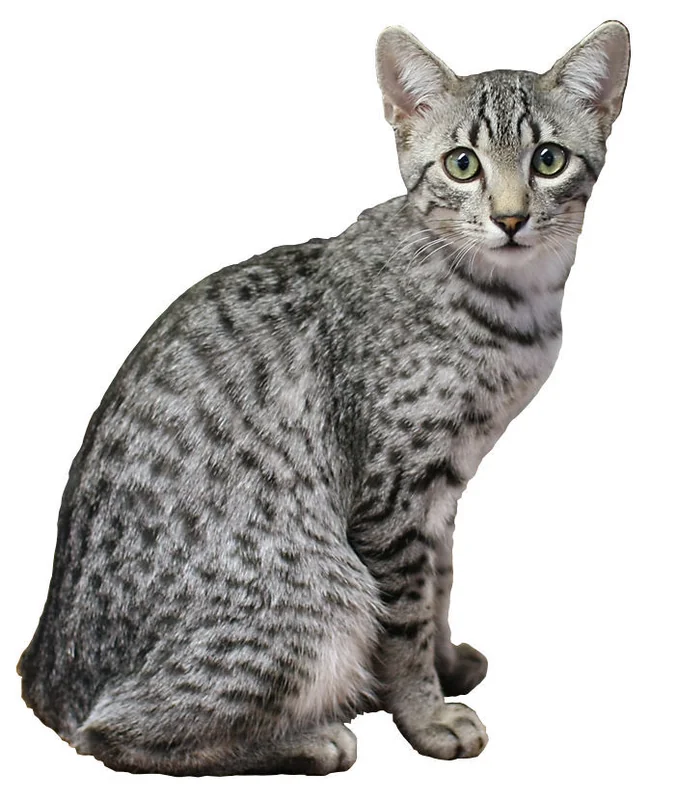 Featured photoegyptian-mau.jpg
The Egyptian Mau is the only naturally spotted domestic cat breed recognized by the major registries. The spotted tabby pattern appears on cats depicted in ancient Egyptian art, and 'mau' is the Egyptian word for cat. The modern pedigree lines were established in 1956 by Princess Nathalie Troubetskoy, who brought three spotted Egyptian cats from Cairo to the United States. CFA granted championship status in 1977; FIFe recognized the breed in 1992; TICA at its 1979 founding.
Quick facts
- Origin country
- Egypt
- Origin period
- Ancient Egyptian lineage; modern breed established 1956 by Princess Nathalie Troubetskoy
- Coat type
- Short
- Coat colors
- Silver, Bronze, Smoke (black spotted)
- Size category
- Medium
- Average lifespan
- 12-15 years
- Recognition
- CFA 1977 · TICA 1979 · FIFe 1992
Origin
Spotted cats resembling the Egyptian Mau appear in ancient Egyptian art from as early as 1550 BCE and in early domestic cat remains from Egyptian archaeological sites. The word 'mau' is the Egyptian term for cat. The modern pedigree lines were established in 1956 by Princess Nathalie Troubetskoy, who imported three spotted Egyptian cats from Cairo — a male and two females — to Rome and subsequently to the United States, establishing the Fatima cattery as the foundation of the North American population.
Recognition
Princess Troubetskoy's breeding programme led to CFA provisional status in 1968 and full championship status in 1977. The International Cat Association recognized the Egyptian Mau at its 1979 founding in Texas. The Fédération Internationale Féline recognized the breed in 1992. The GCCF does not maintain a separate Egyptian Mau breed register; the breed is shown in the United Kingdom through affiliated specialist clubs under the CFA or FIFe standard.
Standard
The CFA standard describes a medium-sized, graceful, muscular cat with a slightly rounded wedge head and gooseberry-green eyes. The defining characteristic is the natural random-spot pattern on the coat — not a classic tabby's blotch or mackerel's stripe, but discrete round to oval spots. Three coat colours are recognized: silver (pale silver ground with charcoal spots), bronze (warm bronze ground with dark brown spots), and smoke (black with a white undercoat producing spots visible only in motion). The forehead carries a characteristic 'M' marking and the skin at the temple shows dotted lines forming the 'mascara' pattern.
Sources & further reading (3)
- registry-breed-profile — accessed 2026-04-30
- encyclopedia — accessed 2026-04-30
- fife-standard — accessed 2026-04-30
Frequently asked questions
Is the Egyptian Mau the only naturally spotted cat breed?
Yes. The Egyptian Mau is distinguished by a naturally occurring random spot pattern not produced by deliberate outcrossing to spotted wild-cat hybrids. The CFA, TICA, and FIFe standards recognize this natural spotted tabby pattern as the breed's defining characteristic. Breeds such as the Bengal and Ocicat also carry spotted coats, but those were developed through specific outcrossing programmes.
When was the Egyptian Mau recognized by the major registries?
The Cat Fanciers' Association granted championship status in 1977 after the breed had held provisional status since 1968. The International Cat Association recognized the Egyptian Mau at its 1979 founding. The Fédération Internationale Féline recognized the breed in 1992.
What coat colours are accepted for the Egyptian Mau?
The CFA recognizes three coat colours: silver (pale silver ground with charcoal markings), bronze (warm bronze ground with dark brown markings), and smoke (black with a white undercoat that reveals spots visible in motion). A fourth colour, black, may appear in breeding lines but is not accepted for show competition under the CFA standard.