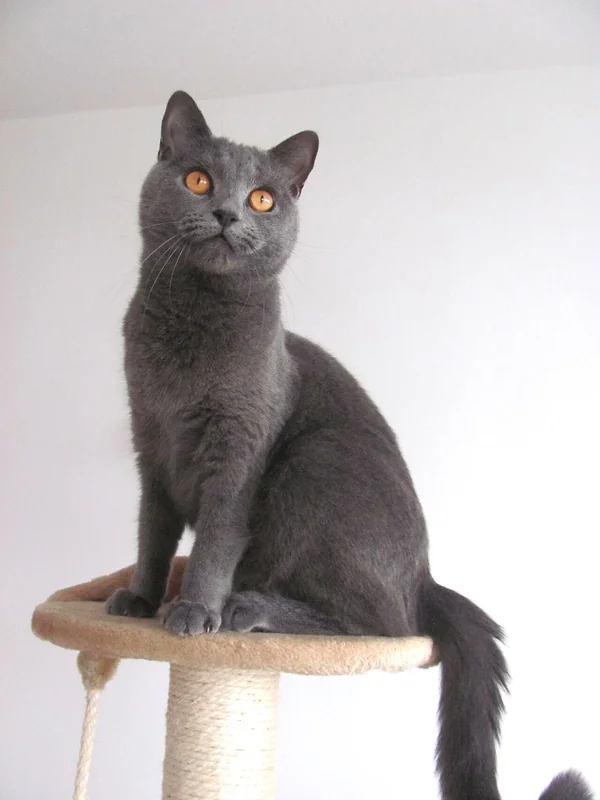
The Chartreux is a natural breed from France, regarded as the French national cat. The breed is documented in French literature from the 16th century — the poet Joachim du Bellay wrote a poem for his Chartreux cat Belaud in 1558. The modern breeding programme was established by the Leger sisters at Belle-Ile in the 1920s. FIFe recognized the Chartreux in 1977; TICA at its 1979 founding; and CFA granted championship status in 1987.
Quick facts
- Origin country
- France
- Origin period
- Pre-16th century; French national cat breed; CFA championship 1987
- Coat type
- Short
- Coat colors
- Blue (blue-grey in any shade — the only recognized colour)
- Size category
- Medium
- Average lifespan
- 12-15 years
- Recognition
- CFA 1987 · TICA 1979 · FIFe 1977
Origin
The Chartreux is one of France's oldest natural breeds. Written references to a blue cat of this type appear from the 16th century — the poet Joachim du Bellay composed an elegy for his Chartreux cat Belaud in 1558, and the natural historian Buffon classified the breed in the 18th century. The modern pedigree programme was established by Christine and Suzanne Leger at Belle-Ile-en-Mer in the 1920s, using the island's existing blue cat population as foundation stock.
Recognition
The Fédération Internationale Féline recognized the Chartreux in 1977 as a distinct French natural breed. The International Cat Association recognized it at its 1979 founding. The Cat Fanciers' Association granted championship status in 1987. The GCCF does not maintain a separate Chartreux registry; in the United Kingdom the breed has historically been grouped with the British Blue under show conditions, a classification dispute that remains ongoing.
Standard
The CFA standard describes a robust, medium-large, well-muscled cat with a distinctive broad, rounded head and a tapering muzzle giving a 'smiling' facial expression. The coat is dense, water-resistant, and slightly woolly in texture with a characteristic resilient feel. The only recognized colour is blue in any shade from ash to slate-grey. The eyes are rounded, open, and gold to copper in colour. The Chartreux standard distinguishes the breed from the British Shorthair by its finer bone structure, arched neck, relatively smaller ears, and the distinctive muzzle taper.
Sources & further reading (3)
- registry-breed-profile — accessed 2026-04-30
- encyclopedia — accessed 2026-04-30
- fife-standard — accessed 2026-04-30
Frequently asked questions
Is the Chartreux the same as the British Blue?
No. The Chartreux and the British Shorthair (British Blue) are distinct breeds with separate standards. The Chartreux has a more tapered muzzle giving a 'smiling' expression, finer bone structure, and a woolly-textured coat, whereas the British Shorthair has a broader, rounder head with full cheeks, heavier bone, and a crisp plush coat. FIFe and CFA maintain separate standards; the GCCF has historically shown both under one class, which has caused ongoing classification disputes.
When was the Chartreux recognized internationally?
The Fédération Internationale Féline recognized the Chartreux in 1977. The International Cat Association recognized it at its 1979 founding. The Cat Fanciers' Association granted championship status in 1987. The breed is recognized across all major European registries under FIFe affiliation.
What colour is the Chartreux coat?
The CFA, FIFe, and TICA standards recognize only blue — a blue-grey in any shade from light ash to dark slate-grey — for the Chartreux. The coat has a characteristic dense, slightly woolly texture described in the CFA standard as 'breaking like a sheepskin'. No other coat colour is accepted for championship competition under any major registry.