Felis catus
Ceylon Cat
 Featured photoceylon.jpg
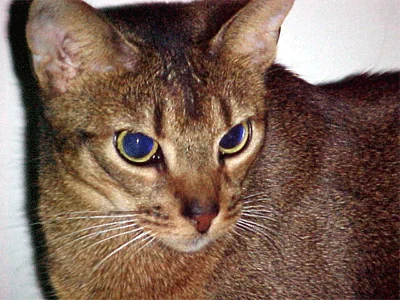
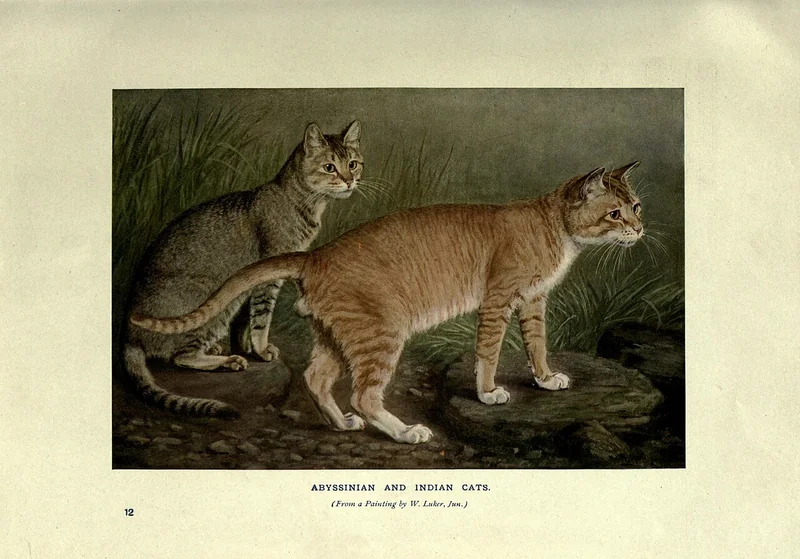
The Ceylon is a natural breed from Sri Lanka (formerly Ceylon), where it has lived as an indigenous domestic cat for centuries. The breed was documented and exported to Italy by Dr. Paolo Pellegatta beginning in 1984; the ANFI (Associazione Nazionale Felina Italiana) recognized the Ceylon in 1988. CFA, TICA, GCCF, and FIFe have not published Ceylon standards. The standard describes a medium-sized, semi-foreign cat with a ticked tabby coat and a characteristic 'M' marking on the forehead.
Quick facts
- Origin country
- Sri Lanka (formerly Ceylon)
- Origin period
- Natural Sri Lankan breed; documented by Italian researcher Dr. Paolo Pellegatta from 1984; ANFI Italy recognition 1988
- Coat type
- Short
- Coat colors
- Manille (warm sandy ground with dark ticking — the most-cited colour), Black, Blue, Red, Cream, Tortoiseshell
- Size category
- Medium
- Average lifespan
- 12-15 years
- Recognition
- —
Origin
The Ceylon is a natural breed indigenous to Sri Lanka (formerly Ceylon), where ticked-coat cats with a characteristic 'M' marking on the forehead have lived as domestic cats for centuries. The breed was first documented by Italian researcher Dr. Paolo Pellegatta beginning in 1984. Pellegatta travelled to Sri Lanka multiple times to study the indigenous cat population and exported foundation cats to Italy, where the breed was developed for show. The Manille colour — a warm sandy ground with dark agouti ticking — is the most-cited variant and is regarded as the breed's signature.
Recognition
The Associazione Nazionale Felina Italiana (ANFI) recognized the Ceylon in 1988 — the first formal cat registry to do so. The breed remains primarily affiliated with Italian and Mediterranean breed clubs; CFA, TICA, GCCF, and FIFe have not published Ceylon standards. Some WCF-affiliated bodies in continental Europe recognize the breed under the Italian standard.
Standard
The ANFI standard describes a medium-sized, slim, athletic cat with a semi-foreign body type, fine bone structure, and long legs. The head is small with a slightly rounded forehead; the muzzle is well-defined. The ears are large and set well apart on the head. The defining characteristic is the agouti ticked tabby coat with a clear 'M' marking on the forehead — a feature shared with the Abyssinian and Egyptian Mau but distinct in the Ceylon's specific colour expression. The coat is short and fine, lying close to the body.
Sources & further reading (3)
- encyclopedia — accessed 2026-04-30
- registry-standard — accessed 2026-04-30
- registry-standard — accessed 2026-04-30
Frequently asked questions
Where does the Ceylon breed come from?
The Ceylon is a natural breed indigenous to Sri Lanka (formerly Ceylon), where ticked-coat cats have lived as domestic cats for centuries. The modern breed was documented and exported to Italy by Dr. Paolo Pellegatta beginning in 1984.
Is the Ceylon recognized by CFA or TICA?
No. The Ceylon is recognized by the Associazione Nazionale Felina Italiana (ANFI) since 1988 and by some WCF-affiliated bodies in continental Europe. CFA, TICA, GCCF, and FIFe have not published Ceylon standards.
What is the Manille colour?
Manille is the most-cited Ceylon coat colour: a warm sandy or wheat-coloured ground with dark agouti ticking on the back and head, producing a striking 'wild' appearance. The colour is regarded as the breed's signature and is described in the ANFI breed standard as the original Sri Lankan natural colour.