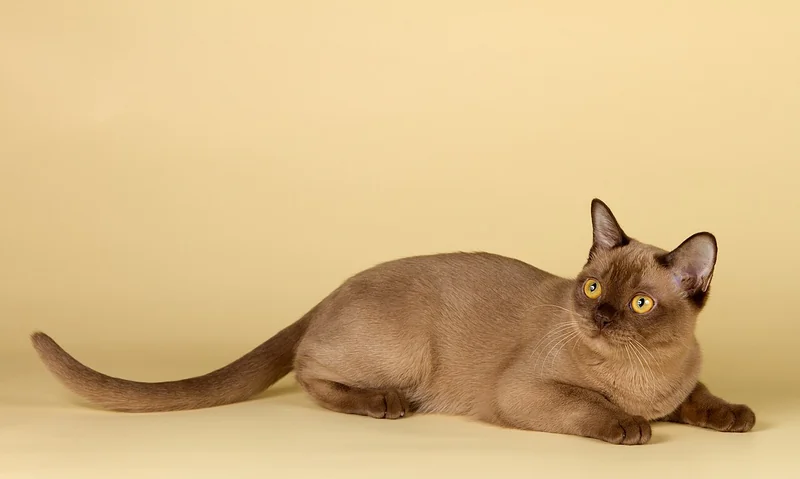
The Burmese is a short-haired breed founded on Wong Mau, a brown female cat imported from Burma to the United States in 1930 by Dr. Joseph Creadick Thompson. Thompson crossed Wong Mau with a Siamese male and subsequent selective breeding established the Burmese type. CFA recognized the breed in 1936; GCCF in 1952; FIFe at its 1949 founding; and TICA at its 1979 founding. The standard describes a compact, muscular cat with a rounded head and short, satin-textured coat.
Quick facts
- Origin country
- Myanmar (Burma)
- Origin period
- 1930 (Wong Mau imported by Dr. Joseph Thompson); CFA recognition 1936
- Coat type
- Short
- Coat colors
- Sable (CFA) / Brown (GCCF/FIFe), Champagne (CFA) / Chocolate (GCCF/FIFe), Blue, Platinum (CFA) / Lilac (GCCF/FIFe), Red, Cream, Tortoiseshell, Blue Tortoiseshell, Chocolate Tortoiseshell, Lilac Tortoiseshell
- Size category
- Medium
- Average lifespan
- 18-25 years
- Recognition
- CFA 1936 · TICA 1979 · GCCF 1952 · FIFe 1949
Origin
Dr. Joseph Creadick Thompson imported a small brown female cat named Wong Mau from Rangoon, Burma (Myanmar) to San Francisco in 1930. Thompson, working with Virginia Cobb, Billie Gerst, and geneticist Clyde Keeler, began a systematic breeding programme. Wong Mau was crossed with a Siamese male; subsequent litters produced brown kittens — the Burmese — and hybrid intermediates now recognized as Tonkinese. The Burmese carries the cb allele of the albino series; homozygous cb/cb individuals express the Burmese coat colour.
Recognition
CFA recognized the Burmese in 1936 — one of the earliest recognitions of a breed founded on a single import cat. CFA suspended recognition in 1947 due to widespread Siamese hybridization in registered lines; recognition was fully restored in 1953 after breeders purified the lines. The FIFe standard was published at the federation's 1949 founding. GCCF recognized the breed in 1952. TICA recognized the Burmese at its 1979 founding.
Standard
CFA and GCCF standards describe a medium-sized, compact, well-muscled cat of surprising weight for its size — described in the CFA standard as 'much heavier than it appears'. The head is pleasingly round with wide-set rounded eyes. The coat is short, fine, and close-lying with a glossy, satin-like sheen. CFA recognizes four colours — sable (rich warm brown), champagne (warm honey-beige), blue, and platinum (pale silver-grey); GCCF and FIFe recognize a broader range including red, cream, and tortoiseshell variants.
Sources & further reading (3)
- registry-breed-profile — accessed 2026-04-30
- encyclopedia — accessed 2026-04-30
- gccf-registry — accessed 2026-04-30
Frequently asked questions
What is the Burmese's typical lifespan?
Breed-club records consistently report a lifespan of 18 to 25 years for the Burmese — among the longest-lived of all recognized domestic cat breeds. The CFA Burmese parent club and multiple veterinary insurance datasets have confirmed longevity well beyond the typical domestic cat range.
When was the Burmese recognized?
CFA recognized the Burmese in 1936, one of the earliest recognitions for a breed founded on a single import cat. The FIFe standard was published at the 1949 founding. GCCF recognized the breed in 1952. TICA recognized it at its 1979 founding. CFA briefly suspended recognition from 1947 to 1953 due to Siamese hybridization.
What is the difference between American and European Burmese?
The American Burmese (CFA standard) has a more rounded, cobby head and fuller cheeks. The European Burmese (FIFe and GCCF standard) has a more moderate, slightly wedge-shaped head with a longer profile. Both standards recognize the same basic body type — compact, muscular, deceptively heavy — but differ in head shape and the range of accepted colours; European/GCCF standards accept red, cream, and tortoiseshell variants not in the CFA four-colour standard.