Setophaga petechia
Yellow Warbler (Setophaga petechia)
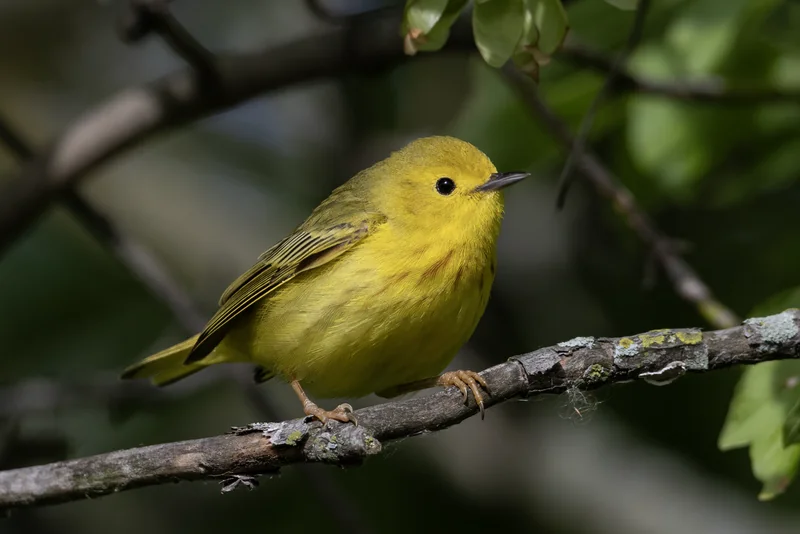 Featured photoyellow-warbler.jpg
Setophaga petechia, the American yellow warbler, is a small Parulidae warbler distributed across most of North America. Adults are 12 to 13 cm long with a wingspan of 16 to 22 cm and weigh 7 to 25 g (varies geographically). Both sexes are largely yellow; males show distinct chestnut breast streaks. The IUCN lists the species as Least Concern. The yellow warbler is one of the most familiar and widespread Neotropical migrants among North American songbirds.
Quick facts
- Habitat
- Wet thickets, willow stands, alder swamps, riparian shrub, and second-growth scrub. Almost always found near water during the breeding season.
- Range
- Breeds across most of Canada and the United States. Winters from Mexico south through Central America to northern South America. The species shows extensive geographic variation; over forty subspecies have been described, several formerly treated as separate species (mangrove warbler, golden warbler).
- Size
- 12–13 cm body · 16–22 cm wingspan · 7–25 g
- Plumage
- Adult males show a uniform bright yellow body with chestnut streaks running down the breast and flanks, dark eyes, and yellow-edged wings. Females are duller yellow without the breast streaking. The species' bright unmarked face — yellow with no eye-ring or eyestripe — is a useful field mark separating it from other small yellow warblers.
- Song
- A loud, sweet, accelerating warble often transcribed as 'sweet-sweet-sweet, I'm so sweet'. The call is a sharp 'chip'.
- Migration
- Long-distance Neotropical migrant. North American breeders winter from Mexico to northern South America; tropical resident populations exist in mangrove and Caribbean island settings.
- Conservation
- Least Concern (LC)
Overview
Setophaga petechia is one of the most widely distributed of the Parulidae wood-warblers, with over forty described subspecies across North, Central, and South America. The northern continental subspecies (the 'American yellow warbler' sensu stricto) is a long-distance migrant; tropical subspecies are largely resident. Several formerly separate species (mangrove warbler, golden warbler of the Caribbean) are now treated as subspecies of S. petechia.
Distribution
The breeding range covers nearly the entire forested portion of Canada and the contiguous United States, extending into Alaska and northern Mexico. Wintering grounds reach Central America and northern South America. The species is among the earliest arriving Neotropical migrants in spring and one of the latest to depart in autumn across most of its temperate range.
Cowbird parasitism
Yellow warblers are a frequent host species for the brown-headed cowbird, but the warbler has evolved one of the best-documented anti-parasitism behaviours among songbirds: when a cowbird egg appears in the nest, the warbler will sometimes build a new nest floor over the existing clutch and start a fresh cycle on top. Multi-storey nests with two or three buried clutches have been recorded.
Sources & further reading (3)
- iucn-red-list — accessed 2026-04-29
- encyclopedia — accessed 2026-04-29
- ornithology-reference — accessed 2026-04-29
Frequently asked questions
Why are male yellow warblers streaked with chestnut?
Adult males show fine chestnut breast streaks against the otherwise uniform yellow body — a sexually dichromatic plumage signal absent in the duller-yellow female. The streaking serves a mate-choice and territory-display function. Females routinely choose males with brighter and more extensive streaking, suggesting the trait advertises male condition.
How do yellow warblers respond to cowbird parasitism?
Yellow warblers cannot eject the larger cowbird eggs from the cup-shaped nest. Instead, when a parasitism event is detected, the female may build a new nest floor of grass and bark strips over the entire clutch — burying both her own eggs and the cowbird egg — and then re-lay on top. Multi-storey nests with two or three buried clutches have been documented.
Are mangrove warblers a separate species?
Modern taxonomic treatments consolidate the mangrove warbler (S. petechia subspecies erithachorides) and the golden warbler (Caribbean subspecies petechia) into the single species Setophaga petechia, the American yellow warbler. Older guides may treat them as separate species. The North American migratory subspecies group (aestiva) and the resident tropical groups remain morphologically and ecologically distinct.