Corvus brachyrhynchos
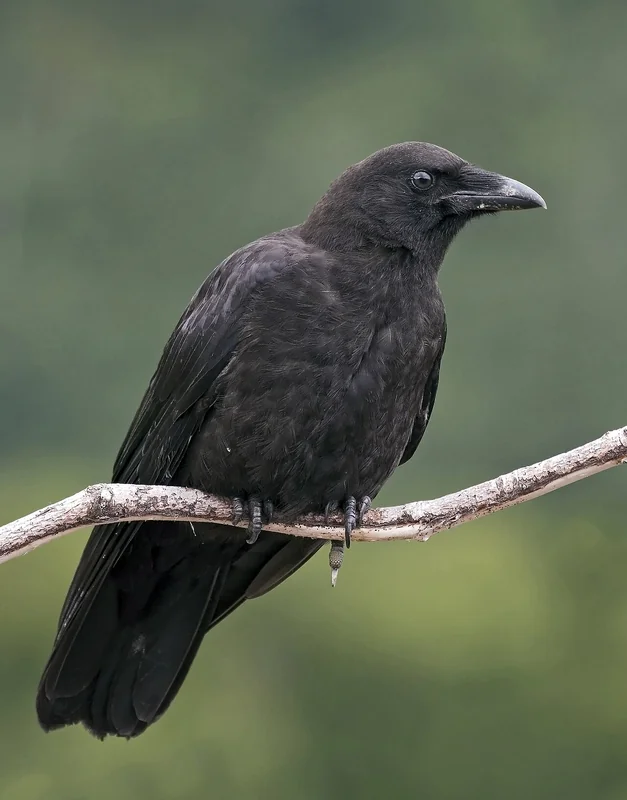
American Crow (Corvus brachyrhynchos)
 Featured photoamerican-crow.jpg
Corvus brachyrhynchos, the American crow, is a large all-black corvid distributed across most of North America. Adults are 40 to 53 cm long with a wingspan of 85 to 100 cm and weigh 316 to 620 g. The plumage is uniformly glossy black with no field-visible iridescence patterns. The IUCN lists the species as Least Concern. American crows are among the most cognitively studied birds, with documented tool use, complex social structure, and individual face recognition of humans.
Quick facts
- Habitat
- Open and partly wooded country, farmland, suburbs, and city parks. The species is among the most successful North American birds in human-modified landscapes.
- Range
- Most of North America from southern Canada south through the contiguous United States and into northern Mexico. The species is broadly resident, with northern populations making short-distance autumn movements south.
- Size
- 40–53 cm body · 85–100 cm wingspan · 316–620 g
- Plumage
- Both sexes are uniformly glossy black including the bill, legs, and eyes. The species is most reliably separated from the closely related fish crow (C. ossifragus) by voice — the American crow's caw is a clear single-note 'caw' while the fish crow gives a more nasal two-syllable 'uh-uh'.
- Song
- A loud, clear 'caw caw caw' delivered from a perch or in flight. Captive American crows mimic human speech with practice but the behaviour is rare in the wild.
- Migration
- Partial migrant. Northern populations make short-distance autumn movements south; central and southern populations are resident year-round.
- Conservation
- Least Concern (LC)
Overview
Corvus brachyrhynchos belongs to the family Corvidae and shows the cognitive sophistication that defines the group. American crows form long-term family groups in which adult offspring stay with their parents and help raise the next year's brood — cooperative breeding is unusual in temperate songbirds. The species is closely related to the fish crow (C. ossifragus), the northwestern crow (now lumped with American crow), and the common raven (C. corax).
Cognition
American crows are among the most intensively studied avian cognition models. Marzluff and colleagues at the University of Washington demonstrated that wild crows recognize individual human faces, retain the memory for years, and pass the information socially to other crows in the area — researchers wearing 'dangerous' masks were mobbed by crows that had never personally encountered them. Tool use, multi-step problem solving, and complex social play are all documented.
Social behaviour
American crows form large communal night roosts outside the breeding season, sometimes numbering tens of thousands of birds. Day-time foraging is in family groups of 2-15 birds. Pairs are socially monogamous and form long-term bonds; the same pair often returns to a previous nesting territory year after year. Cooperative breeding (offspring helping parents raise the next brood) is documented.
Sources & further reading (3)
- iucn-red-list — accessed 2026-04-29
- encyclopedia — accessed 2026-04-29
- ornithology-reference — accessed 2026-04-29
Frequently asked questions
Can American crows recognize human faces?
Yes — research at the University of Washington (Marzluff and colleagues) demonstrated that wild American crows recognize individual human faces and retain the memory for at least five years. Crows that observed a researcher wearing a 'dangerous' mask trapping their conspecifics later mobbed any researcher wearing that mask, even years later — and the information spread socially to crows that had never personally encountered the trapping event.
How can you tell American crows from common ravens?
Ravens are larger (60-70 cm vs. 40-53 cm) with a heavier bill, a wedge-shaped tail (vs. fan-shaped in the crow), and shaggy throat feathers. The voice differs: ravens give a deep croaking 'kraa', crows a clear 'caw'. Ravens are typically solitary or in pairs; crows form larger groups. In flight, ravens often soar; crows usually flap.
Why do crows roost in such large flocks?
Communal night roosts of American crows can hold tens of thousands of birds, sometimes hundreds of thousands. Proposed functions include reduced predation risk through dilution, information sharing about good foraging sites (the 'information centre' hypothesis), and thermoregulation in cold weather. The roosting behaviour is non-breeding-season only; pairs return to scattered nesting territories in spring.