Spinus tristis
American Goldfinch (Spinus tristis)
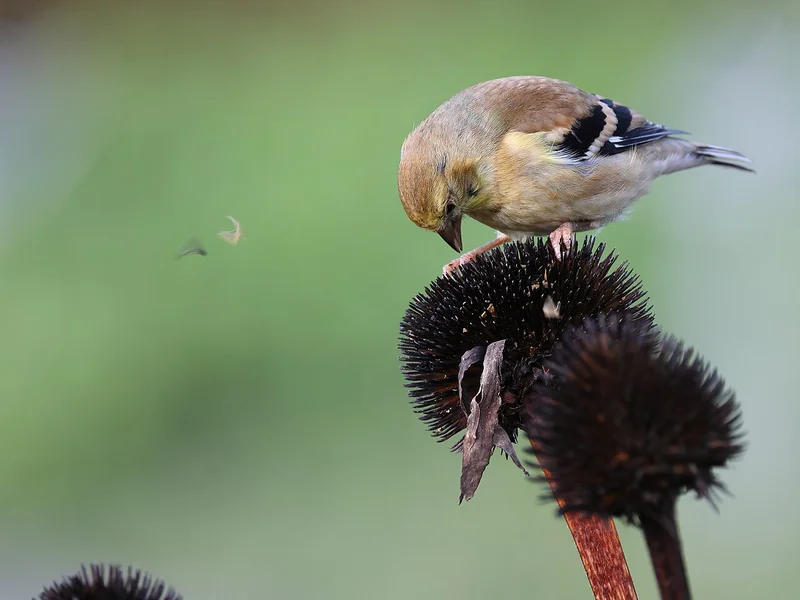 Featured photoamerican-goldfinch.jpg
Spinus tristis, the American goldfinch, is a small Fringillidae finch widespread across North America. Adults are 11 to 14 cm long with a wingspan of 19 to 22 cm and weigh 11 to 20 g. Breeding males are brilliant yellow with a black cap and black wings barred white; females and non-breeding males are duller olive-yellow. The IUCN lists the species as Least Concern. The American goldfinch is among the few wholly granivorous songbirds and times its breeding to the late-summer thistle seed peak.
Quick facts
- Habitat
- Weedy fields, roadsides, orchards, suburban gardens, and open deciduous woodland edges. The species is closely tied to thistle, sunflower, and alder seed availability.
- Range
- Most of North America from southern Canada through the contiguous United States and into northern Mexico. Northern populations migrate; populations across the central US are resident year-round.
- Size
- 11–14 cm body · 19–22 cm wingspan · 11–20 g
- Plumage
- Breeding males are bright lemon-yellow with a black forehead patch, black wings barred and edged white, and a white rump. Females and winter males are uniformly drab olive-yellow with darker wings; the species moults completely twice a year, alone among North American cardueline finches.
- Song
- A long warbling jumble of musical phrases delivered from a perch or in flight; the flight call is a per-chic-or-ee in undulating bouncing flight.
- Migration
- Short-distance partial migrant. Northern populations move south for winter; central-latitude populations are resident.
- Conservation
- Least Concern (LC)
Overview
Spinus tristis belongs to the family Fringillidae, the cardueline finches. The species is one of the only American songbirds that nests as late as July or August, timing the brood to the peak availability of thistle and other late-summer composite seeds. The complete twice-yearly moult is unusual among North American finches and produces the dramatic seasonal contrast between the bright spring-summer male and his drab winter plumage.
Distribution
The breeding range covers most of southern Canada and the northern two-thirds of the contiguous United States. Wintering birds reach the Gulf Coast and the highlands of central Mexico. The species is one of the most numerous songbirds on North American Christmas Bird Counts, with a continental population estimated by Partners in Flight at over forty million.
Diet and breeding
Adults are wholly granivorous — even the brood is fed on regurgitated seeds rather than the insect mash that almost every other songbird supplies. Late-summer breeding aligns with peak seed crops of thistle and sunflower; the nest is a tightly woven cup lined with thistledown. Brown-headed cowbird parasitism rarely succeeds because the seed-only diet starves the cowbird chick.
Sources & further reading (3)
- iucn-red-list — accessed 2026-04-29
- encyclopedia — accessed 2026-04-29
- ornithology-reference — accessed 2026-04-29
Frequently asked questions
Why do American goldfinches breed so late in the summer?
The species is wholly granivorous, including the brood, and times the nesting season to the peak availability of thistle, sunflower, and alder seeds in July and August. This is several months later than most North American songbirds, which breed in May and June to match an insect peak. Late-summer goldfinch broods can fledge as late as September.
Are male goldfinches always bright yellow?
No. American goldfinches undergo a complete moult twice a year — once in early spring into the bright yellow-and-black breeding plumage, and again in late autumn into a drab olive-yellow winter plumage. Females stay olive-yellow year-round. Twice-yearly complete moult is unusual among North American finches and produces the marked seasonal contrast.
Are goldfinches good at thwarting cowbird parasitism?
Effectively yes, though not by behaviour. Brown-headed cowbird eggs hatch and the chick begs in the goldfinch nest, but the all-seed diet that goldfinches feed their nestlings does not contain enough protein for the cowbird chick to develop. Cowbird chicks raised by goldfinches typically die within a few days, so although the parasitism happens, it rarely succeeds.