Haematopus palliatus
American Oystercatcher (Haematopus palliatus)
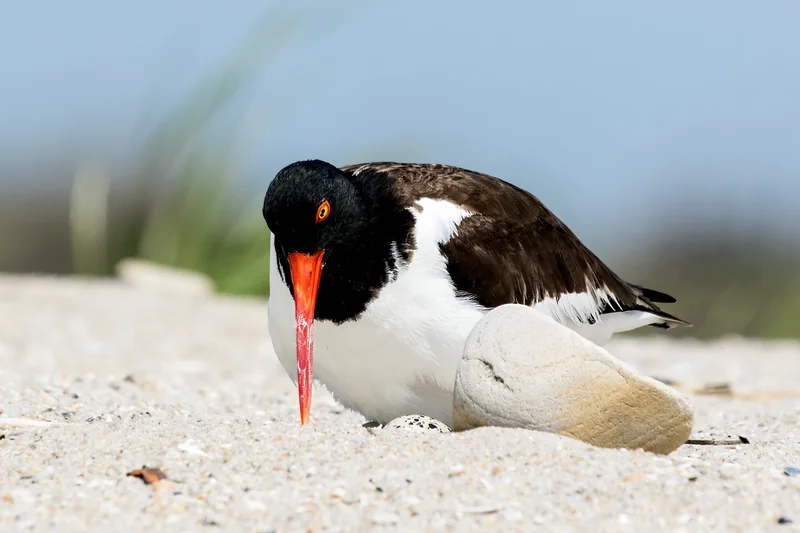 Featured photoamerican-oystercatcher.jpg
Haematopus palliatus, the American oystercatcher, is a large shorebird of the family Haematopodidae. Adults are 40 to 44 cm long with a wingspan of 81 cm and weigh 400 to 700 g. The plumage is sharply pied — black head, neck, and back; white belly and underwings; and a heavy bright red-orange bill that is the diagnostic feature of the family. The IUCN lists the species as Least Concern. American oystercatchers are highly specialized bivalve predators and represent one of the textbook examples of foraging-niche specialization among birds.
Quick facts
- Habitat
- Sandy and rocky beaches, salt marsh edges, oyster reefs, and shellfish flats. The species is strictly coastal and rarely occurs inland.
- Range
- Atlantic and Pacific coasts of the Americas — from southern New England south along the US Atlantic and Gulf coasts to Argentina, and along the Pacific coast from Mexico south to Chile. Two distinct populations on the two American coasts have shown some differentiation but are currently treated as one species.
- Size
- 40–44 cm body · 81 cm wingspan · 400–700 g
- Plumage
- Adults show a sharply pied pattern: black head, neck, back, and upper breast contrasting with white belly and underparts; the wings show a broad white wing-stripe visible in flight. The heavy slightly upturned bill is bright orange-red, the eye is yellow with a red orbital ring, and the legs are pale pink. Juveniles show duller dark-brown-and-white plumage with a paler bill, gaining the bright adult colours over the first one to two years.
- Song
- A loud piercing 'wheep' or 'kleep' delivered both in flight and from the ground. The species is highly vocal during territorial display, with pairs sometimes performing a coordinated bowing 'piping' call together.
- Migration
- Partial migrant. Northern Atlantic populations move south for winter; central and southern populations are largely resident. The species' range has slowly extended north along the US Atlantic coast over recent decades.
- Conservation
- Least Concern (LC)
Overview
Haematopus palliatus is one of about eleven Haematopus oystercatchers worldwide. The family is a small group of large shorebirds specialized on bivalve molluscs and other shellfish, with the heavy laterally compressed bill as the key adaptation. The American oystercatcher's two regional populations — the Atlantic and the Pacific — show some morphological and behavioural differentiation but are currently treated as a single species.
Foraging specialization
American oystercatchers use two distinct foraging techniques on bivalve prey: 'hammering' (pounding the bivalve's hinge open with the bill, requiring the prey to be on a hard substrate that absorbs the strike) and 'stabbing' (slipping the bill between the slightly opened valves of an underwater bivalve and severing the adductor muscle). Individual birds tend to specialize in one technique throughout life, with hammering more common in juveniles and stabbing more common among older more experienced birds. The specialization is one of the textbook examples of within-species foraging-niche partitioning in shorebirds.
Conservation
American oystercatcher populations have been historically affected by coastal development and disturbance at beach nest sites. The species nests directly on open beach above the high-tide line, making nests vulnerable to recreational beach use, dogs, and storm overwash. Cooperative state-and-federal beach-protection programmes since the 1970s have supported population stability or modest increases on most of the US Atlantic coast.
Sources & further reading (2)
- iucn-red-list — accessed 2026-04-29
- encyclopedia — accessed 2026-04-29
Frequently asked questions
Do oystercatchers really eat oysters?
Yes — and other bivalve molluscs (clams, mussels). The heavy laterally compressed bill is specialized for the task. Oystercatchers use either 'hammering' (pounding the bivalve's hinge open against a hard substrate) or 'stabbing' (slipping the bill between the slightly opened valves of an underwater bivalve and severing the adductor muscle). The species is one of the most specialized bivalve predators among birds.
Why do individual oystercatchers specialize in hammering or stabbing?
Each foraging technique requires a different combination of skill, eye-hand coordination, and bill calibration. Individual birds learn one technique in their first year and tend to use it throughout life with progressively higher success rates. Hammering is more common among juveniles (lower coordination requirement); stabbing is more common among older experienced birds. The within-species specialization is a textbook example of behavioural niche partitioning in shorebirds.
Are American and Eurasian oystercatchers the same species?
No. American oystercatcher (H. palliatus) and Eurasian oystercatcher (H. ostralegus) are sister species but distinctly different — the Eurasian shows a complete dark hood that meets the back, while the American has a black head and neck transitioning more abruptly into the white breast. Both are now treated as separate species, though the genus Haematopus is small and several other regional species remain under taxonomic review.