Turdus migratorius
American Robin (Turdus migratorius)
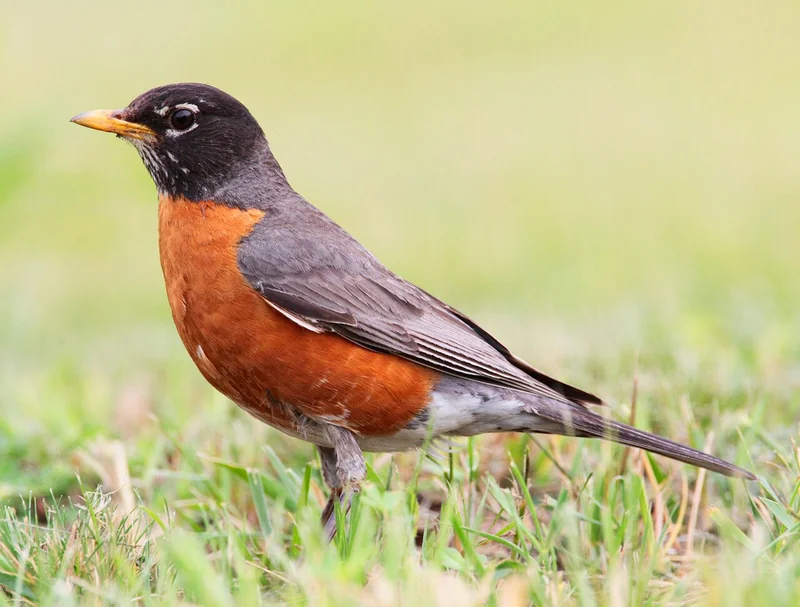 Featured photoamerican-robin.jpg
Turdus migratorius, the American robin, is a large thrush distributed across North America from Alaska and Canada south to central Mexico. Adults are 23 to 28 cm long with a wingspan of 31 to 40 cm and weigh 65 to 95 g. The species shows a grey-brown back and a brick-red breast that gives the bird its colloquial name; the IUCN Red List assesses the species as Least Concern, with one of the largest population estimates of any North American bird.
Quick facts
- Habitat
- Open woodlands, forest edges, suburban lawns, parks, and farmland. The species tolerates human-modified landscapes exceptionally well and is among the most numerous breeding birds across the suburban United States and southern Canada.
- Range
- Most of North America: breeds from the tree line of Alaska and northern Canada south through the contiguous United States to the highlands of central Mexico. Northern populations are migratory; populations south of the snow line are resident year-round.
- Size
- 23–28 cm body · 31–40 cm wingspan · 65–95 g
- Plumage
- Adults show a slate-grey back and head with a darker crown, a white throat streaked black, and a brick-red to orange breast and belly. Females are duller than males, with a paler head and breast. Juveniles are heavily spotted below — the spotted pattern is the ancestral thrush condition that adults outgrow.
- Song
- A liquid, caroling phrase often transcribed as 'cheerily, cheer up, cheer up, cheerily', delivered in clear two- or three-note groups. The song is among the earliest dawn vocalizations across temperate North America in spring.
- Migration
- Short- to medium-distance partial migrant. Northern breeding populations move south in autumn; southern populations are resident.
- Conservation
- Least Concern (LC)
Overview
Turdus migratorius is a member of the family Turdidae, the typical thrushes. Despite the colloquial name 'robin', the species is unrelated to the European robin (Erithacus rubecula) — early colonists transferred the name from the European species on the basis of a superficially similar red breast. The American robin is one of the most numerous breeding birds in North America, with a continental population estimated by Partners in Flight at over three hundred million individuals.
Distribution
The breeding range covers nearly the entire North American continent, from the boreal tree line south to the highlands of central Mexico. Migratory northern populations winter from the southern half of the United States south into Mexico and occasionally Cuba. Vagrants have reached western Europe on rare occasions, generally during exceptional autumn weather systems.
Behaviour
American robins forage on lawns and open ground, running short distances, pausing, and tilting the head before striking at earthworms — a behaviour for which the species is widely recognized. Outside the breeding season, robins form large nomadic flocks that track fruit availability, sometimes numbering in the thousands at communal winter roosts.
Nesting
The female builds a sturdy cup nest of grasses and twigs cemented with mud, typically placed on a horizontal branch in a deciduous tree, on a building ledge, or against the trunk on a sheltered fork. The clutch is three to five pale-blue eggs — 'robin's-egg blue' is the colloquial name for the shade. Two broods per season are common across much of the range.
Sources & further reading (3)
- iucn-red-list — accessed 2026-04-29
- encyclopedia — accessed 2026-04-29
- ornithology-reference — accessed 2026-04-29
Frequently asked questions
Is the American robin related to the European robin?
No. The two species share only a superficial similarity in the red breast. The American robin (Turdus migratorius) is a true thrush in the family Turdidae and a close relative of the Eurasian blackbird, while the European robin (Erithacus rubecula) is an Old World flycatcher in the family Muscicapidae. Early English-speaking colonists transferred the familiar name to the larger New World thrush.
Why are American robins associated with spring?
Across the northern half of the breeding range, robins are short-distance migrants that return to thawing ground in late winter or early spring. Their reappearance on lawns coincides with the first thawed soil that lets them forage for earthworms, and their dawn song is among the earliest of the spring chorus — both reasons the species is a folk indicator of the changing season.
What does 'robin's-egg blue' refer to?
The pale, slightly greenish-blue shade of the species' eggs. American robin eggs are unmarked and uniformly coloured, and the shade is distinctive enough that it has been adopted as a named colour in English. The pigment is biliverdin, a bile-derived compound deposited in the eggshell during formation.