Nyctanassa violacea
Yellow-crowned Night Heron (Nyctanassa violacea)
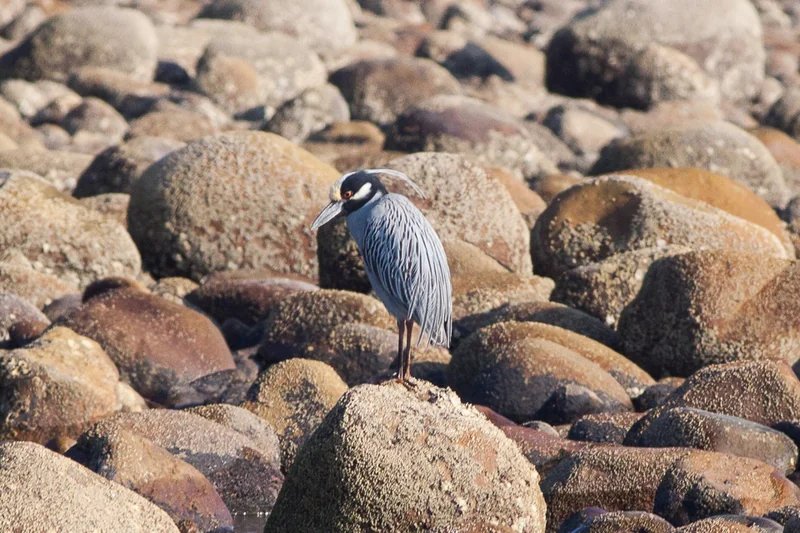 Featured photoyellow-crowned-night-heron.jpg
Nyctanassa violacea, the yellow-crowned night heron, is a medium-sized heron of the family Ardeidae native to the Americas. Adults are 55 to 70 cm long with a wingspan of 101 to 112 cm and weigh 625 to 800 g. The species is recognised by its grey body, bold black-and-white head markings, and yellow crown. Unlike most herons, it is a specialist predator of crustaceans. The IUCN lists the species as Least Concern.
Quick facts
- Habitat
- Mangroves, salt marshes, tidal mudflats, estuaries, and coastal wetlands throughout its range — habitats dominated by crustaceans. Also inland on rivers, lakes, and swamps where crayfish are abundant. Less associated with open freshwater fish habitat than the black-crowned night heron.
- Range
- Coastal and inland wetlands from the eastern United States and the Gulf Coast south through Central America, the Caribbean, and South America to Bolivia, Brazil, and Peru. Island populations on the Galápagos and several Caribbean island groups. Northern populations migrate; southern and Caribbean populations are largely resident.
- Size
- 55–70 cm body · 101–112 cm wingspan · 625–800 g
- Plumage
- Adults are grey overall with a bold black-and-white head — the crown is yellow to white, and the face has bold black-and-white streaking with a white cheek patch. Long white plumes extend from the nape. The eye is red. Legs are yellow-orange. Immature birds are streaky brown, similar to immature black-crowned night herons but typically more finely spotted.
- Song
- A sharp 'quawk' or 'woc' — slightly higher-pitched than the black-crowned night heron's call. Given in flight, particularly at dusk when birds leave communal roosts for foraging areas.
- Migration
- Partially migratory. Northern US breeding populations migrate south in autumn to the Gulf Coast, Caribbean, and South America. Coastal populations in the Gulf of Mexico and Caribbean are largely sedentary. Migrates at night.
- Conservation
- Least Concern (LC)
Overview
Nyctanassa violacea is the sole species in the genus Nyctanassa and is closely related to but distinct from the black-crowned night heron (Nycticorax nycticorax). The most significant ecological difference between the two is dietary specialisation — the yellow-crowned night heron is a dedicated crustacean predator, particularly of intertidal crabs, while the black-crowned night heron is a more generalist fish and frog hunter. This specialisation is reflected in the proportionally heavier, more compressed bill and stouter neck musculature of the yellow-crowned species. The two species often occur in the same wetland but exploit different prey and microhabitats.
Crustacean predation
The yellow-crowned night heron's diet — dominated by crabs and crayfish — is unusual among herons, which are predominantly fish-eaters. The species hunts crabs by stalking slowly through shallow water or along tidal mudflats at low tide, seizing crabs with a swift bill strike. Once caught, a crab is typically dismembered before swallowing — the bird manipulates the prey with the bill to remove large claws and legs before swallowing the body. The bill is proportionally deeper and more heavily built than that of fish-hunting herons, providing the mechanical advantage required to grip and process hard-shelled prey. In areas where blue crabs (Callinectes sapidus) are abundant, a single bird may consume dozens of crabs per night.
Nesting and urban adaptation
Yellow-crowned night herons nest in small colonies or as solitary pairs, often in mangroves, coastal woodland, or trees near water. Unlike many colonial herons, pairs sometimes nest singly in suburban or urban trees near water — the species has adapted to nesting in parks, gardens, and residential areas adjacent to tidal creeks and estuaries in coastal US cities. Nests are stick platforms built in trees or shrubs, and pairs produce two to four chicks per clutch. Both parents share incubation and chick-rearing duties. Urban nesting pairs can become habituated to human presence and may be observed at close range in city parks.
Sources & further reading (2)
- iucn-red-list — accessed 2026-05-07
- encyclopedia — accessed 2026-05-07
Frequently asked questions
How does the yellow-crowned night heron differ from the black-crowned night heron?
The two species can be distinguished by head pattern (yellow-crowned has a bold black face with a white cheek patch; black-crowned has a clean black cap, white face, and grey body), bill shape (yellow-crowned has a heavier, more compressed bill suited to crabs; black-crowned has a more slender fish-hunting bill), and dietary preference (yellow-crowned specialises in crustaceans; black-crowned is a generalist fish and amphibian predator). Both have red eyes and nocturnal habits, and both occur in wetlands across the Americas.
Why is the yellow-crowned night heron's bill shaped differently from other herons?
The yellow-crowned night heron's bill is proportionally deeper, shorter, and more strongly built than those of most herons — an adaptation for seizing and dismembering hard-shelled crustaceans. Crabs require more force to grip and subdue than fish, and the larger jaw muscles and reinforced bill of the yellow-crowned night heron provide this mechanical advantage. The bird manipulates crabs before swallowing, removing claws and legs — tasks that require precise bill control rather than the rapid stabbing motion used by fish-hunting herons.
Do yellow-crowned night herons nest in cities?
Yes — the yellow-crowned night heron is one of the herons most tolerant of urban and suburban environments. It nests in coastal US cities including Charleston, New Orleans, Houston, and Miami, where tidal creeks, mangroves, and park waterways provide both crabs and nesting trees. Urban pairs may nest as solitary couples in park trees and can become quite accustomed to human foot traffic nearby. The availability of crabs in tidal areas adjacent to US coastal cities makes urban environments viable year-round for this species.