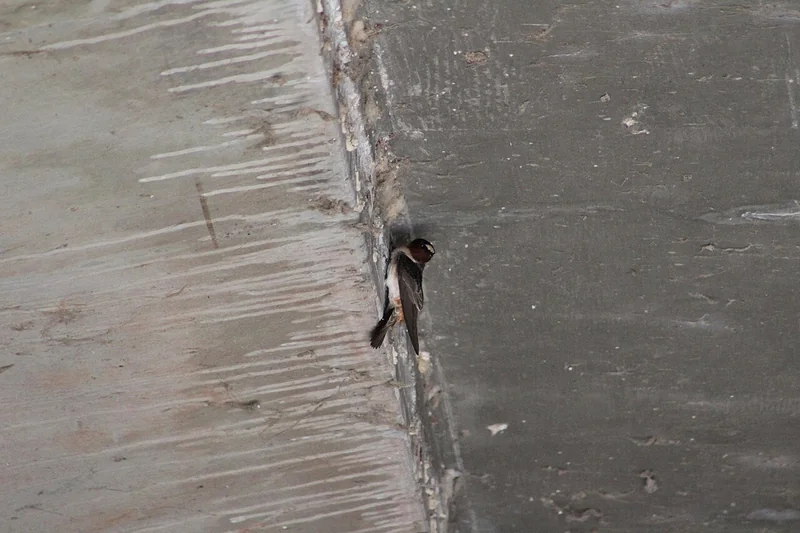
Petrochelidon pyrrhonota, the American cliff swallow, is a small swallow of the family Hirundinidae, distributed across most of North America. Adults are 13 to 14 cm long with a wingspan of 27 to 30 cm and weigh 19 to 31 g. The plumage is dark blue-black above with a chestnut throat, white forehead, and pale buff rump. The IUCN lists the species as Least Concern. American cliff swallows build distinctive gourd-shaped mud nests in dense colonies under overhanging cliffs, bridges, and building eaves.
Quick facts
- Habitat
- Open and partly wooded country across most of North America with available vertical surfaces — natural cliffs, bridges, road overpasses, building overhangs — for colony nesting. The species requires both abundant flying-insect prey and mud sources for nest construction.
- Range
- Breeds across most of North America from Alaska and Canada south through the United States to Mexico. Winters in southern South America from Bolivia and Brazil south to central Argentina. The species' range has expanded substantially with the spread of human-built bridges and overpasses.
- Size
- 13–14 cm body · 27–30 cm wingspan · 19–31 g
- Plumage
- Adults show dark steel-blue upperparts and crown, a chestnut-rust throat and face, a clean white forehead patch, a pale buff rump, and pale buff underparts. The squared tail (without the deeply forked outer streamers of barn swallows) is the most reliable field separator. Both sexes look alike. Juveniles are duller with a paler face.
- Song
- A liquid twittering chatter delivered by flocks at the colony and in flight. Calls are exchanged continuously by flock members during foraging and nest construction. The species is highly vocal at colonies during the breeding season.
- Migration
- Long-distance Trans-equatorial migrant. North American breeders winter in southern South America from Bolivia and Brazil south to central Argentina. The annual round-trip migration covers approximately 16,000 km — among the longer migrations of any North American songbird.
- Conservation
- Least Concern (LC)
Overview
Petrochelidon pyrrhonota is one of about ten Petrochelidon swallow species worldwide, mostly New World. The species is the second-most-numerous swallow in North America (after the barn swallow). The species' nesting strategy — gourd-shaped mud nests in dense colonies under cliff overhangs — was historically restricted to natural rock faces but has expanded dramatically with the spread of human-built bridges, road overpasses, and building eaves that provide identical nesting microhabitat.
Mud-nest construction
Cliff swallow nests are gourd-shaped mud structures plastered to vertical surfaces under overhangs. Each nest is constructed of approximately 1,000-1,400 individual mud-pellets carried one at a time from a nearby mud source — typically a riverbank or pond edge. The nest forms a closed pouch with a small entrance tunnel on the side. Construction takes one to two weeks of paired-bird effort. Colonies of dozens to thousands of nests are common; the species is among the most densely colonial of any North American songbird.
Capistrano migration
American cliff swallows are famous for their precisely-timed annual return to Mission San Juan Capistrano in southern California. The traditional return date of March 19 (St. Joseph's Day) has been documented since the early twentieth century, although recent climate-driven shifts have moved the actual arrival date earlier. The cultural celebration of the swallows' return has been a Capistrano tradition for decades and is one of the better-known North American examples of cultural attachment to a migratory bird's seasonal arrival.
Sources & further reading (2)
- iucn-red-list — accessed 2026-04-30
- encyclopedia — accessed 2026-04-30
Frequently asked questions
Do swallows really return to Capistrano on the same day each year?
American cliff swallows have famously returned to Mission San Juan Capistrano in southern California in mid-March for over a century. The traditional return date of March 19 (St. Joseph's Day) has been documented since the early twentieth century, although recent climate-driven shifts have moved the actual arrival date earlier in some years. The Capistrano celebration of the swallows' return is one of the better-known North American examples of cultural attachment to a bird's seasonal arrival.
How is a cliff swallow nest different from a barn swallow nest?
Both build mud nests, but the structures are different. Cliff swallow nests are closed gourd-shaped pouches with a small side entrance, plastered to vertical surfaces under overhangs. Barn swallow nests are open cup-shaped structures placed on a horizontal ledge or beam. Cliff swallows are also colonial — dozens to thousands of nests packed close together — while barn swallows are typically solitary or in much smaller groupings.
Why are cliff swallows so dependent on bridges?
Cliff swallows nest under overhangs that provide weather protection and support for the gourd-shaped mud nest. Natural cliff overhangs are limited in distribution across North America, but human-built bridges, road overpasses, and building eaves provide identical microhabitat in much greater abundance. The species' range and population have expanded substantially with the spread of these human structures, particularly across the central and western United States where natural cliffs are scarce.