Pygoscelis adeliae
Adélie Penguin (Pygoscelis adeliae)
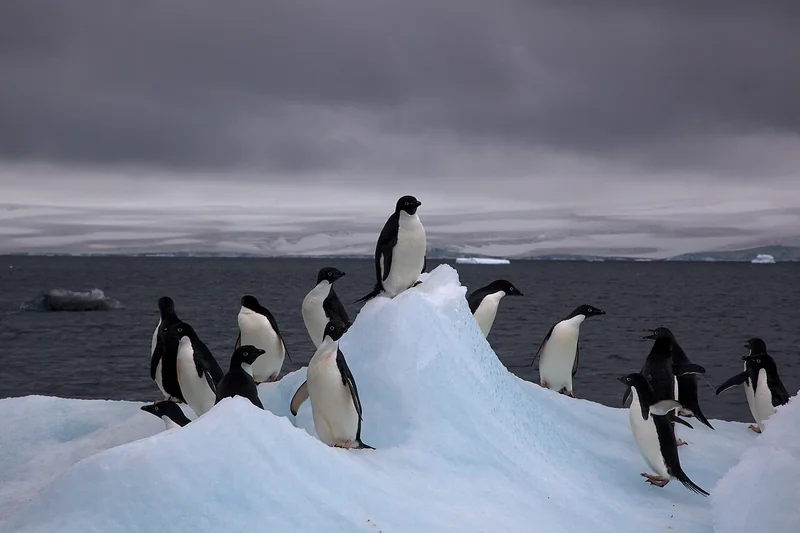 Featured photoadelie-penguin.jpg
Pygoscelis adeliae, the Adélie penguin, is a small antarctic penguin of the family Spheniscidae. Adults are 70 to 73 cm tall and weigh 3 to 6 kg. The plumage is the textbook 'tuxedo' pattern — glossy black back and head, pure white belly — with a thin white ring around each eye. The IUCN lists the species as Least Concern. Adélie penguins are among the most southerly breeding birds on Earth, with colonies as far south as 77°S, and are the most abundant penguin in the Antarctic.
Quick facts
- Habitat
- Antarctic coastal cliffs, headlands, and ice-free rocky beaches during the breeding season. Pack-ice and open antarctic waters during the non-breeding season. The species depends on stable summer ice-free coast for breeding access.
- Range
- Circumpolar antarctic — colonies on the antarctic continental coast, the antarctic peninsula, and several subantarctic islands. The species' breeding range is the most strictly antarctic of any penguin.
- Size
- 70–73 cm body · 64–70 cm wingspan · 3–6 kg
- Plumage
- Adults show a glossy black head, back, wings, and tail; pure white underparts from chin to undertail; and a fine white ring around each eye. The bill is partly hidden by feathers extending forward onto the lower mandible — a useful field mark separating Adélies from the closely related chinstrap and gentoo penguins. Both sexes look alike. Chicks are covered in soft grey-brown down.
- Song
- Adults give loud braying and trumpeting calls during territorial display and pair-bonding. Colony soundscapes are dense with calls that allow individuals to recognize mates and chicks in the crowded breeding colony.
- Migration
- Migrates to the antarctic pack-ice during winter when the breeding islands become inaccessible. Non-breeding-season foraging ranges are much larger than breeding-season ranges.
- Conservation
- Least Concern (LC)
Overview
Pygoscelis adeliae is one of three Pygoscelis penguins (with chinstrap P. antarctica and gentoo P. papua). The species was named after Adélie Land, a region of antarctic coast claimed by France in 1840 and itself named for Adèle Dumont d'Urville, wife of the French naval officer who first reported the coastline. The species is one of two birds (with the emperor penguin) breeding entirely south of the antarctic convergence.
Distribution
Breeding colonies are distributed around the entire antarctic coast and on subantarctic islands. The species' total population is estimated at over four million breeding pairs — the most abundant penguin in the Antarctic. Some western antarctic populations have declined sharply over recent decades (some colonies on the antarctic peninsula have lost over 80 per cent of their breeding pairs since the 1970s), while eastern antarctic populations have generally been stable or increasing — a striking regional pattern that may reflect differential climate impacts on sea ice and krill.
Behaviour
Adélie penguins are aggressively territorial during the breeding season. Pairs construct stone nests on bare rocky ground — small mounds of pebbles laboriously gathered from the surrounding terrain — that elevate the eggs above any meltwater pooling. Pebble theft from neighbouring nests is constant and well-documented; courting males sometimes offer pebbles to females as part of pair-bonding displays. Chick crèches form once chicks are large enough to leave the nest, with parents foraging at sea and returning to feed their own chick by individual call recognition.
Sources & further reading (2)
- iucn-red-list — accessed 2026-04-30
- encyclopedia — accessed 2026-04-30
Frequently asked questions
Why is it called an 'Adélie' penguin?
The species was named after Adélie Land — a region of antarctic coast claimed by France in 1840 and named for Adèle Dumont d'Urville, wife of the French naval officer Jules Dumont d'Urville who first reported the coastline. The species' scientific name (Pygoscelis adeliae) and common name both trace through the place name to the original French naval expedition. The naming is one of several antarctic species with European-explorer-family naming origins.
Why do Adélie penguins steal pebbles?
Pairs construct stone nests on bare rocky ground — small mounds of pebbles that elevate the eggs above any meltwater pooling. Suitable pebbles are limited, and birds frequently steal pebbles from neighbouring nests rather than gathering new ones from the surrounding terrain. The behaviour is constant and well-documented; courting males sometimes offer particularly attractive pebbles to females as part of pair-bonding displays. The pebble-economy of Adélie colonies is one of the textbook examples of conspecific resource competition in birds.
Why are some Adélie populations crashing while others are stable?
Western antarctic populations (particularly along the antarctic peninsula) have declined by over 80 per cent at some colonies since the 1970s, while eastern antarctic populations have generally been stable or increasing. The regional split is striking and reflects differential climate impacts: rapid warming and sea-ice loss in the western antarctic peninsula has reduced krill availability, while the eastern antarctic has warmed more slowly. The species' regional fortunes track climate-driven changes in sea-ice and krill productivity closely.