Melanerpes formicivorus
Acorn Woodpecker (Melanerpes formicivorus)
 Featured photoacorn-woodpecker.jpg
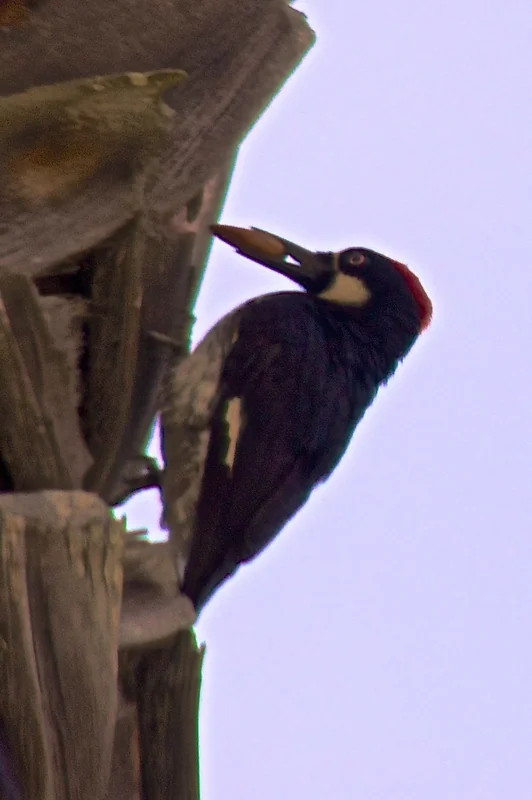
Melanerpes formicivorus, the acorn woodpecker, is a medium-sized woodpecker of the family Picidae, found in oak woodlands from western North America through Central America to Colombia. Adults are 21 to 23 cm long with a wingspan of 35 to 38 cm and weigh 65 to 90 g. The species is named for its extraordinary habit of drilling thousands of individual holes in a single tree — a granary — to store acorns for winter. The IUCN lists the species as Least Concern.
Quick facts
- Habitat
- Oak woodland, mixed oak-pine forest, and pinyon-juniper woodland from the Pacific coast of North America east to the Rocky Mountains and south through the mountains of Central America and Colombia. Requires areas with productive acorn-bearing oaks and large dead trees for granaries.
- Range
- Western North America from Oregon and California east to Colorado and south through Arizona and New Mexico; Mexico through Central America to Colombia and Ecuador. Year-round resident throughout its range.
- Size
- 21–23 cm body · 35–38 cm wingspan · 65–90 g
- Plumage
- Adults have a boldly patterned black, white, and red clown-like face — glossy black upper- and back, white rump, forehead, and facial mask, a brilliant red cap (smaller and more restricted in females), and a pale creamy-white eye. The underparts are white with black streaking on the breast. The wing shows large white patches in flight.
- Song
- A loud, nasal 'waka-waka-waka' or 'jacob-jacob-jacob' call — one of the most distinctive woodpecker calls in the western United States. Also produces a high-pitched 'weet-weet' alarm call.
- Migration
- Sedentary. The species is entirely resident year-round, maintaining a stable group territory centred on the granary tree.
- Conservation
- Least Concern (LC)
Overview
Melanerpes formicivorus is one of approximately 20 species in the genus Melanerpes — a diverse group of New World woodpeckers. The acorn woodpecker is among the most studied cooperative breeders in North America, with long-running population studies at Hastings Reservation in California documenting breeding behaviour for over 40 years. The species' dependence on acorns and oak trees makes it a key component of western oak woodland ecosystems, both as an acorn consumer and as a nest-cavity excavator that creates hollows used by dozens of other bird species.
Granary trees and acorn storage
Acorn woodpecker groups create and maintain granary trees — large dead trees, telephone poles, or wooden buildings — drilled with hundreds to thousands of individual holes, each precisely sized to hold one acorn. A single granary tree may hold 50,000 acorns. The group spends late summer and autumn drilling new holes and transferring stored acorns to tighter-fitting holes as they dry and shrink — a labour-intensive maintenance task that occupies much of the group's activity. Granary trees are a critical winter food cache and are defended year-round against corvids and other acorn thieves by the whole group.
Cooperative breeding and group living
Acorn woodpecker groups consist of 2–16 individuals — a breeding coalition of related males, one or more breeding females, and non-breeding helpers (offspring from previous years). Multiple males may mate with multiple females in a single group. All adults in the group share incubation, brooding, and chick-feeding duties, and all defend the granary. This highly cooperative system allows the group to maintain and defend the granary effectively against thieves and to raise more young per breeding attempt than a lone pair could. The cooperative system is maintained by the indivisibility of the granary resource.
Sources & further reading (2)
- iucn-red-list — accessed 2026-05-07
- encyclopedia — accessed 2026-05-07
Frequently asked questions
Why do acorn woodpeckers store acorns in holes?
Acorns are a rich winter food source but are only available for a brief period in autumn. Acorn woodpeckers avoid starvation by storing thousands of acorns in a granary tree during the autumn harvest. Each acorn is placed in a precisely drilled hole — too tight for the acorn to fall out, too small for a corvid bill to extract it easily. As acorns dry and shrink over winter, the birds move them to tighter holes to prevent loss. A large, well-maintained granary represents months of accumulated labour and is a critical group survival asset.
What are the 'waka-waka' calls for?
The loud nasal 'waka-waka-waka' calls are used for territorial advertisement, group communication, and alarm. The species is highly vocal — group members call frequently while foraging and near the granary. The calls carry well in open oak woodland and allow group members scattered across the territory to coordinate. When the granary is threatened by a jay, crow, or rival woodpecker group, the calls escalate rapidly into a loud group alarm response.
Do other animals use the granary holes?
Yes — acorn woodpecker granary holes are occasionally raided by Lewis's woodpeckers, Steller's jays, American crows, and western scrub-jays. The acorn woodpecker group defends the granary actively against these thieves. The abandoned nest cavities that acorn woodpeckers excavate in live trees are important secondary cavities for dozens of other bird species — including western screech-owls, wood ducks, and violet-green swallows.