Hylocichla mustelina
Wood Thrush (Hylocichla mustelina)
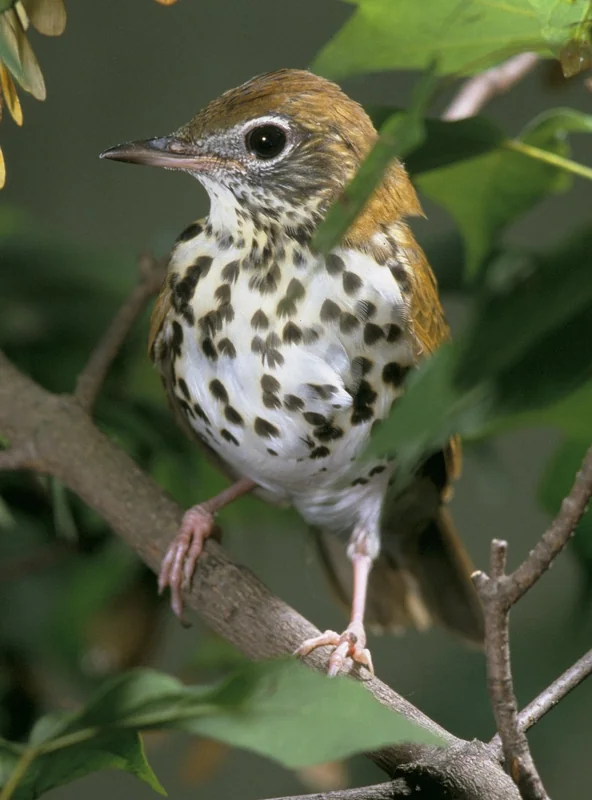 Featured photowood-thrush.jpg
Hylocichla mustelina, the wood thrush, is a medium-sized thrush of the family Turdidae, distributed across the eastern half of North America. Adults are 19 to 21 cm long with a wingspan of 30 to 40 cm and weigh 40 to 50 g. The plumage is warm brown above with bold round black spots on a white breast. The IUCN lists the species as Least Concern, although populations have declined modestly over recent decades. The wood thrush's clear flute-like song is widely considered one of the most beautiful bird songs in North America.
Quick facts
- Habitat
- Mature deciduous and mixed forest with abundant understory vegetation. The species requires intact mature forest with dense undergrowth and is sensitive to forest fragmentation.
- Range
- Breeds across the eastern half of North America from southern Canada south to the Gulf Coast and west to the Great Plains. Winters in Central America from southern Mexico to Panama.
- Size
- 19–21 cm body · 30–40 cm wingspan · 40–50 g
- Plumage
- Adults show warm rufous-brown upperparts (brightest on the head and crown), a clean white breast and belly with bold round black spots covering the entire underbody, a thin white eye-ring, and a pale streaked face. Both sexes look alike. The species' bold spotting separates it from the related but unrelated wood-warblers and is the most reliable field mark.
- Song
- A clear, flute-like 'ee-oh-lay' phrase with paired-note harmonics — the bird produces two notes simultaneously through the dual sides of its syrinx. The song is among the most-praised bird vocalizations in North America and was a particular favourite of Henry David Thoreau.
- Migration
- Long-distance Neotropical migrant. Breeds across the eastern United States and southern Canada; winters in Central America from southern Mexico to Panama. The migration is one of the longer thrush movements in North America.
- Conservation
- Least Concern (LC)
Overview
Hylocichla mustelina is the only species in the genus Hylocichla — the genus was split out of Catharus in molecular phylogenies of the late twentieth century. The species' Latin epithet 'mustelina' means 'weasel-like' or 'of weasels', a reference to the bird's warm brown colouration similar to a weasel's pelt. Henry David Thoreau wrote frequently of the wood thrush's song in his journals, calling it the most beautiful bird voice he knew.
Distribution
The breeding range covers the eastern half of North America. The species requires mature forest with dense understory and is sensitive to forest fragmentation — wood thrush populations have declined by over 50 per cent across most of their breeding range since the 1970s. Drivers include fragmentation of breeding-range mature forest, loss of Central American wintering habitat, and acid-rain-driven calcium depletion in northeastern soils that affects egg-shell formation.
Two-voiced song
The wood thrush's song is produced through both sides of the syrinx (the bird's vocal organ) simultaneously, creating a paired-harmony effect that no single-throated singer can produce. Each side of the syrinx contributes an independent note, and the two combine into the characteristic flute-like 'ee-oh-lay' phrase. The two-voiced singing is shared with several other Turdidae thrushes but is most pronounced in the wood thrush.
Sources & further reading (2)
- iucn-red-list — accessed 2026-04-30
- encyclopedia — accessed 2026-04-30
Frequently asked questions
How can a wood thrush sing two notes at once?
The wood thrush's syrinx (the bird's vocal organ, located at the bottom of the trachea) has two independently controllable sides. The bird produces one note on each side simultaneously, creating a paired-harmony 'ee-oh-lay' phrase that no single-throated singer can replicate. The two-voiced singing is shared with several other Turdidae thrushes but is most pronounced in the wood thrush and is part of why the song is so widely praised.
Why are wood thrush populations declining?
Wood thrush populations have declined by over 50 per cent across most of their breeding range since the 1970s. Drivers include fragmentation of mature deciduous forest on the breeding range (cowbird parasitism increases at fragment edges), loss of Central American wintering habitat to deforestation, and possibly acid-rain-driven calcium depletion in northeastern forest soils that affects egg-shell formation. The species is one of several Neotropical migrants showing pronounced long-term decline.
Why does Thoreau mention the wood thrush so often?
Henry David Thoreau wrote frequently of the wood thrush in his Walden Pond journals. He called the species' song the most beautiful bird voice he knew and used it as a recurrent symbol of the eastern American forest soundscape he loved. The flute-like quality of the song carries far through still woodland air, and is among the most-praised North American bird vocalizations from the nineteenth century onward.