Cinclus mexicanus
American Dipper (Cinclus mexicanus)
 Featured photoamerican-dipper.jpg
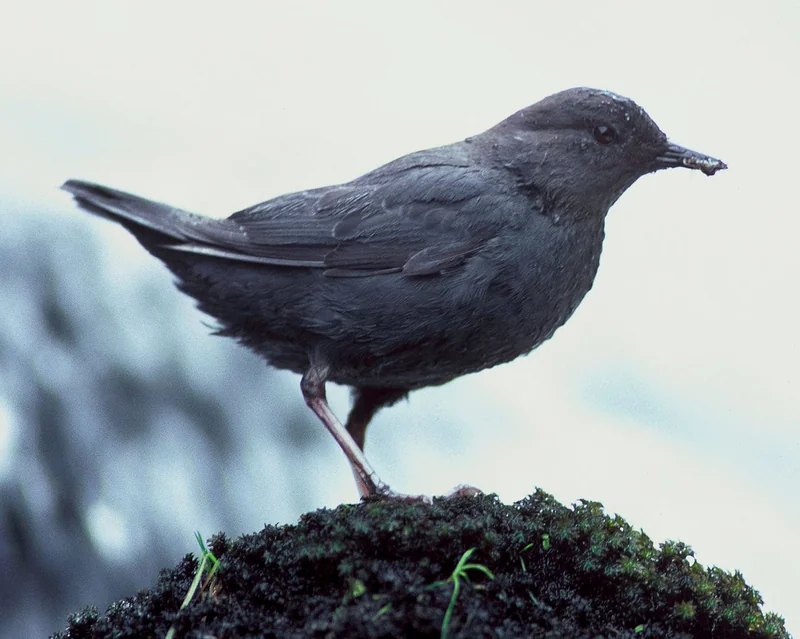
Cinclus mexicanus, the American dipper, is a small songbird of the family Cinclidae, distributed across western North American mountain streams. Adults are 14 to 22 cm long with a wingspan of 23 cm and weigh 46 to 63 g. The plumage is uniformly slate-grey throughout. The IUCN lists the species as Least Concern. American dippers are the only North American songbirds that habitually swim and dive in flowing water, walking on the streambed in search of aquatic insect larvae.
Quick facts
- Habitat
- Fast-flowing mountain streams and rivers across western North America. The species requires clear, clean, fast water with abundant aquatic insect larvae and rocky banks for nesting.
- Range
- Western North America from Alaska south through the Rocky Mountains, Sierra Nevada, and Cascade Range to central Mexico. The species' range is restricted to mountain streams; lowland populations are absent.
- Size
- 14–22 cm body · 23 cm wingspan · 46–63 g
- Plumage
- Adults are uniformly slate-grey throughout the body, head, and wings — paler underparts and slightly darker upperparts. The white eyelid is conspicuous when the bird blinks, particularly during nictating-membrane activity underwater. Both sexes look alike. Juveniles are paler grey-and-white below.
- Song
- A varied bubbling melodic warble delivered from a perch over the stream — surprisingly loud and complex for such a small bird. The song carries above the rushing water and is one of the most distinctive mountain-stream sounds in western North America.
- Migration
- Largely sedentary on the breeding range. Some altitudinal movements between high-elevation summer sites and lower-elevation winter sites occur but no long-distance migration.
- Conservation
- Least Concern (LC)
Overview
Cinclus mexicanus is one of five Cinclus dipper species worldwide and the only New World dipper. The family Cinclidae is one of the most ecologically distinctive small bird families — all five species are obligate fast-stream specialists that feed underwater, an unusual ecological niche for a songbird. The species' Latin epithet 'mexicanus' reflects the original type specimen having been collected in central Mexico.
Underwater foraging
American dippers walk on the bottom of fast-flowing mountain streams, foraging for aquatic insect larvae among rocks and gravel. The bird grips the streambed with strong feet and uses its short wings to maintain position against the current. Foraging dives typically last 5-15 seconds and may cover 5-10 metres along the streambed. The species' eyes have a transparent nictating membrane that allows underwater vision while protecting the cornea from grit, and the nostrils have flap valves that close while submerged.
Behaviour
American dippers are highly territorial and hold long linear territories along stretches of mountain stream — typically 200-500 metres of stream per pair. The species perches characteristically on streamside rocks and frequently bobs the body up and down — the source of the family's English name 'dipper'. The bobbing behaviour is shared by all five Cinclus species and may serve a visual signalling function in the constantly moving stream environment.
Sources & further reading (2)
- iucn-red-list — accessed 2026-04-30
- encyclopedia — accessed 2026-04-30
Frequently asked questions
Can a small songbird really walk underwater?
Yes — and the American dipper is the only North American songbird that does so habitually. The bird grips the streambed with strong feet and uses short wings to maintain position against the current. Foraging dives typically last 5-15 seconds and may cover 5-10 metres along the streambed, with the bird gleaning aquatic insect larvae from gravel and rocks. Specialized adaptations (transparent nictating eye membrane, closing nostril flaps, dense waterproof plumage) support the underwater foraging.
Why does the dipper bob up and down?
American dippers — like all five Cinclus species — perch on streamside rocks and frequently bob the body up and down (the source of the family's English name). The behaviour is consistent and rhythmic, performed by both sexes year-round. The functional explanation is debated; possibilities include a visual signal that stays detectable in the constantly moving stream environment, a way to spot prey in fast water, or a postural side-effect of stream-foraging anatomy. The behaviour is one of the most distinctive field marks of the family.
Why is the species restricted to mountain streams?
American dippers depend on clear, clean, fast-flowing water with abundant aquatic insect larvae. Lowland streams are typically slower, warmer, and more turbid, with less abundant insect prey of the type the species requires. Mountain streams across western North America provide the cold, oxygen-rich, fast-flowing conditions that sustain the mayfly, caddisfly, and stonefly larvae that dominate the dipper's diet. Pollution and stream regulation that reduce water quality have been documented to extirpate local dipper populations.