Aix sponsa
Wood Duck (Aix sponsa)
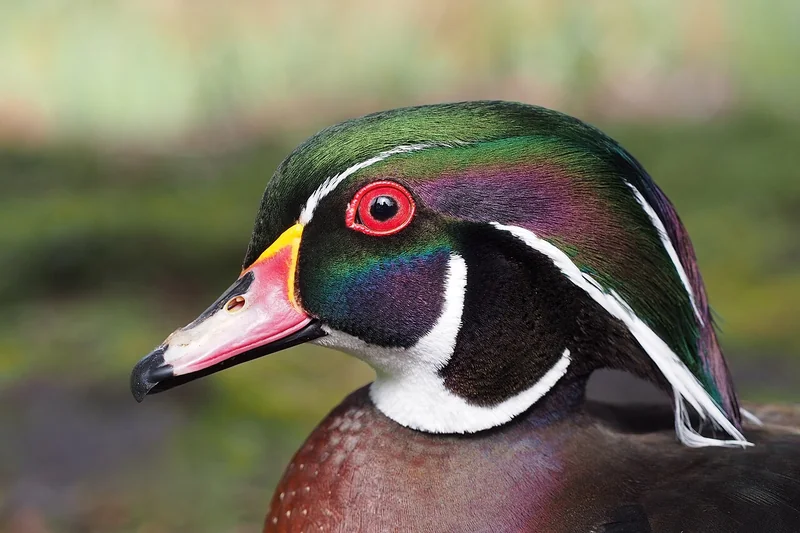 Featured photowood-duck.jpg
Aix sponsa, the wood duck, is a medium-sized perching duck of the family Anatidae. Adults are 47 to 54 cm long with a wingspan of 66 to 73 cm and weigh 454 to 862 g. Adult males in breeding plumage are extraordinarily ornate — iridescent green-and-purple crested head with white facial markings, deep chestnut breast, buff flanks finely barred black, and a dark back. Females are subtler grey-brown with a white teardrop eye-patch and a soft crest. The IUCN lists the species as Least Concern. The wood duck recovered strongly from late nineteenth-century near-extinction.
Quick facts
- Habitat
- Wooded swamps, beaver ponds, riparian forest, and wooded margins of lakes and rivers. The species is unusual among ducks in nesting in tree cavities, sometimes high above the ground.
- Range
- Eastern half of North America from southern Canada south through the United States to the Gulf Coast and into Mexico, plus a separate population in the Pacific Northwest. The eastern range covers most of the wooded United States; the western range is much smaller.
- Size
- 47–54 cm body · 66–73 cm wingspan · 454–862 g
- Plumage
- Adult males in breeding plumage show an iridescent green-and-purple head with a sweeping crest, bold white chinstrap and facial striping, deep chestnut breast spotted with white, and intricately patterned buff-and-black flanks above a dark back. Adult females are softer grey-brown with a striking white teardrop eye-patch, a paler buff breast streaked dark, and a small soft crest.
- Song
- Females give a high-pitched rising 'oo-eek!' alarm call that carries far in flooded forest. Males have a soft thin upslurred whistle. The species is generally quieter than most dabbling ducks.
- Migration
- Partial migrant. Most northern populations move south for winter to the southern United States and Mexico; populations in the southeastern US are largely resident.
- Conservation
- Least Concern (LC)
Overview
Aix sponsa is one of two Aix perching ducks (with the East Asian mandarin duck A. galericulata). The two are sister species and share the perching-duck habit of nesting in tree cavities, with the females and ducklings showing strong arboreal behaviour absent in most other Anatidae. The wood duck is widely regarded as the most ornately plumaged duck of the Americas.
Conservation history
Wood ducks were nearly extirpated from the eastern United States by the late nineteenth century — a combination of unregulated hunting, drainage of bottomland forests, and loss of cavity-bearing dead trees. The 1918 Migratory Bird Treaty Act protected the species; nest-box programmes from the 1930s onward provided artificial cavities; and bottomland reforestation completed the recovery. The species' current population is among the most abundant ducks in North America.
Cavity nesting
Wood ducks nest in tree cavities, often in standing dead trees in or near flooded forest. The female lays a clutch of nine to fifteen eggs and the precocial ducklings leave the nest within 24 hours of hatching — they jump from the cavity entrance, sometimes from heights of ten metres or more, and bounce on landing without injury. The dramatic 'duckling jump' is one of the textbook examples of post-hatching dispersal in birds.
Sources & further reading (2)
- iucn-red-list — accessed 2026-04-29
- encyclopedia — accessed 2026-04-29
Frequently asked questions
Why is the male wood duck so colourful?
The male wood duck's elaborate breeding plumage is a sexually selected ornament. Males display the plumage during the autumn pair-formation period (most ducks pair in autumn rather than spring) and females consistently choose mates with the most intact and saturated plumage. The trait correlates with male condition — moulting and maintaining the plumage is energetically expensive — making it a viability-indicator ornament.
Do wood duck ducklings really jump from tree cavities?
Yes — within 24 hours of hatching, wood duck ducklings climb to the cavity entrance and jump out one at a time at the female's call from below. Jump heights of three to ten metres are typical, and heights up to fifteen metres are documented. The ducklings are extremely light, fluffy, and bounce on landing without injury. The behaviour is shared with the closely related mandarin duck and a few other Aix-relatives.
How did wood ducks recover from near-extinction?
Wood ducks were on the verge of extirpation from the eastern United States by 1900. Three interventions drove the recovery: the 1918 Migratory Bird Treaty Act ended unregulated market hunting; widespread nest-box programmes from the 1930s onward provided artificial cavities to compensate for the loss of dead-tree nesting sites; and bottomland reforestation restored breeding habitat. The species is now among the most abundant ducks in North America.