Rhipidura leucophrys
Willie Wagtail (Rhipidura leucophrys)
 Featured photowillie-wagtail.jpg
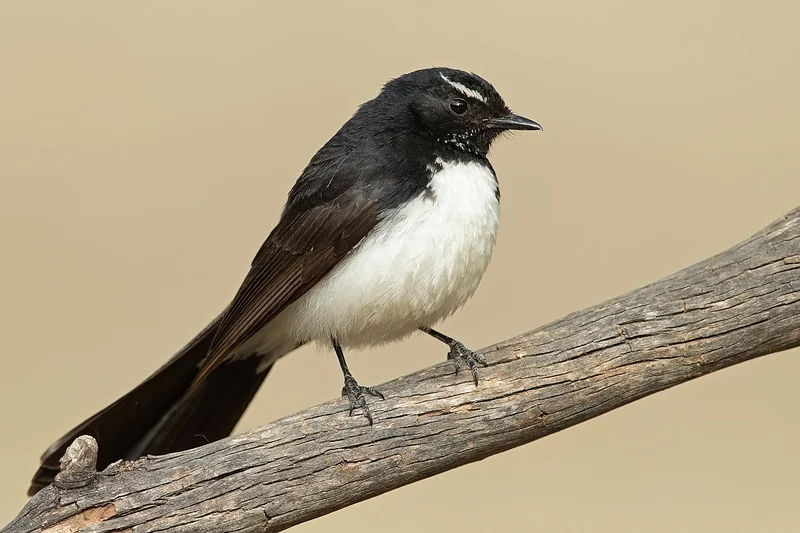
Rhipidura leucophrys, the willie wagtail, is a medium-sized passerine of the family Rhipiduridae and Australia's largest fantail. Adults are 19 to 21 cm long with a wingspan of 19 to 21 cm and weigh 17 to 24 g. The plumage is sharply black above and white below with a white eyebrow. The species is one of the most widespread and familiar Australian birds, notable for its bold aggression toward much larger animals and for its broad fanned tail that swings side to side as the bird forages. The IUCN lists the species as Least Concern.
Quick facts
- Habitat
- Open woodland, savanna, farmland, riparian scrub, suburban parks, and gardens across Australia, Papua New Guinea, and eastern Indonesia. Avoids dense closed forest. One of the most habitat-generalist Australian passerines.
- Range
- Widespread in Australia (absent only from the driest central deserts and the densest rainforest of northern Queensland), Papua New Guinea, the Solomon Islands, and eastern Indonesia including the Moluccas.
- Size
- 19–21 cm body · 19–21 cm wingspan · 17–24 g
- Plumage
- Entirely black on the upperparts, wings, throat, and upper breast; white below with a bold white eyebrow stripe and white whisker marks. The long, broad tail is black with white tips and is constantly fanned and swung side to side during foraging. Sexes are identical.
- Song
- A sweet, melodic 'sweet-pretty-creature' or 'pretty-little-creature' — one of Australia's most recognisable bird songs, delivered persistently even at night. Also produces a harsh scolding chatter when mobbing intruders.
- Migration
- Sedentary to locally nomadic. Most populations are resident. Some seasonal movement in the interior of Australia tracks rainfall and insect availability.
- Conservation
- Least Concern (LC)
Overview
Rhipidura leucophrys is the largest of the approximately 50 fantail species in the family Rhipiduridae, a family centred in the Australasian region. Despite the name 'wagtail', the willie wagtail is not related to the true wagtails of the family Motacillidae — the English name was applied by early European settlers in Australia who noted the side-to-side tail movement. The genus name Rhipidura means 'fan-tail' in Greek, and the species is one of the most studied Australasian songbirds because of its familiarity and bold behaviour in human-modified landscapes.
Fearless aggression
Willie wagtails are famous in Australia for their willingness to mob and attack birds and animals many times their size — wedge-tailed eagles, kookaburras, cats, dogs, and even horses that approach too close to the nest. The attacks are sustained and persistent, with the small bird diving at the intruder repeatedly and clinging briefly to fur or feathers before retreating. This aggression is most intense during the breeding season but is maintained year-round as territorial defence. In Aboriginal culture of some regions, the willie wagtail is associated with gossiping or revealing secrets — a bird to be wary of around the campfire.
Fan tail function and foraging
The broad, continuously fanned and side-swept tail is central to the species' foraging strategy. As the bird runs across the ground or through low vegetation, the sweeping tail flushes small invertebrates — insects and spiders — from cover, which the bird immediately pursues and captures. The white tail-tip pattern may also act as a visual lure, attracting the attention of small invertebrates. The tail-fanning behaviour is maintained even at high speed and distinguishes the species from all other Australasian birds it shares habitat with.
Sources & further reading (2)
- iucn-red-list — accessed 2026-05-07
- encyclopedia — accessed 2026-05-07
Frequently asked questions
Is the willie wagtail related to wagtails?
No. Despite the English name, the willie wagtail belongs to the family Rhipiduridae (fantails) — a family endemic to Australasia — and is not related to the true wagtails (family Motacillidae) of Europe and Asia. The name was applied by early European settlers who noted the tail-swinging behaviour. The two families are separated by tens of millions of years of evolutionary divergence.
Why is the willie wagtail so bold toward much larger animals?
The species' aggression toward large animals (including wedge-tailed eagles, horses, and humans) near the nest is a high-intensity territorial defence behaviour. For a small bird, even a very large animal is a potential nest predator or trampling hazard, and sustained mobbing effectively displaces most threats through persistence and harassment. The birds have been documented maintaining attacks for over 30 minutes until a large animal moves on. Outside the breeding season the species is still territorial but less aggressively so.
What does the willie wagtail's song sound like?
The song is a sweet, melodic phrase often transcribed as 'sweet-pretty-creature' or 'pretty-little-creature', repeated persistently — sometimes for minutes at a time and occasionally at night, earning the bird an alternative name of 'nightbird' in some regions. The song is one of the most recognisable in Australia. The alarm call is a harsh, scolding chatter delivered when mobbing predators.