Meleagris gallopavo
Wild Turkey (Meleagris gallopavo)
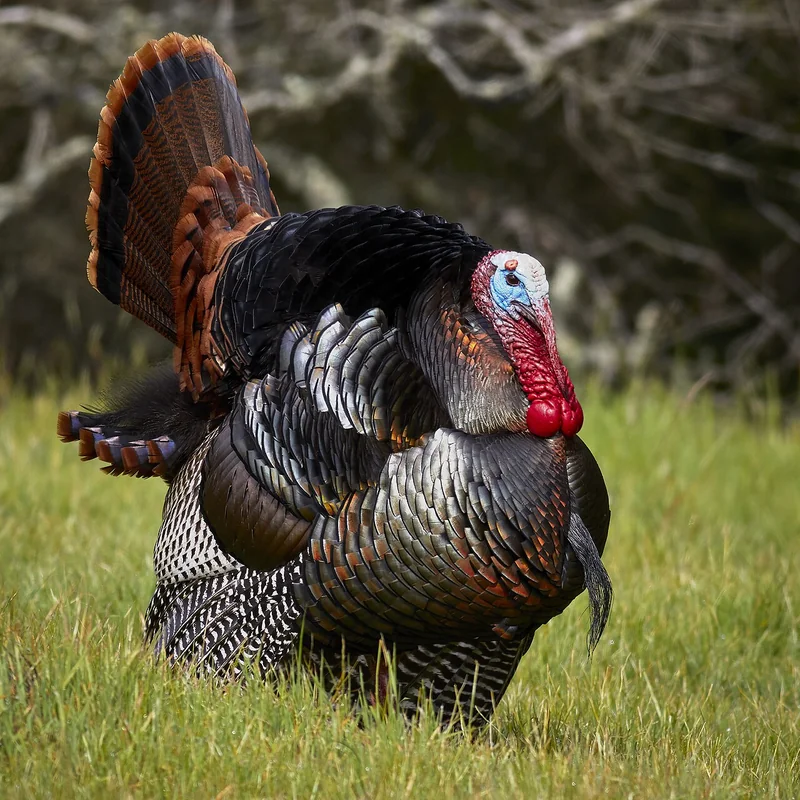 Featured photowild-turkey.jpg
Meleagris gallopavo, the wild turkey, is a large gamebird of the family Phasianidae, native to North America. Adults are 76 to 125 cm long with a wingspan of 1.25 to 1.44 m and weigh 2.5 to 11 kg, with males substantially larger than females. The plumage is dark with strong iridescent bronze, copper, and green sheen; the head is bare and red-skinned in males. The IUCN lists the species as Least Concern. Wild turkeys recovered from near-extirpation in the early twentieth century to current populations exceeding seven million.
Quick facts
- Habitat
- Mature mixed and deciduous forest with adjacent open clearings — pasture edges, agricultural margins, and second-growth woodland. The species roosts in large trees overnight and forages on the ground by day.
- Range
- Most of forested North America from southern Ontario and the eastern United States south to Mexico. Reintroduced and naturalized populations exist across most of the historical range plus parts of the western United States and Hawaii.
- Size
- 76–125 cm body · 125–144 cm wingspan · 2.5–11 kg
- Plumage
- Adult males are dark with strong iridescent bronze, copper, green, and red feather sheen; the bare head and neck show red, blue, and white skin patches that intensify in display. The chest carries a 'beard' of stiff bristle-like feathers. Adult females are duller, with less iridescence and a feathered head, and rarely carry a beard. Juveniles resemble females with paler plumage.
- Song
- Males give the famous 'gobble' — a rapid descending series of resonant notes carrying nearly a kilometre. The call is one of the most recognizable bird vocalizations in North America. Females give a softer 'yelp' or 'cluck'.
- Migration
- Resident year-round throughout the range; no regular migration. Local seasonal movements between summer breeding habitat and winter roost areas occur but are short-distance.
- Conservation
- Least Concern (LC)
Overview
Meleagris gallopavo is one of two Meleagris turkey species (with the ocellated turkey M. ocellata of Mesoamerica). The species is the wild ancestor of the domestic turkey — domesticated by indigenous peoples in southern Mexico approximately two thousand years ago. The species was Benjamin Franklin's preferred candidate for the United States national bird (over the bald eagle) on grounds of greater 'respectability' as a native American bird.
Conservation history
Wild turkey populations crashed across most of the United States by the early twentieth century — fewer than thirty thousand birds survived continent-wide by the 1930s, after centuries of unregulated hunting and habitat loss. Concerted reintroduction programmes from the 1950s onward, plus regulated hunting, have driven a remarkable recovery. The current US wild population exceeds seven million, larger than at any point in recorded history. The species is one of the great twentieth-century North American conservation success stories.
Display and breeding
Male wild turkeys (toms) display through the spring breeding season by fanning the tail vertically, dragging the wingtips on the ground, and erecting the head feathers; the bare head and neck skin colours intensify dramatically during display, shifting between red, white, and blue. The gobble call carries nearly a kilometre and serves both territory advertisement and female attraction. Multiple females typically gather around a dominant displaying male in a lek-like aggregation.
Sources & further reading (2)
- iucn-red-list — accessed 2026-04-30
- encyclopedia — accessed 2026-04-30
Frequently asked questions
Are wild turkeys really the ancestors of domestic turkeys?
Yes. The domestic turkey was domesticated by indigenous peoples in southern Mexico approximately two thousand years ago, from a southern subspecies of M. gallopavo. Spanish conquistadors brought domestic turkeys back to Europe in the early 1500s, where the species was widely adopted; the modern domestic turkey reached North American colonial agriculture from European stock, only later interbreeding with wild populations of the same species.
Did Benjamin Franklin really propose the turkey as the national bird?
The full story is more nuanced than the popular version. Franklin did write privately in 1784 expressing dissatisfaction with the bald eagle (which he called a bird of 'bad moral character') and suggesting the turkey would be a more 'respectable' choice — a 'true original Native of America'. The remark was in a letter to his daughter and was never a formal proposal. The eagle was already chosen by the Continental Congress in 1782.
How did wild turkey populations recover?
By the 1930s wild turkey populations had crashed to fewer than thirty thousand birds continent-wide. Recovery began with state-level reintroduction programmes in the 1950s, using birds trapped from remaining strongholds and translocated to vacant historical range. Combined with regulated hunting, habitat restoration, and the natural reforestation of much of the eastern US, the population has expanded to over seven million — larger than at any point in recorded history.