Motacilla alba
White Wagtail (Motacilla alba)
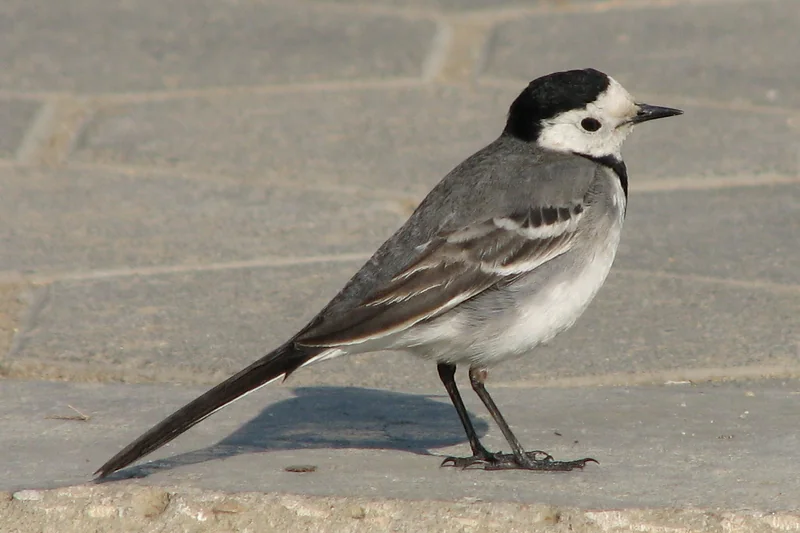 Featured photowhite-wagtail.jpg
Motacilla alba, the white wagtail, is a slender passerine of the family Motacillidae, the most widespread and abundant wagtail of the Palearctic. Adults are 17 to 19 cm long with a wingspan of 25 to 30 cm and weigh 17 to 25 g. The species is characterised by its crisp grey, white, and black plumage and the incessant vertical pumping of its long tail — behaviour that gives the wagtail family its English name. The IUCN lists the species as Least Concern.
Quick facts
- Habitat
- Open habitats near water — lake shores, river banks, wet grassland, farmland, wetland margins, and urban environments including car parks, rooftops, and sewage works. Strongly associated with human settlements across the Palearctic.
- Range
- Breeds across the entire Palearctic from Iceland and the British Isles east through Europe, Russia, central Asia, and the Far East to Japan and Alaska. Winters in sub-Saharan Africa, South and Southeast Asia, and southern Europe.
- Size
- 17–19 cm body · 25–30 cm wingspan · 17–25 g
- Plumage
- Adults show a long tail with white outer feathers, grey back, white underparts, and a black-and-white head pattern — the exact arrangement varies by subspecies. The nominate race has a grey back and white face. The British subspecies (yarrellii, pied wagtail) has a black back in breeding males. All forms share the long tail that pumps up and down constantly.
- Song
- A sharp, metallic 'chizzick' or 'tsli-vitt' flight call — one of the most familiar bird calls across European farmland and towns. The song is a pleasant twittering warble delivered from a prominent perch.
- Migration
- Migratory across most of the range. Northern and eastern populations winter in Africa and South Asia. British and southern European populations are partially migratory or sedentary. Migrates in small flocks and individually, often along coastlines.
- Conservation
- Least Concern (LC)
Overview
Motacilla alba is one of ten to twelve species in the genus Motacilla (depending on taxonomic authority) and is the most widespread member of the wagtail family Motacillidae. Up to twelve subspecies are recognised across the breeding range, differing primarily in head and back pattern. The British subspecies M. a. yarrellii (pied wagtail) was long treated as a distinct species by some authorities. The species' association with human settlement — farmyards, car parks, sewage works, urban rooftops — makes it one of the most familiar small birds across Europe and Asia.
Tail-wagging behaviour
The incessant up-and-down pumping of the tail is the most distinctive behavioural feature of white wagtails and wagtails generally. The adaptive function of this behaviour remains debated — proposed explanations include signalling to predators that the bird is vigilant (a form of pursuit-deterrent signalling), communication with conspecifics, or assistance with flushing insect prey. Studies of pied wagtails suggest the tail-wagging rate increases in the presence of predators, which supports the predator-signalling hypothesis.
Urban communal roosts
White wagtails form large communal roosts outside the breeding season — particularly in urban areas where artificial lighting, warmth from buildings, and shelter from wind make city centres attractive. Roosts of tens of thousands have been documented in Dublin, London, and various Asian cities. Individual birds commute several kilometres from daytime foraging areas to a communal roost. The roost site may change over a winter season, apparently tracking food availability in the surrounding area. The roosts are noisy and conspicuous, making white wagtails among the most observed urban birds in the Palearctic.
Sources & further reading (2)
- iucn-red-list — accessed 2026-05-07
- encyclopedia — accessed 2026-05-07
Frequently asked questions
Why do wagtails wag their tails?
The adaptive function of tail-wagging in wagtails is still debated. The leading hypothesis is that it signals to predators that the bird is vigilant — a pursuit-deterrent signal equivalent to the 'stotting' of gazelles. Studies show that tail-wagging rates increase when predators are detected nearby. A secondary hypothesis is that it functions as a social signal to other wagtails. Some researchers also propose it helps flush insect prey from the ground.
What is the difference between a white wagtail and a pied wagtail?
Pied wagtail is the name for the British and Irish subspecies (Motacilla alba yarrellii), which has a black back in breeding males compared with the grey back of the continental white wagtail (nominate M. a. alba). Both are subspecies of the same species M. alba. On migration and in winter, the two subspecies occasionally mix in Britain, allowing direct comparison of the back colour difference.
Where do white wagtails migrate to in winter?
Northern and eastern Palearctic populations (Scandinavia, Russia, central Asia) winter in sub-Saharan Africa and South and Southeast Asia. Populations from western Europe — France, Britain, Ireland, Iberia — are partially migratory, with some individuals wintering locally and others moving south to the Mediterranean or northwest Africa. British pied wagtails show significant individual variation — some are sedentary, others move south to France and Iberia.