Zonotrichia albicollis
White-throated Sparrow (Zonotrichia albicollis)
 Featured photowhite-throated-sparrow.jpg
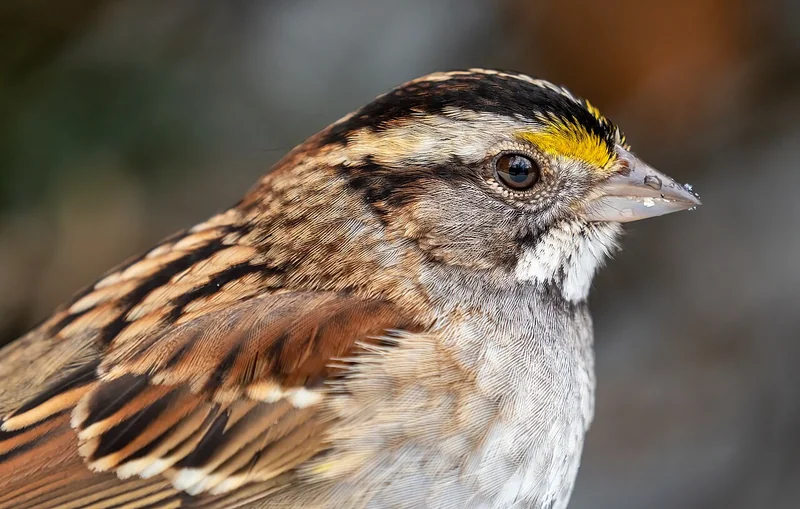
Zonotrichia albicollis, the white-throated sparrow, is a medium-sized New World sparrow of the family Passerellidae. Adults are 16 to 19 cm long with a wingspan of 23 cm and weigh 22 to 32 g. The plumage shows a sharp white throat patch, black-and-white striped or tan-and-brown striped crown, and yellow lores. The species occurs in two genetically distinct colour morphs that pair almost exclusively across morphs — a textbook example of disassortative mating. The IUCN lists the species as Least Concern.
Quick facts
- Habitat
- Boreal forest edges, second-growth woodland, brushy clearings, and during migration any thick hedgerow or garden cover.
- Range
- Breeds across the boreal forest of Canada and the northeastern United States. Winters across the eastern and central United States south to the Gulf Coast and into northern Mexico. The species is a familiar autumn migrant in eastern North America.
- Size
- 16–19 cm body · 23 cm wingspan · 22–32 g
- Plumage
- Adults show a sharply defined white throat patch, yellow lores between the eye and bill, and bold supercilia; the crown stripes are either bright black-and-white or tan-and-brown depending on the genetic morph. Both morphs occur in both sexes. Underparts are pale grey with light streaking on the flanks; back streaking is rich brown-and-black.
- Song
- A clear, plaintive whistled phrase often transcribed as 'O sweet Canada Canada Canada' or 'Old Sam Peabody Peabody Peabody'. The song is among the most familiar boreal-forest voices to North American listeners.
- Migration
- Long-distance migrant within North America. Breeds across the boreal zone; winters from the southern United States south to northern Mexico.
- Conservation
- Least Concern (LC)
Overview
Zonotrichia albicollis is one of five Zonotrichia sparrows in North America. The species is unusual among songbirds in having two genetically distinct colour morphs — a 'white-striped' form with bright black-and-white crown stripes and a 'tan-striped' form with softer brown-and-tan crown stripes. The morph difference is determined by a chromosomal inversion on chromosome 2 and is essentially unrelated to age, season, or sex.
Disassortative mating
The two crown morphs of the white-throated sparrow pair almost exclusively across morphs: white-striped birds mate with tan-striped birds far more often than expected by chance. This 'disassortative mating' is one of the canonical avian examples of a polymorphism maintained by behavioural mate choice rather than purely by selection on individual fitness. The behaviour appears stable across decades of monitoring.
Behaviour
White-striped birds (both sexes) are more aggressive in territory defence and song than tan-striped birds; tan-striped birds invest more in parental care. The combinations cross-pair predictably: white-striped males with tan-striped females, white-striped females with tan-striped males. Each pair therefore tends to combine one aggressive territory-holder and one attentive parent — a sex-and-morph-specific division of labour.
Sources & further reading (2)
- iucn-red-list — accessed 2026-04-29
- encyclopedia — accessed 2026-04-29
Frequently asked questions
Why do white-throated sparrows have two morphs?
The two crown morphs (white-striped and tan-striped) are determined by a large chromosomal inversion on chromosome 2 that has been stable for several million years. Disassortative mating — the pronounced tendency for white-striped and tan-striped birds to pair across morphs — maintains both genetic variants in the population at near-equal frequencies. The polymorphism is one of the textbook examples of a behaviourally maintained chromosomal inversion in vertebrates.
Are the two morphs different sexes?
No — both crown morphs occur in both sexes. The morph is determined by chromosome 2 inversion genotype, independent of the sex chromosomes. White-striped and tan-striped birds are essentially equally common, and the disassortative pairing pattern (white with tan) means each population maintains both morphs in roughly equal proportions across decades.
Why does the song sound like 'O sweet Canada'?
Folk renderings of the song vary by listener and country: 'O sweet Canada Canada Canada' in Canada, 'Old Sam Peabody Peabody Peabody' in the eastern United States. The actual song is a clear whistled phrase of two introductory notes followed by three repeating triplets — a distinctive shape that human listeners reach for memorable lyrics to remember. The song's pitch has been declining slightly across decades, the cause is debated.