Haliaeetus albicilla
White-tailed Eagle (Haliaeetus albicilla)
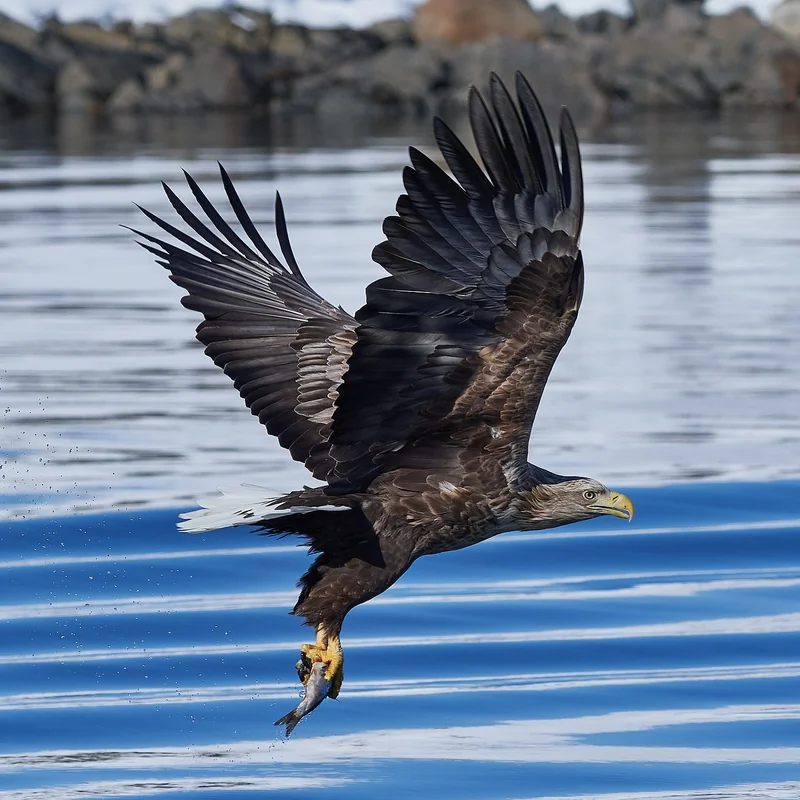 Featured photowhite-tailed-eagle.jpg
Haliaeetus albicilla, the white-tailed eagle, is the largest eagle in Europe and the fourth-largest eagle in the world by wingspan. Adults are 66 to 98 cm long with a wingspan of 178 to 245 cm — the largest wingspan of any European bird — and weigh 3.5 to 7.0 kg. The species is recognised by its massive pale yellow bill, pale brown body, and distinctive short wedge-shaped white tail. The IUCN lists the species as Least Concern following major population recoveries across Europe.
Quick facts
- Habitat
- Large rivers, lakes, estuaries, sea coasts, and wetlands with abundant fish and adjacent mature forest or crags for nesting. Requires undisturbed, large trees (or cliff ledges) for the massive stick nest. Tolerates human presence if undisturbed at nest sites.
- Range
- Holarctic: breeds from Greenland and Iceland through much of Europe, Russia, and Siberia to the Pacific coast and Japan. Winters south to the Middle East, South and East Asia. Reintroduced to Britain (Scotland 1975, England 2019) after extinction.
- Size
- 66–98 cm body · 178–245 cm wingspan · 3500–7000 g
- Plumage
- Adults are brown overall with a pale buff-brown head and neck, massive pale yellow bill, and a short, wedge-shaped pure white tail — the key field mark. Younger birds show a dark tail that gradually lightens; the pure white adult tail is not attained until 5–6 years of age. The wings are broad and rectangular (the 'flying barn door' shape compared to the slimmer silhouette of the golden eagle).
- Song
- A loud, far-carrying, yelping 'klee-klee-klee' call — given near the nest, in display flights, and during territorial interactions. More vocal than many large eagles.
- Migration
- Partially migratory. Populations at high latitudes (Greenland, northern Russia) move south in winter. Central European and British populations are largely sedentary or undertake only short movements.
- Conservation
- Least Concern (LC)
Overview
Haliaeetus albicilla is a member of the sea eagle genus Haliaeetus alongside the bald eagle (H. leucocephalus) and the African fish eagle (H. vocifer). The two species are very closely related — the white-tailed and bald eagles are sister species, having diverged relatively recently. The white-tailed eagle held the largest wingspan of any eagle in the world on old records, but modern measurements place the Philippine eagle marginally wider. The species is the national bird of Poland.
European extirpation and recovery
White-tailed eagles were extirpated from much of western Europe during the 18th–19th centuries by persecution (poisoning, trapping, shooting) and egg collection. The species was extinct in Britain by the early 20th century. Reintroduction began in Scotland in 1975 using Norwegian-sourced chicks, and the Scottish population grew to over 100 breeding pairs by the 2010s. A subsequent reintroduction to England (Isle of Wight, 2019) and Wales (2021) has established new populations. Across Europe, populations have recovered substantially from 20th-century lows due to legal protection, reduced persecution, and reintroduction programmes.
Nest architecture and site fidelity
White-tailed eagle nests are among the largest structures built by any bird. A nest (eyrie) is used year after year, with the pair adding material each season — nests can accumulate to over 1 m deep, 2 m wide, and weigh hundreds of kilograms. The largest nests eventually become so heavy that the supporting branch or tree cracks. Pairs show strong nest-site fidelity, returning to the same eyrie for decades if undisturbed. In Scotland, nest trees have been protected by legal designation and physical barriers since reintroduction.
Sources & further reading (2)
- iucn-red-list — accessed 2026-05-07
- encyclopedia — accessed 2026-05-07
Frequently asked questions
How is the white-tailed eagle different from the golden eagle?
The two species differ in several ways. The white-tailed eagle is larger (wider wingspan), has a much broader, more rectangular wing shape ('flying barn door'), has a massive pale yellow bill (the golden eagle has a smaller, darker bill), and — in adults — has the diagnostic white wedge-shaped tail. The golden eagle is darker overall with a golden-buff head in adults, a slimmer silhouette, and uses upland moorland and mountain habitats more than lakeside and coastal habitats favoured by the white-tailed eagle.
Why was the white-tailed eagle extinct in Britain?
White-tailed eagles were systematically killed in Britain during the 18th and 19th centuries by gamekeepers, sheep farmers, egg collectors, and taxidermists. The species was viewed as a threat to lambs, game birds, and fish, and was shot, trapped, and poisoned. The last confirmed breeding pair in Britain was in Shetland in 1916. Reintroduction from Norway began in 1975 in Scotland and has been progressively extended to England and Wales.
How does the white-tailed eagle catch fish?
The white-tailed eagle catches fish by flying low over the water surface and snatching a fish from just below the surface with its talons — a technique called 'plunge-snatching' or 'tailing'. Unlike the osprey, the eagle does not fully submerge. It typically targets slow-moving or surface-dwelling fish of 0.5–3 kg. The eagle also takes fish from other birds by kleptoparasitism — chasing ospreys, cormorants, and herons until they drop their catch.