Eudocimus albus
American White Ibis (Eudocimus albus)
 Featured photowhite-ibis.jpg
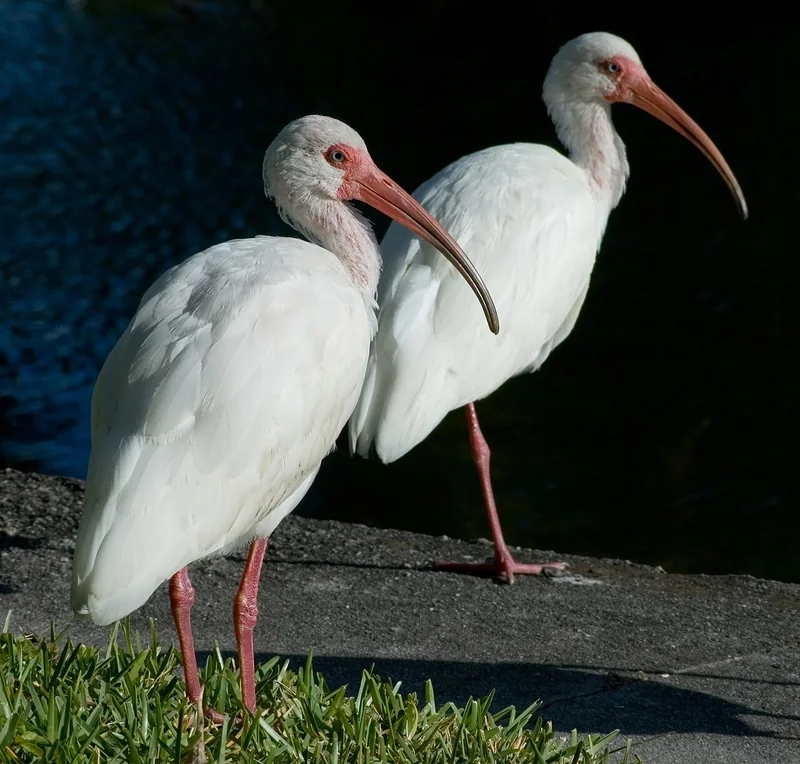
Eudocimus albus, the American white ibis, is a medium-sized ibis of the family Threskiornithidae, distributed across coastal habitats of the southeastern United States and the Caribbean basin. Adults are 53 to 70 cm long with a wingspan of 90 to 105 cm and weigh 750 to 1,050 g. The plumage is uniformly pure white with black wingtips visible in flight and a striking long downcurved red bill. The IUCN lists the species as Least Concern. The species is one of the most familiar wading birds across coastal Florida and the Gulf Coast.
Quick facts
- Habitat
- Coastal salt marshes, mangrove swamps, freshwater marshes, and shallow coastal lagoons across the southeastern United States and the Caribbean. The species also forages in suburban park ponds and golf-course water hazards.
- Range
- Coastal southeastern United States from Virginia south through Florida and west along the Gulf Coast to Texas, plus the Caribbean basin and northeastern Mexico south to coastal Venezuela.
- Size
- 53–70 cm body · 90–105 cm wingspan · 750–1050 g
- Plumage
- Adults are uniformly pure white throughout the body and head, with conspicuous black wingtips visible in flight, a striking long downcurved bright red bill, bright red bare facial skin, red legs, and pale blue-grey eyes. Both sexes look alike. Juveniles are mottled brown above with white belly; the white adult plumage develops over two to three years through staged moults.
- Song
- Adults give a low grunting 'urnk' or croaking sound, particularly at colonies and in flight. The species is mostly silent while foraging. Colony soundscapes during the breeding season include various low-pitched honks and grunts.
- Migration
- Partial migrant. Northern populations move south for winter to the Gulf Coast and Caribbean; central and southern populations are largely resident. Some long-distance movements occur but most birds remain in coastal habitats year-round.
- Conservation
- Least Concern (LC)
Overview
Eudocimus albus is one of two Eudocimus ibis species (with the closely related scarlet ibis E. ruber of South America). The two species are sister taxa and were historically considered a single species; modern taxonomy treats them as separate, but they hybridize freely where ranges overlap (parts of coastal Venezuela and Trinidad). The hybrid offspring show intermediate orange-pink plumage. The species is one of the most familiar wading birds across coastal Florida.
Distribution
The breeding range covers coastal southeastern United States, the Caribbean basin, and parts of coastal Mexico and northern South America. The species has expanded inland in Florida and Louisiana over recent decades, with breeding colonies now established at suburban park ponds and golf courses far from the coast. The shift reflects the species' adaptability to human-modified wetland habitats.
Bill probing
American white ibises forage by probing shallow water and mud with the long downcurved bill. The bill's tip is densely packed with mechanoreceptive nerve endings that detect movement of buried prey — fiddler crabs, aquatic insects, small fish, snakes — even when the bird cannot see them. The technique works in muddy or vegetation-choked habitats where visual hunting would fail and is shared with most other Threskiornithidae ibises and spoonbills.
Sources & further reading (2)
- iucn-red-list — accessed 2026-04-30
- encyclopedia — accessed 2026-04-30
Frequently asked questions
Are American white ibis and scarlet ibis the same species?
Currently treated as separate species (Eudocimus albus and E. ruber), but the two are sister taxa and hybridize freely where ranges overlap (parts of coastal Venezuela and Trinidad). Hybrid offspring show intermediate orange-pink plumage. The two were historically considered a single species, and some authorities continue to treat them as conspecific. The lumped vs. split taxonomic question is unresolved.
Why is the bill curved downward?
The long downcurved bill is the diagnostic Threskiornithidae shape and is specialized for probing shallow water and mud for buried prey. The bill's tip is densely packed with mechanoreceptive nerve endings that detect movement of fiddler crabs, aquatic insects, small fish, and other prey by touch — the technique works even when the bird cannot see the prey. The downward curve allows the bill to enter mud at an angle that exposes the maximum sensory surface to prey movement.
Are white ibises moving inland?
Yes — the species has expanded inland in Florida and Louisiana over recent decades. Breeding colonies are now established at suburban park ponds, golf-course water hazards, and small inland wetlands far from the coast. The shift reflects the species' adaptability to human-modified wetland habitats and the abundance of frog, crayfish, and insect prey in such settings. The University of Miami's mascot, the 'Sebastian the Ibis', is a white ibis — reflecting the species' Florida-cultural prominence.