Sitta carolinensis
White-breasted Nuthatch (Sitta carolinensis)
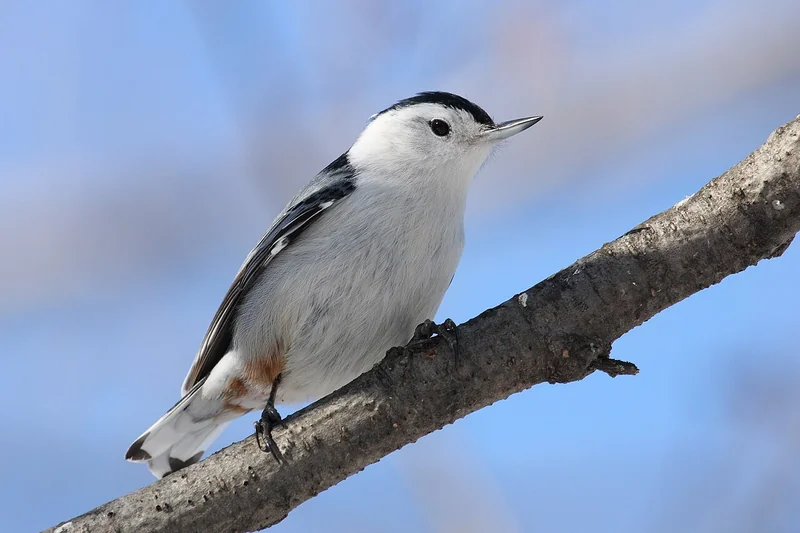 Featured photowhite-breasted-nuthatch.jpg
Sitta carolinensis, the white-breasted nuthatch, is a small Sittidae of forested North America. Adults are 13 to 14 cm long with a wingspan of 20 to 27 cm and weigh 18 to 30 g. The plumage is blue-grey above, white below, with a black crown and nape and a chestnut wash on the lower belly. The IUCN lists the species as Least Concern. The species' diagnostic head-down trunk-foraging gait — the textbook 'upside-down' nuthatch behaviour — is shared with the rest of the genus Sitta.
Quick facts
- Habitat
- Mature deciduous and mixed woodland; the species favours large trees with deeply furrowed bark. Backyard feeders are also routinely used.
- Range
- Across most of North America from southern Canada south through the United States to the highlands of central Mexico. The species shows substantial regional plumage and vocal variation, and several proposed splits into multiple species are under discussion.
- Size
- 13–14 cm body · 20–27 cm wingspan · 18–30 g
- Plumage
- Adults show blue-grey upperparts, a black cap and nape (extending further onto the back in males than in females), pure white face and underparts, and a chestnut to rusty wash on the lower belly and undertail. The bill is straight, sharply pointed, and slightly upturned — useful for prying insects from bark crevices.
- Song
- A nasal, low-pitched 'whi-whi-whi-whi' delivered in long even-pitched series. The call is a sharp 'yank' or 'yenk', often delivered repeatedly while moving along a trunk.
- Migration
- Resident year-round throughout the range; no regular migration. Local irruptive movements occur in some winters when seed crops fail.
- Conservation
- Least Concern (LC)
Overview
Sitta carolinensis is one of four Sitta nuthatches in North America (with red-breasted, pygmy, and brown-headed nuthatches). The genus Sitta is famous for its head-down trunk-foraging — nuthatches hold the trunk with their feet and walk down head-first, exploiting bark crevices that head-up trunk-foragers (woodpeckers, creepers) tend to skip. The species is one of the most familiar feeder-and-suet visitors across forested North America.
Distribution
The range covers most of forested North America. The species shows substantial regional vocal variation — eastern, interior western, and Pacific subspecies have distinct song types — and some authorities have proposed splitting these into separate species. The current taxonomy treats them as subspecies, but molecular and behavioural evidence may eventually support a split.
Caching
White-breasted nuthatches cache seeds and nuts in autumn, wedging individual items into bark crevices or behind loose bark slabs and recovering them through winter. The 'nuthatch' name comes from the bird's habit of wedging a nut into bark and 'hatching' (hammering) it open — the same behaviour produces one of the species' most familiar autumn-feeder behaviours, taking sunflower seeds away from a feeder one at a time to cache in nearby bark.
Sources & further reading (2)
- iucn-red-list — accessed 2026-04-29
- encyclopedia — accessed 2026-04-29
Frequently asked questions
Why do nuthatches walk down trees head-first?
Nuthatches forage head-down on tree trunks — the only North American songbird family that does so. The behaviour gives the genus Sitta access to bark-crevice prey that head-up climbers (woodpeckers, brown creepers) have already inspected from below. The 'view-angle' difference exposes different prey, and the behavioural niche partitioning lets several species share the same trunks without direct competition.
Why is it called a 'nuthatch'?
The name dates to Old English and means 'nut hacker'. White-breasted nuthatches wedge nuts and seeds into bark crevices and hammer them open with the bill — the same behaviour also produces autumn caching of sunflower seeds and acorns. The 'hatch' part of the name is unrelated to bird hatching; it comes from an archaic English verb meaning 'to chop'.
Are eastern and western white-breasted nuthatches the same species?
Currently treated as subspecies of Sitta carolinensis but the eastern, interior western, and Pacific populations have distinct songs and some genetic differentiation. Some authorities have proposed splitting them into two or three species. The split has not been adopted by the major North American taxonomic committees but remains an active area of taxonomic discussion.