Cinnyris venustus
Variable Sunbird (Cinnyris venustus)
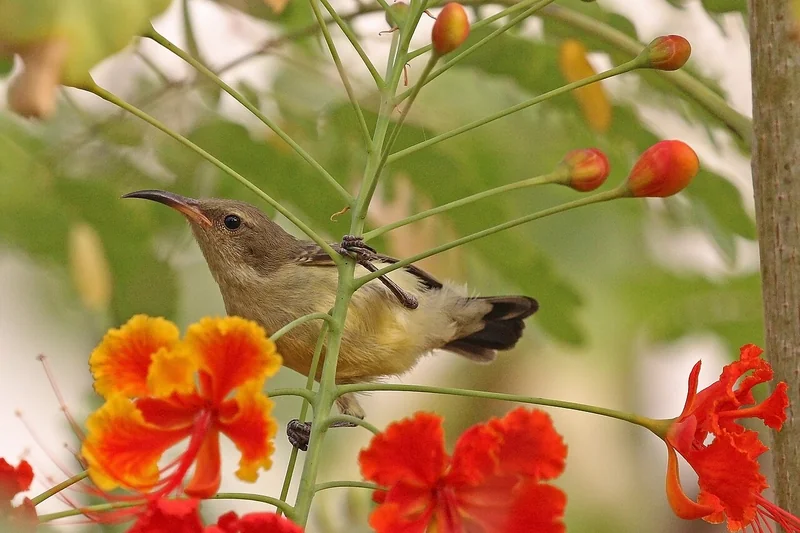 Featured photovariable-sunbird.jpg
Cinnyris venustus, the variable sunbird, is a small nectarivorous passerine of the family Nectariniidae, widespread across sub-Saharan Africa. Adult males are 10 to 11 cm long with a wingspan of 11 to 12 cm and weigh 6 to 9 g. Males display iridescent metallic green upperparts, a violet-purple breast band, and yellow underparts — a combination that appears to change colour dramatically with the angle of light. The IUCN lists the species as Least Concern.
Quick facts
- Habitat
- Woodland savanna, forest edges, bushland, gardens, parks, and cultivated areas with flowering trees and shrubs across sub-Saharan Africa. Particularly common in acacia woodland and suburban gardens with planted flowering species.
- Range
- Widespread in sub-Saharan Africa from Senegal and Cameroon east through the Sudan, Ethiopia, and Kenya south to Tanzania, Zambia, and the eastern coast of South Africa. One of the most abundant sunbirds of East Africa.
- Size
- 10–11 cm body · 11–12 cm wingspan · 6–9 g
- Plumage
- Males have brilliant iridescent metallic green upperparts, head, and throat that shift from green to gold to blue-purple in changing light, a narrow violet-purple breast band, and yellow (west Africa) or white (east Africa) underparts depending on the subspecies — the source of the common name 'variable'. Females are uniform olive-green above and pale yellowish below. The long, strongly decurved bill is characteristic.
- Song
- A rapid, high-pitched 'tswee-tswee' and a sweet, twittering warbling song delivered from a prominent flowering perch. Males call persistently to establish territories around nectar sources.
- Migration
- Sedentary to locally nomadic, following seasonal flowering of key plant species. No regular long-distance migration.
- Conservation
- Least Concern (LC)
Overview
Cinnyris venustus is one of approximately 30 species in the large sunbird genus Cinnyris, which occurs across Africa, the Middle East, South Asia, and Southeast Asia. Multiple subspecies of the variable sunbird are recognised, differing primarily in the underpart colour (yellow in West Africa, white in East Africa). The iridescent plumage reflects structural coloration — microstructure in the feather barbules produces the metallic sheen by thin-film interference, rather than by pigment. The colour therefore shifts dramatically depending on the angle of light and the viewer's position.
Nectarivory and plant relationships
Variable sunbirds are important pollinators of many African flowering plants, visiting flowers with short to medium tube lengths and picking up pollen on the bill and forehead. The species is a key pollinator of Leonotis leonurus (wild dagga), Aloe species, and various Erythrina trees across East Africa. Unlike bananaquits, variable sunbirds more frequently serve as legitimate pollinators than nectar-robbers on their common host plants — the bill length and curvature are more closely matched to floral tube length in the species' most common food plants.
Iridescent structural colour
The brilliant metallic green and violet-purple coloration of male variable sunbirds is produced by structural coloration — specifically thin-film interference in the layered barbule microstructure of the feathers — rather than by pigment. This is the same mechanism that produces the iridescence in hummingbirds, peacocks, and morpho butterflies. The perceived colour changes with the angle of observation and illumination, producing the 'variable' appearance that inspired the English name. Under direct sunlight the plumage can appear vivid emerald green, deep blue-violet, or even golden, depending on the viewing angle.
Sources & further reading (2)
- iucn-red-list — accessed 2026-05-07
- encyclopedia — accessed 2026-05-07
Frequently asked questions
Why is it called the 'variable' sunbird?
The name has two origins. First, the metallic plumage appears to change colour dramatically — from emerald green to violet to golden — depending on the angle of light and the viewer's position, because the colour is produced by structural iridescence rather than pigment. Second, different subspecies across Africa differ significantly in underpart colour (yellow in West Africa, white in East Africa), adding to the 'variable' pattern.
How does structural coloration differ from pigment coloration?
Pigment coloration absorbs certain wavelengths of light and reflects others — the perceived colour comes from the reflected wavelengths. Structural coloration produces colour by the physical interaction of light with microscale structures in the feather barbules — thin layers of different materials create thin-film interference, selectively reflecting or cancelling specific wavelengths. The perceived colour shifts with the angle of observation, producing the iridescence seen in sunbirds, hummingbirds, peacocks, and morpho butterflies.
Is the variable sunbird common in gardens?
Yes — the variable sunbird is one of the most frequently encountered small birds in East African suburban gardens wherever flowering plants are present. The species is attracted to planted aloes, bottlebrush, Leonotis, and other nectar-rich garden plants. It is a regular visitor to gardens in Nairobi, Dar es Salaam, Kampala, and many other East African cities. Its brilliant plumage and active behaviour make it a conspicuous garden bird even for non-birders.