Cygnus columbianus
Tundra Swan (Cygnus columbianus)
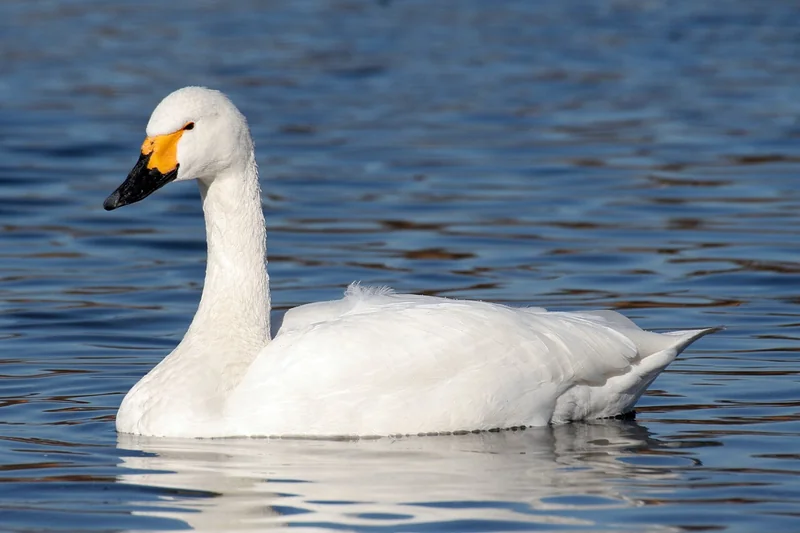 Featured phototundra-swan.jpg
Cygnus columbianus, the tundra swan, is a medium-large swan distributed across the Holarctic Arctic. Adults are 1.15 to 1.5 m long with a wingspan of 1.7 to 1.95 m and weigh 5 to 9 kg. The plumage is uniformly pure white with a black bill that typically carries a small yellow patch at the base. The IUCN lists the species as Least Concern. The species was historically split into two species — Bewick's swan (Eurasian) and whistling swan (North American) — but is now treated as a single species.
Quick facts
- Habitat
- Arctic tundra during the breeding season; large coastal estuaries, freshwater lakes, and agricultural fields during winter. The species depends on shallow open water with abundant submerged vegetation.
- Range
- Breeds across the high Arctic of North America (Alaska to Hudson Bay) and across the Eurasian Arctic (Russian tundra). Winters across the southern United States, northern Mexico, parts of Europe (the British Isles, the Netherlands, France, Italy), and East Asia (Japan, Korea, eastern China).
- Size
- 115–150 cm body · 170–195 cm wingspan · 5–9 kg
- Plumage
- Adults are uniformly pure white with a black bill that typically carries a small yellow patch at the base, between the bill and the eye. The yellow patch is more extensive on the Eurasian Bewick's subspecies and absent or very small on the North American whistling subspecies — useful field differentiation. Juveniles are pale grey-brown for their first year and slowly whiten over the second.
- Song
- A high-pitched whooping 'wow-wow-wow' or 'hoo-hoo' delivered both in flight and from the water. The voice is higher-pitched than the trumpeter swan and more bugling than the mute swan. Migrating flocks vocalize continuously; the calls carry kilometres across open habitat.
- Migration
- Long-distance migrant. Arctic breeders travel south to the southern United States, southern Europe, and East Asia for winter — annual round-trip migrations of 6,000-10,000 km are typical.
- Conservation
- Least Concern (LC)
Overview
Cygnus columbianus is one of three Cygnus swans regularly occurring in North America. The species is split into two subspecies: the Eurasian Bewick's swan and the North American whistling swan. The two were historically treated as separate species; molecular evidence supports the lumped treatment but the two retain distinct geographic ranges and slight plumage differences.
Distribution
The breeding range covers the high Arctic of both North America and Eurasia. Winter range extends across the southern United States and northern Mexico (whistling subspecies), parts of Europe and the British Isles (Bewick's subspecies), and East Asia (Japan, Korea, eastern China — Bewick's). The species' annual round-trip migrations of 6,000-10,000 km are among the longer waterfowl movements in the Holarctic.
Conservation
The IUCN globally lists tundra swan as Least Concern. The North American whistling subspecies has shown stable to increasing populations over recent decades. The Eurasian Bewick's subspecies has declined sharply in northwestern Europe over the last 20 years — drivers include illegal hunting along migration routes, lead-shot poisoning, and possibly climate-driven shifts in wintering habitat.
Sources & further reading (2)
- iucn-red-list — accessed 2026-04-30
- encyclopedia — accessed 2026-04-30
Frequently asked questions
What's the difference between tundra and trumpeter swan?
Trumpeter swans are larger (138-165 cm vs. 115-150 cm) with a heavier all-black bill that joins the eye in a continuous black wedge. Tundra swans show a small yellow patch at the bill base separating bill from eye in most individuals, plus a smaller overall size. The voice differs sharply — trumpeter calls are deep bugling 'oh-oh', tundra calls are higher-pitched whooping 'wow-wow-wow'.
Are Bewick's and whistling swans the same species?
Yes — molecular evidence supports treating them as two subspecies of Cygnus columbianus, the tundra swan. The Eurasian Bewick's subspecies breeds across Russian Arctic tundra and winters across northwestern Europe. The North American whistling subspecies breeds across the Alaskan and Canadian Arctic and winters in the southern United States. The two were historically treated as separate species but are now lumped on genetic and morphological grounds.
Why has the European Bewick's swan population declined?
The Eurasian Bewick's subspecies has declined sharply across northwestern European wintering grounds over the last 20 years. Drivers include illegal hunting along Russian and Baltic migration routes, lead-shot poisoning at wetland sites, and possibly climate-driven shifts in wintering habitat. The population is now the subject of intensive international monitoring and conservation action — including the long-running Slimbridge population study in the UK.