Baeolophus bicolor
Tufted Titmouse (Baeolophus bicolor)
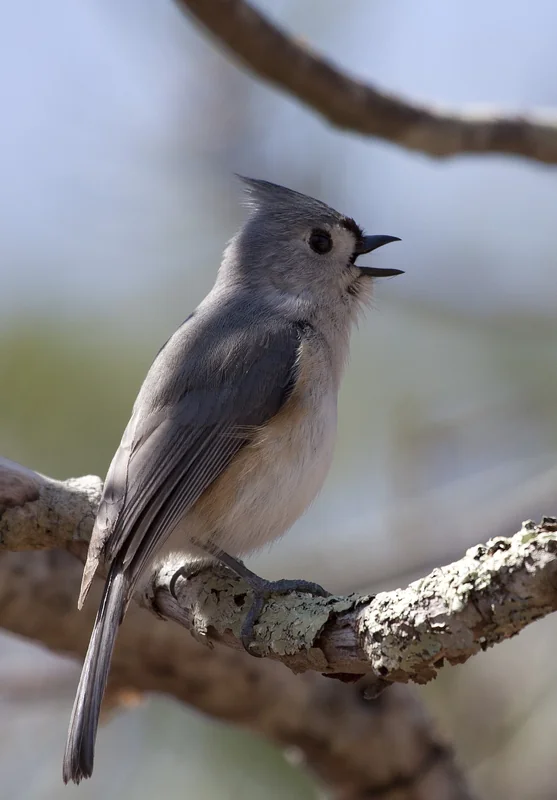 Featured phototufted-titmouse.jpg
Baeolophus bicolor, the tufted titmouse, is a small Paridae of the eastern half of the United States and southeastern Canada. Adults are 14 to 17 cm long with a wingspan of 23 to 28 cm and weigh 18 to 26 g. The plumage is grey above, white below, with a rusty wash on the flanks and a sharp pointed crest. The species is assessed as Least Concern by the IUCN Red List and has expanded its range steadily north over the last century.
Quick facts
- Habitat
- Mature deciduous and mixed woodland, wooded suburbs, and parks. Nests in natural cavities and old woodpecker holes; never excavates its own.
- Range
- Eastern half of the United States from southern Maine and Ontario west to eastern Texas and the Great Plains, south to the Gulf Coast and northeastern Mexico. The northward range edge has advanced steadily over the last century, aided by suburban tree planting and feeders.
- Size
- 14–17 cm body · 23–28 cm wingspan · 18–26 g
- Plumage
- Both sexes show a soft grey upperparts and crest, white face with a small black patch above the bill, white underparts, and a peach-rust wash along the flanks under the wings. The crest is a reliable field mark and is raised when the bird is alarmed.
- Song
- A loud, clear, whistled 'peter-peter-peter' delivered from a high perch through much of the year. The call is a buzzy scolding chatter.
- Migration
- Resident year-round throughout the range; no regular migration.
- Conservation
- Least Concern (LC)
Overview
Baeolophus bicolor is one of five Baeolophus titmice in North America. The genus was split out of Parus in the 1990s on molecular evidence; older field guides will list the species as Parus bicolor. The tufted titmouse is among the most familiar bird-feeder visitors across the eastern United States and is often the species voicing the dawn whistled peter-peter that heralds spring.
Distribution and behaviour
The range covers the entire eastern half of the United States and has expanded north into southern Canada over the last century, with the northward edge tracking warmer winters and suburban tree cover. Tufted titmice are non-migratory and form mixed-species winter foraging flocks with chickadees, nuthatches, and downy woodpeckers.
Nesting
Tufted titmice nest in natural cavities and abandoned woodpecker holes, lining the chamber with bark strips, leaves, moss, and animal hair — and sometimes pulling hair directly from live mammals (squirrels, dogs, even people) to add to the nest lining. The clutch is typically five to six pale white eggs with brown spots.
Sources & further reading (3)
- iucn-red-list — accessed 2026-04-29
- encyclopedia — accessed 2026-04-29
- ornithology-reference — accessed 2026-04-29
Frequently asked questions
Where does the tufted titmouse get its English name?
The 'tufted' refers to the pointed grey crest at the back of the head, raised conspicuously when the bird is alarmed or singing. 'Titmouse' is an Old English term, unrelated to mice — it comes from 'tit' (small bird) and the Old English 'mase' (also small bird). The two-word name is genuine pleonasm preserved by tradition.
Why does the species' range keep moving north?
The northern range edge has advanced steadily into southern Canada over the last century. Likely contributors are warmer winters reducing cold-induced mortality, the spread of suburban tree planting providing nest cavities, and the steady availability of bird feeders supplying winter food. Other formerly southern species (northern cardinal, Carolina wren) have shown similar northward shifts.
Do tufted titmice really pull hair from live animals for their nest?
Yes. Tufted titmice are well-documented removing hair directly from live squirrels, raccoons, opossums, dogs, and occasionally humans, in addition to gathering shed hair from the ground. The hair is used to line the nest cavity. Several other Paridae species show the same behaviour but it is most reliably observed in this species.