Megascops asio
Eastern Screech Owl (Megascops asio)
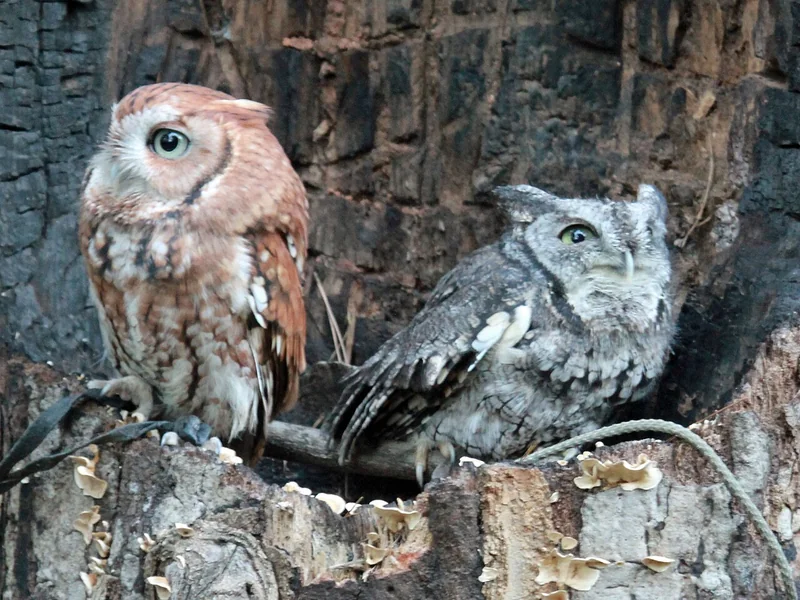 Featured photoeastern-screech-owl.jpg
Megascops asio, the eastern screech owl, is a small owl of the family Strigidae, distributed across the eastern half of North America. Adults are 16 to 25 cm long with a wingspan of 46 to 61 cm and weigh 121 to 244 g. The species occurs in two distinct colour morphs — grey and rusty-red — that interbreed freely. The IUCN lists the species as Least Concern. The screech owl's name is misleading; the typical voice is a soft tremulous trilling whinny rather than an actual screech.
Quick facts
- Habitat
- Mixed and deciduous woodland, woodland edges, suburban yards, and city parks with mature trees. Cavity-nester reliant on natural tree hollows, old woodpecker holes, or nest boxes.
- Range
- Eastern half of North America from southern Canada south through the eastern United States and into northeastern Mexico. The range edge meets the western screech owl (M. kennicottii) along a narrow contact zone in the central US Great Plains.
- Size
- 16–25 cm body · 46–61 cm wingspan · 121–244 g
- Plumage
- Two distinct genetically based colour morphs occur, both with prominent ear-tufts and bright yellow eyes: the grey morph shows mottled grey-and-black plumage with fine darker streaking; the rufous (red) morph shows warm chestnut-red plumage with similar darker streaking. Both morphs occur across most of the species' range, often in the same family. An intermediate brown morph exists in some southern populations.
- Song
- A soft tremulous descending whinny followed by a longer level trill — neither of which sounds remotely like a 'screech'. The trill is the most familiar nocturnal voice in suburban yards across the species' range.
- Migration
- Resident year-round throughout the range; no regular migration.
- Conservation
- Least Concern (LC)
Overview
Megascops asio is one of about twenty Megascops screech owls of the New World — most of the genus is Neotropical, with only a few species reaching the United States and Canada. The species was historically lumped with the western screech owl (M. kennicottii) into a single 'common screech owl' until the 1980s; the two are now treated as separate species after molecular and vocal evidence showed they retain reproductive isolation across their narrow contact zone.
Colour polymorphism
Eastern screech owls show one of the clearest examples of avian colour polymorphism: a grey morph and a rufous (red) morph, both occurring across most of the range and freely interbreeding. The morph ratio shifts geographically — rufous birds are more common in warm southern populations, grey birds dominate in cooler northern populations — suggesting the polymorphism is maintained partly by climate-related selection (rufous birds suffer higher cold-weather mortality).
Behaviour
Eastern screech owls are strictly nocturnal and forage by perch-and-pounce hunting in dense vegetation. The species is among the most generalist of small owls, with a diet ranging from insects to fish. Daytime roosts are typically in tree cavities or dense conifer foliage; the species is famously difficult to spot at rest because of its excellent camouflage. Pairs are socially monogamous and may use the same nesting cavity for many years.
Sources & further reading (2)
- iucn-red-list — accessed 2026-04-29
- encyclopedia — accessed 2026-04-29
Frequently asked questions
Why is it called a 'screech' owl when it doesn't screech?
The species' typical vocalizations are a soft tremulous descending whinny and a longer level trill — neither of which sounds like a screech. The English name predates careful field observation and likely transferred from Old World owls (the European tawny owl, the barn owl) that do produce more screech-like calls. The 'screech' is therefore a folk-etymology misnomer that has stuck.
Why do eastern screech owls have two colour morphs?
The grey morph and the rufous (red) morph are determined by an autosomal gene with the rufous form dominant. Both morphs occur across most of the species' range and interbreed freely; clutches sometimes contain both colours among siblings. The morph ratio shifts geographically — rufous birds are more common in the warm southeast, grey birds dominate in cooler northern populations — suggesting climate-driven differential mortality contributes to maintaining the polymorphism.
Are eastern and western screech owls really different species?
Currently yes — split in 1983 after evidence that the two retain reproductive isolation across their narrow contact zone in the central US Great Plains. Vocal differences are clear: the eastern's descending whinny vs. the western's accelerating bouncing-ball call. Molecular evidence supports the split. The two were lumped as a single 'common screech owl' (Otus asio) until the 1980s, and older field guides will list them that way.