Cygnus buccinator
Trumpeter Swan (Cygnus buccinator)
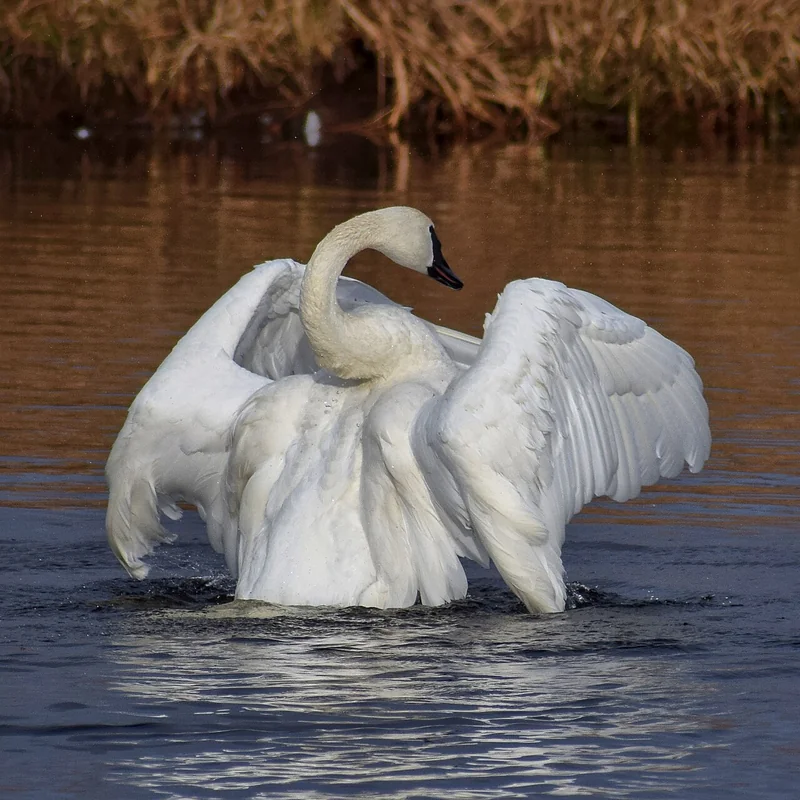 Featured phototrumpeter-swan.jpg
Cygnus buccinator, the trumpeter swan, is the largest native waterfowl in North America. Adults are 138 to 165 cm long with a wingspan of 185 to 250 cm and weigh 7 to 13.6 kg, with the largest males approaching 16 kg. The plumage is pure white with an entirely black bill and bare facial skin. The IUCN lists the species as Least Concern after a remarkable conservation recovery — the species was reduced to fewer than seventy individuals in the lower 48 US states by the 1930s.
Quick facts
- Habitat
- Shallow lakes, marshes, slow-moving rivers, and beaver ponds with abundant aquatic vegetation. The species is unusually tolerant of frozen winter conditions, persisting on geothermal-heated open water in the Yellowstone area year-round.
- Range
- Historically across most of forested North America from Alaska south to the central United States. Currently restricted to scattered populations in Alaska, western and central Canada, the upper Midwest, and the Greater Yellowstone area, with reintroduction programmes expanding the range.
- Size
- 138–165 cm body · 185–250 cm wingspan · 7–13.6 kg
- Plumage
- Adults are uniformly pure white with an entirely black bill, black bare facial skin, and black legs. The bill base joins the eye in a continuous black wedge — diagnostic against the closely related tundra swan, which has a separating yellow patch. Juveniles are pale grey-brown for the first year, slowly moulting to white over the second. The species is sometimes confused with the introduced mute swan; the mute's orange bill with a black knob is the easiest separating field mark.
- Song
- A loud, resonant trumpeting 'oh-oh' or 'koh-hoh', often delivered in coordinated pair duets. The bugling call is distinctive enough that the species was named for it — 'buccinator' is Latin for 'trumpeter'.
- Migration
- Partial migrant. Northern Alaskan and Canadian populations move south for winter to ice-free waters; the Yellowstone-area population is largely resident on geothermal-heated water; reintroduced central populations are increasingly resident with mild winters.
- Conservation
- Least Concern (LC)
Overview
Cygnus buccinator is the largest of North America's three native swans (with tundra swan C. columbianus and the introduced mute swan C. olor as the others). The species' Latin epithet buccinator means 'trumpeter' — Latin buccina is the curved military trumpet of ancient Rome — and refers to the loud bugling call. Trumpeter swans pair for life and may live thirty years in the wild.
Conservation history
Trumpeter swans were extirpated across nearly all of their historical range by the 1930s — fewer than seventy individuals survived in the lower 48 US states, and the Alaska population's existence was uncertain. Drivers included unregulated hunting for swan-down in the eighteenth and nineteenth centuries and lead-shot poisoning. Concerted protection from the 1930s onward, combined with reintroduction programmes from the 1960s, drove a strong recovery; the species was downlisted from US Endangered Species protection and IUCN now lists it as Least Concern.
Behaviour
Trumpeter swans are socially monogamous and typically pair for life. Pairs cooperate in nest construction, incubation, and cygnet rearing, and the bond persists year-round including through winter migration. Wintering flocks of unpaired birds and family groups are loose, but the pairs remain visibly attached. The bugling pair-duet is the most distinctive vocalization of the species.
Sources & further reading (2)
- iucn-red-list — accessed 2026-04-29
- encyclopedia — accessed 2026-04-29
Frequently asked questions
How did trumpeter swans recover from near-extinction?
By the 1930s fewer than seventy trumpeter swans survived in the contiguous United States, and the Alaska population's existence was uncertain. The 1918 Migratory Bird Treaty Act ended legal market hunting, and concerted protection of remaining nesting populations through the 1930s-1950s allowed slow recovery. Reintroduction programmes from the 1960s onward — particularly in the upper Midwest — re-established populations across much of the historical range. The IUCN downlisting reflects the recovery.
What's the difference between trumpeter and tundra swan?
Trumpeter swans are larger (138-165 cm vs. 130-150 cm) with a heavier all-black bill that joins the eye in a continuous black wedge. Tundra swans show a small yellow patch at the bill base separating bill from eye in most individuals. The voice differs sharply — trumpeter call is a deep bugling 'oh-oh', tundra call is a higher-pitched whooping 'wow-wow-wow'. Range overlap is mostly in winter; summer breeding ranges are largely separate.
Why does the species name 'buccinator' mean 'trumpeter'?
Latin buccina is the curved military trumpet of ancient Rome, and 'buccinator' is the soldier who blew it. The naturalist John Richardson coined the trumpeter swan's scientific name in 1832 in reference to the species' loud, deep, bugling call — a sound carrying for over a kilometre across a still lake. The English common name is a translation of the same imagery.