Tachycineta bicolor
Tree Swallow (Tachycineta bicolor)
 Featured phototree-swallow.jpg
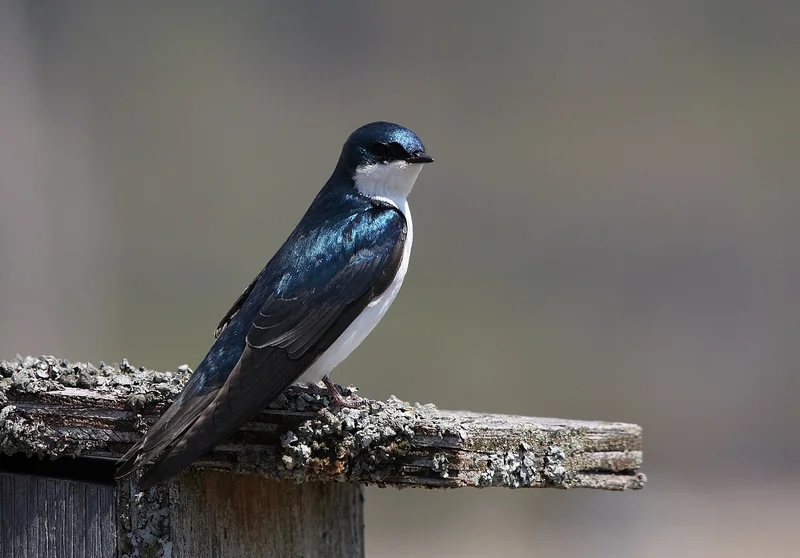
Tachycineta bicolor, the tree swallow, is a small swallow of the family Hirundinidae, distributed across North America. Adults are 12 to 15 cm long with a wingspan of 30 to 35 cm and weigh 16 to 25 g. Adult males show iridescent blue-green upperparts and pure white underparts; females are duller with a brownish wash above. The IUCN lists the species as Least Concern. Tree swallows are among the earliest spring migrants north and the only North American swallow capable of overwintering in the southern United States.
Quick facts
- Habitat
- Open and partly wooded country near water — fields, marshes, lake edges, and beaver ponds. Cavity-nester reliant on natural tree hollows, old woodpecker holes, or human-made nest boxes.
- Range
- Breeds across most of North America from Alaska and Canada south through the United States. Winters from the southern United States south to Cuba and Central America. Limited overwintering in the southern US is documented and increasing.
- Size
- 12–15 cm body · 30–35 cm wingspan · 16–25 g
- Plumage
- Adult males show metallic blue-green upperparts (more blue in some lights, more green in others — the colour is structural) with sharply contrasting pure white underparts from chin to undertail. Females and first-year birds are duller — brown-tinged blue above with the same white underparts. The white-vs-iridescent contrast is sharp and gives the species a strong visual presence in flight.
- Song
- A liquid bubbling twitter delivered from a perch or in flight; the call is a high 'cheep' or 'chip' often given in coordinated flock chatter.
- Migration
- Short- to medium-distance migrant. Most populations move south to the southern US, Mexico, and the Caribbean for winter; small overwintering populations in the southern US are documented and increasing.
- Conservation
- Least Concern (LC)
Overview
Tachycineta bicolor is the type species of the genus Tachycineta and one of the most numerous swallows in North America. The species' tolerance of fruit (uniquely among North American swallows) allows it to overwinter in the southeastern United States — most other Hirundinidae are obligate aerial insectivores tied to year-round insect availability.
Distribution
The breeding range covers most of North America from Alaska and Canada south to the central and southern United States. Long-running monitoring populations exist at Cornell's Ithaca, NY study site and at Queen's University in Ontario; both have followed individually marked birds for over thirty years. Migratory return to the breeding range often happens in March, weeks before any other swallow.
Behaviour
Tree swallows are cavity nesters and accept human-made boxes readily — nest-box competition with eastern bluebirds is well documented. Pairs are socially monogamous but show high rates of extra-pair paternity (fifty to seventy per cent of broods contain offspring sired by a male other than the social mate), one of the highest documented among songbirds. Communal pre-roost flocks of tens of thousands form along the eastern US coast each autumn.
Sources & further reading (2)
- iucn-red-list — accessed 2026-04-29
- encyclopedia — accessed 2026-04-29
Frequently asked questions
Why can tree swallows overwinter further north than other swallows?
Most North American swallows are obligate aerial insectivores and must move south as flying insects disappear. Tree swallows uniquely supplement the diet with fruit — especially bayberries — through autumn and winter, allowing populations to remain in the southeastern United States year-round. Documented overwintering ranges have expanded slightly northward over recent decades.
Why are extra-pair paternity rates so high in tree swallows?
Long-running marked-population studies (Ithaca, NY and Queen's University, Ontario) show fifty to seventy per cent of tree swallow broods contain offspring sired by a male other than the social mate. The species is one of the highest known among songbirds. Proposed drivers include the open colony social structure, female mate choice for genetic compatibility independent of social pairing, and density-dependent opportunities for extra-pair encounters.
Why is the male's plumage iridescent green or blue depending on the light?
The colour is structural, produced by light scattering from feather microstructure rather than by pigment. The wavelengths reflected to the viewer's eye depend on the angle of light and viewing — the same male may appear bright sapphire blue in direct light and emerald green at a different angle. The same physics applies to many other iridescent birds (peacock, hummingbird, magpie).