Ramphastos toco
Toco Toucan (Ramphastos toco)
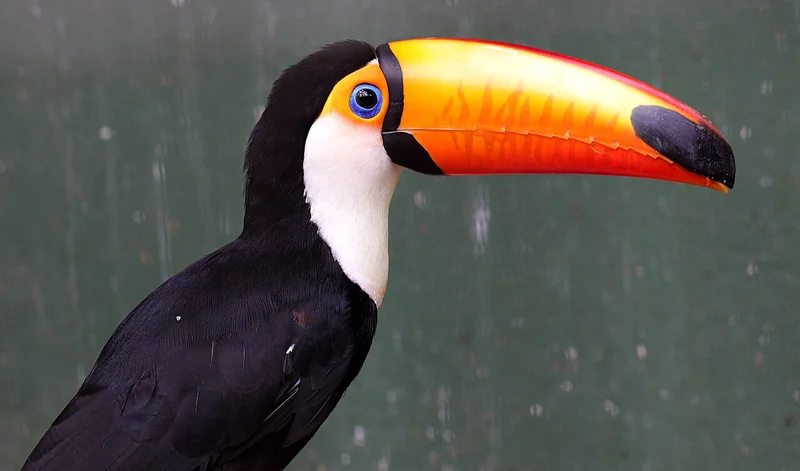 Featured phototoco-toucan.jpg
Ramphastos toco, the toco toucan, is the largest of about forty toucan species. Adults are 55 to 65 cm long with a wingspan of 1.0 to 1.2 m and weigh 0.5 to 0.9 kg. The plumage is mostly black with a white throat, blue eye-rings, and the spectacular outsized orange-yellow bill that has made the species iconic. The IUCN lists the species as Least Concern. Toco toucans are unusually flexible in habitat for a tropical forest bird, occurring in open savanna and forest-edge mosaics rather than closed-canopy rainforest.
Quick facts
- Habitat
- Semi-open habitats — savanna with scattered trees, gallery forest along rivers, forest edges, and orchards. The species avoids closed-canopy rainforest and is therefore the most-seen toucan in mosaic landscapes across central South America.
- Range
- Most of central South America east of the Andes, including the Cerrado of central Brazil, the Pantanal, the Bolivian and Paraguayan Chaco, and northern Argentina. The species' range is one of the largest among toucans.
- Size
- 55–65 cm body · 100–120 cm wingspan · 500–900 g
- Plumage
- Adults are black throughout the body except for a clean white throat and upper breast, a sharp white rump (visible in flight), and brilliant blue facial skin around the eye. The bill is enormous — about a third the bird's total length — and bright orange-yellow with a black tip and a black mark at the bill base. Both sexes look alike. The bill is hollow and structurally light despite its massive appearance.
- Song
- A loud, harsh, croaking 'krek-krek' or grunting series. Pairs and family groups call frequently from high perches, with the call carrying through open savanna habitat.
- Migration
- Largely sedentary across the breeding range. Some local seasonal movements track fruit availability but no regular long-distance migration.
- Conservation
- Least Concern (LC)
Overview
Ramphastos toco is the largest of about forty toucan species in the family Ramphastidae. The toucan family is endemic to the Neotropics and is one of the most distinctive bird groups in the region. The species is one of the most familiar toucans in popular culture and was the inspiration for Guinness's classic 'My Goodness, My Guinness' advertising mascot in the 1930s — though the cartoon Toucan Sam of Froot Loops cereal is loosely based on a different toucan species.
Distribution
Unlike most toucan species, which are restricted to closed-canopy Neotropical rainforest, the toco toucan occupies a much broader range of habitats — open savanna, gallery forest, forest edges, and orchards across central South America. The flexibility makes the species one of the most-seen toucans in the Pantanal, the Brazilian Cerrado, and the Bolivian Chaco. Population trends are generally stable, although some peripheral populations face pressure from deforestation and live-bird trade.
Bill function and thermoregulation
The toco toucan's enormous bill — about a third of the bird's total length — has been studied as one of the most striking thermoregulatory organs in any bird. The bill surface is densely vascularized and the bird can shunt blood flow to and from the bill to dump or conserve heat. Infrared imaging shows the bill heating up dramatically during periods of high activity, then cooling as the bird rests. The bill effectively acts as a controllable radiator, with about half of the bird's resting metabolic heat dispatched through the bill surface.
Sources & further reading (2)
- iucn-red-list — accessed 2026-04-30
- encyclopedia — accessed 2026-04-30
Frequently asked questions
Why is the toco toucan's bill so big?
The bill has at least three documented functions: thermoregulation (the densely vascularized bill surface acts as a controllable radiator that dumps or conserves body heat), reaching fruits on thin branches that would not support the bird's weight, and visual signalling in territorial and social interactions. Infrared imaging shows the bill heating up dramatically during periods of high activity, then cooling as the bird rests, with about half of the bird's resting metabolic heat dispatched through the bill surface.
Is the bill heavy?
Surprisingly light. The bill is hollow and reinforced with thin internal struts of bone — a structure analogous to a bird's hollow flight bones but adapted for the bill. The result is a bill that looks massive but weighs only a small fraction of what a solid bone bill of the same size would weigh. The hollow structure is essential for flight; a solid bill of equivalent dimensions would make the bird unable to take off.
Why doesn't the toco toucan live in dense rainforest?
Most toucan species are restricted to closed-canopy Neotropical rainforest, but the toco toucan is unusual in occupying open savanna, gallery forest, and forest-edge habitats across central South America. The species is more flexible in diet and habitat than typical rainforest toucans, and the open-country distribution lets it occur in the Pantanal, the Brazilian Cerrado, and the Bolivian Chaco — habitats where most other toucans cannot persist.