Strix aluco
Tawny Owl (Strix aluco)
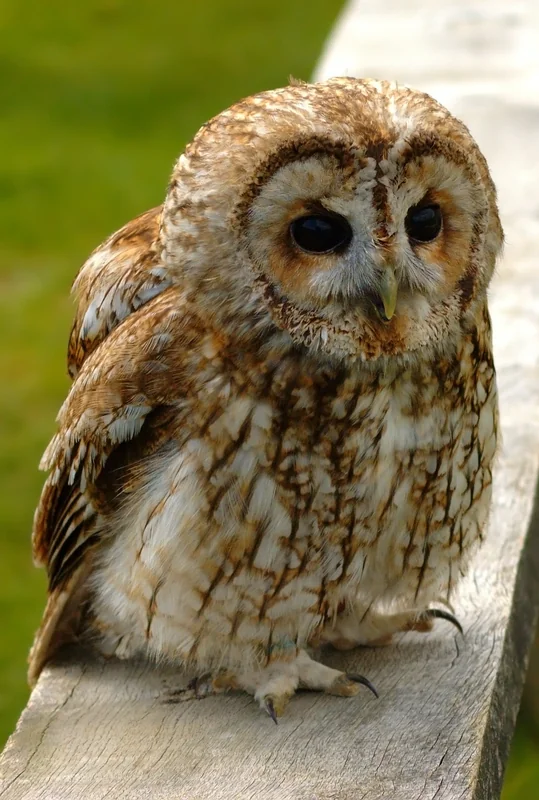 Featured phototawny-owl.jpg
Strix aluco, the tawny owl, is a medium-sized owl distributed across most of Europe and across temperate Asia to Korea. Adults are 37 to 46 cm long with a wingspan of 81 to 105 cm and weigh 385 to 800 g. The plumage is uniformly mottled brown, often warm tawny but sometimes grey-brown depending on morph. The IUCN lists the species as Least Concern. The species is the textbook 'movie owl' across Europe — its hooting call is one of the most familiar bird sounds in European cultural memory.
Quick facts
- Habitat
- Mixed and deciduous forest, woodland edges, parks, and large gardens with mature trees. The species adapts readily to suburban and urban habitats with sufficient mature tree cover.
- Range
- Across most of Europe (excluding Iceland, Ireland, and far northern Scandinavia), North Africa, the Middle East, and across temperate Asia to the Korean peninsula. The species is one of the most familiar European owls.
- Size
- 37–46 cm body · 81–105 cm wingspan · 385–800 g
- Plumage
- Adults occur in two colour morphs — a warm rufous-brown morph and a colder grey-brown morph — both within the same populations. The plumage is uniformly mottled, with a rounded head lacking ear-tufts, dark eyes (most owls have yellow eyes; tawny owls have nearly black ones), and a paler facial disc. Both sexes look alike. The dark eye is one of the most reliable field marks separating tawny owls from other European Strigidae.
- Song
- Males give the famous 'hoooooo, hu-hu-hu-hu-hooooo' hooting song from a high perch in the breeding season. Females give the 'kewick' contact call. The textbook 'twit-twoo' folk rendering of European owl calls is actually a duet — the female's 'kewick' followed by the male's 'hoo'.
- Migration
- Sedentary across the entire range. Long-eared and short-eared owls migrate; tawny owls do not. The species' year-round residency makes it a useful indicator of stable woodland habitat across Europe.
- Conservation
- Least Concern (LC)
Overview
Strix aluco is the type species of the genus Strix and one of the most familiar European owls. The Latin epithet 'aluco' is from a Greek-derived word for 'owl'. The species is broadly distributed across Europe and Asia and is the textbook 'movie owl' across Europe — its hooting call is one of the most familiar bird sounds in European cultural memory and is the standard 'owl sound' used in films and TV produced in Britain and continental Europe.
Twit-twoo duet
The folk rendering of European owl calls as 'twit-twoo' is actually a duet between male and female tawny owls. The female gives the 'kewick' contact call (the 'twit') and the male responds with the hooting 'hoooooo' (the 'twoo'). Single-bird calls do not produce the 'twit-twoo' sequence; the duet is delivered by a pair near the nest during the breeding season. Most film and TV uses of the 'twit-twoo' sound are actually mismatched — the producers conflate the two birds' calls into one bird.
Distribution
The breeding range covers most of Europe (excluding Iceland, Ireland, and far northern Scandinavia), North Africa, the Middle East, and across temperate Asia to the Korean peninsula. Population trends are generally stable to slightly declining; some western European populations have decreased modestly with woodland fragmentation, but the broader range remains stable. The species is one of the most-studied European owls.
Sources & further reading (2)
- iucn-red-list — accessed 2026-04-30
- encyclopedia — accessed 2026-04-30
Frequently asked questions
Is the 'twit-twoo' sound made by one bird?
No — it's a duet between male and female tawny owls. The female gives the 'kewick' contact call (the 'twit') and the male responds with the hooting 'hoooooo' (the 'twoo'). Single-bird calls do not produce the 'twit-twoo' sequence; the duet is delivered by a pair near the nest during the breeding season. Most film and TV uses of the 'twit-twoo' sound are mismatched — the producers conflate the two birds' calls into one bird's voice.
Why do tawny owls have dark eyes?
Most European owls have yellow eyes, but tawny owls have dark brown to nearly black eyes — one of the most reliable field marks for the species. The dark eye is associated with strictly nocturnal hunting in dense forest, where light-gathering capacity matters more than colour discrimination. Other strictly nocturnal owls (barn owls, several Strix species) share the dark-eye trait.
Why is the tawny owl absent from Ireland?
Ireland lacks several common European woodland species, including the tawny owl. The pattern reflects post-glacial recolonization timing — Ireland was separated from Britain by sea early in the post-glacial period, before tawny owls (which are non-migratory and disperse poorly across water) could colonize. Several other British woodland species (woodpeckers, squirrels, deer) are similarly absent or recent introductions in Ireland for the same reason.