Buteo swainsoni
Swainson's Hawk (Buteo swainsoni)
 Featured photoswainsons-hawk.jpg
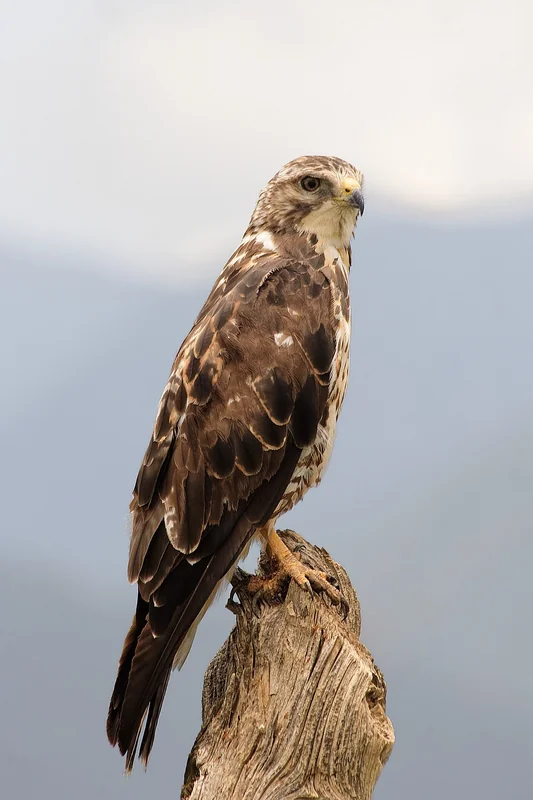
Buteo swainsoni, Swainson's hawk, is a medium-sized buteonine hawk of the family Accipitridae, distributed across western North America. Adults are 43 to 56 cm long with a wingspan of 1.17 to 1.37 m and weigh 0.7 to 1.4 kg. The plumage is variable — most adults show dark brown upperparts and a paler buff-and-rufous underbody with a dark breast band. The IUCN lists the species as Least Concern. Swainson's hawks undertake one of the longest annual migrations of any North American raptor — from prairie breeding grounds to the pampas of Argentina.
Quick facts
- Habitat
- Open prairies, agricultural grasslands, and sagebrush steppe across the western United States and Canadian prairies. The species depends on open hunting habitat with scattered tall trees or utility poles for nesting and perches.
- Range
- Western North America from southern Alaska, the Canadian prairies, and the western United States south to central Mexico. Winters in southern South America, particularly the Argentine pampas. The migration route is one of the most-documented raptor flyways.
- Size
- 43–56 cm body · 117–137 cm wingspan · 0.7–1.4 kg
- Plumage
- Adults occur in light, intermediate, and dark colour morphs. Light-morph adults (the most common) show dark brown upperparts, a clean white throat, a dark chocolate-brown breast band, and pale buff-and-rufous underparts. Dark-morph adults are uniformly chocolate-brown throughout. Intermediate adults show various combinations. The pointed wings (more pointed than red-tailed hawk) are a useful field mark in flight.
- Song
- A high-pitched whistled 'kreee' delivered both in flight and from a perch — similar to but slightly higher-pitched than the more familiar red-tailed hawk scream.
- Migration
- Long-distance migrant. North American breeders travel south to the Argentine pampas for the southern summer — annual round-trip migrations of 16,000-20,000 km. The migration concentrates through Central America at sites such as Veracruz (Mexico) and Panama.
- Conservation
- Least Concern (LC)
Overview
Buteo swainsoni is one of several Buteo soaring hawks of North America. The species was named after the British naturalist William Swainson by the American naturalist Charles Bonaparte in 1832. The species is one of the more numerous breeding hawks across the western US and Canadian prairies, and is one of the most-studied long-distance raptor migrants worldwide.
Long-distance migration
Swainson's hawks undertake one of the longest annual migrations of any North American raptor. North American breeders travel south to the Argentine pampas for the southern summer — annual round-trip migrations of approximately 16,000-20,000 km. The migration concentrates through Central America and forms one of the most spectacular hawk-migration spectacles in the world. Veracruz (Mexico) hosts the famous 'River of Raptors' migration count where hundreds of thousands of Swainson's hawks pass each autumn.
Pesticide crisis and recovery
Swainson's hawk populations crashed sharply in the 1990s when wintering birds in Argentina were killed by monocrotophos pesticide applied to alfalfa and sunflower fields. The pesticide was used to control grasshoppers — the same prey the hawks fed on — and large numbers of hawks died from secondary poisoning. International cooperation between US, Canadian, and Argentine conservation agencies led to monocrotophos restriction in 1996; populations have recovered strongly since. The episode is one of the textbook examples of cross-border raptor conservation.
Sources & further reading (2)
- iucn-red-list — accessed 2026-04-30
- encyclopedia — accessed 2026-04-30
Frequently asked questions
How long is the Swainson's hawk migration?
Annual round-trip migrations of approximately 16,000-20,000 km. North American breeders travel south to the Argentine pampas for the southern summer, then return north for the next breeding season. The migration is one of the longest of any North American raptor and concentrates through Central America — the famous 'River of Raptors' at Veracruz, Mexico hosts hundreds of thousands of Swainson's hawks each autumn.
Why do Swainson's hawks eat so many insects?
Swainson's hawks have an unusually insect-heavy summer diet for a buteo hawk. Grasshoppers, dragonflies, and other large flying insects can make up over half the diet during summer outbreak years. Large flocks of migrating Swainson's hawks descend on prairie grasshopper outbreaks and consume hundreds of insects per bird per day. The behavioural specialization made the species especially vulnerable to the 1990s monocrotophos pesticide crisis in Argentina.
Why did Swainson's hawks crash in the 1990s?
Swainson's hawk populations crashed sharply in the 1990s when wintering birds in Argentina were killed by monocrotophos pesticide applied to alfalfa and sunflower fields. The pesticide was used to control grasshoppers — the same prey the hawks fed on — and large numbers of hawks died from secondary poisoning. International cooperation between US, Canadian, and Argentine conservation agencies led to monocrotophos restriction in 1996; populations have recovered strongly since. The episode is one of the textbook examples of cross-border raptor conservation.