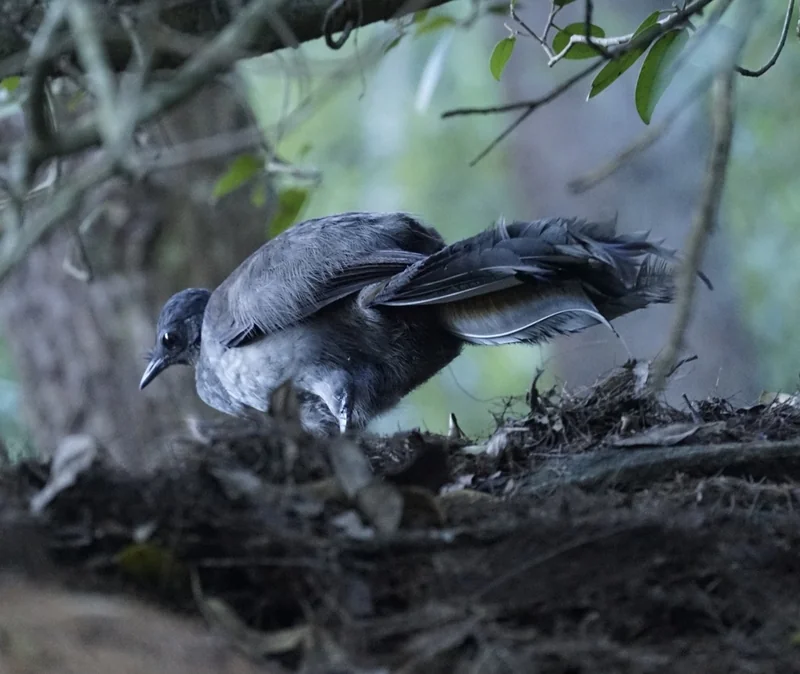
Menura novaehollandiae, the superb lyrebird, is a large songbird of the family Menuridae, native to eastern Australian forest. Adults are 80 to 100 cm long (males including the long tail) and weigh 0.9 to 1.1 kg. The plumage is grey-brown with a magnificent lyre-shaped tail in adult males during the breeding season. The IUCN lists the species as Least Concern. Superb lyrebirds are the world's most accomplished avian vocal mimics, reproducing the calls of dozens of other species and ambient sounds with extraordinary fidelity.
Quick facts
- Habitat
- Eucalyptus forest, temperate rainforest, and wet sclerophyll woodland of southeastern Australia. The species occupies dense forest understorey and is rarely seen in open country.
- Range
- Native to southeastern Australia from southern Queensland through New South Wales to Victoria and Tasmania. Introduced and naturalized in southwestern Tasmania.
- Size
- 80–100 cm body · 70–80 cm wingspan · 0.9–1.1 kg
- Plumage
- Adults show grey-brown body plumage that matches the leaf-litter forest floor. Adult males in breeding plumage carry an extraordinary lyre-shaped tail — two thick S-curved outer feathers, a row of fine filamentous central feathers, and the typical longer plumes — that fans into a parasol shape during display. Adult females and juvenile males have plain straight tails. The tail of the displaying male is one of the most spectacular plumage features of any songbird.
- Song
- Superb lyrebirds are the world's most accomplished vocal mimics. The full song integrates the species' own warbling phrases with mimicry of dozens of other species' calls and ambient sounds — chainsaws, camera shutters, alarms — reproduced with extraordinary fidelity.
- Migration
- Sedentary. The species' weak flight ability is suited only to short distances; lyrebirds spend nearly all of life on the ground.
- Conservation
- Least Concern (LC)
Overview
Menura novaehollandiae is one of two Menura lyrebird species (with the smaller Albert's lyrebird M. alberti). Despite the chicken-like body size and ground-foraging habits, lyrebirds are songbirds (order Passeriformes) — the largest songbirds in the world. The species is one of the most extraordinary vocal mimics among birds, with documented mimicry of over twenty other bird species plus various ambient sounds. The species is depicted on the Australian ten-cent coin.
Vocal mimicry
Superb lyrebirds reproduce the songs and calls of dozens of other species with extraordinary fidelity, plus various ambient sounds — chainsaws, camera shutters, car alarms, dogs barking, even snippets of human speech. The mimicry is so accurate that recordings of lyrebird mimicry of other species are sometimes mistaken for the actual species. Field studies have shown that some mimicked phrases are passed culturally between male lyrebirds in the same area, with regional 'dialects' of mimicked phrases that can persist for decades.
Display
Males establish small clearings in the forest floor — 'display mounds' — and perform an elaborate courtship sequence. The tail is fanned vertically over the back into the famous lyre shape, the male sings the integrated mimicry sequence for ten to fifteen minutes, and visiting females observe the display. Females select males based on display quality and mimicry repertoire size; only a few highest-ranking males in any area father most of the chicks. The display is one of the most elaborate courtship sequences among songbirds.
Sources & further reading (2)
- iucn-red-list — accessed 2026-04-30
- encyclopedia — accessed 2026-04-30
Frequently asked questions
Are lyrebirds really the world's best vocal mimics?
Yes — superb lyrebirds reproduce the calls of dozens of other bird species plus various ambient sounds (chainsaws, camera shutters, car alarms, dogs barking, even human speech) with extraordinary fidelity. The mimicry is so accurate that recordings of lyrebird mimicry of other species are sometimes mistaken for the actual species. Field studies have documented over twenty different species' calls in single individual males' repertoires.
Why is the tail shaped like a lyre?
Adult males in breeding plumage have an extraordinary tail composed of two thick S-curved outer feathers, a row of fine filamentous central feathers, and longer plumes. When fanned vertically over the back during display, the tail forms a parasol shape that resembles the ancient Greek string instrument the lyre — the source of the species' English name. The tail is sexually selected and only adult males develop it; females and juveniles have plain straight tails.
Are lyrebirds related to pheasants?
No, despite the superficial similarity in body size and ground-foraging habits. Lyrebirds are songbirds (order Passeriformes) — the largest songbirds in the world. Their pheasant-like appearance is convergent evolution, not a phylogenetic relationship. Within the Passeriformes, lyrebirds are an early-branching lineage of the suborder Passeri (oscines), with the closely related scrub-birds as their nearest relatives.