Malurus cyaneus
Superb Fairywren (Malurus cyaneus)
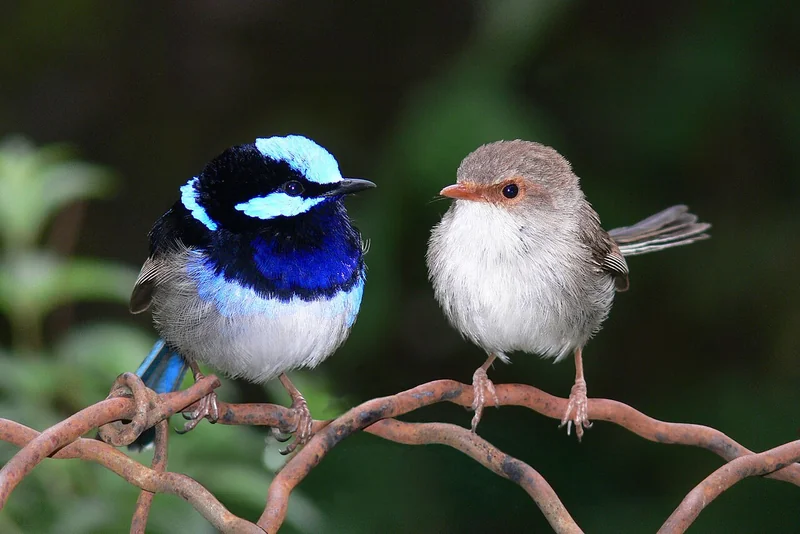 Featured photosuperb-fairywren.jpg
Malurus cyaneus, the superb fairywren, is a small passerine of the family Maluridae, one of Australia's most widespread and recognisable birds. Adults are 14 cm long with a wingspan of 13 to 14 cm and weigh 8 to 11 g. Breeding males display vivid cobalt-blue upperparts and black mask and throat against a white belly — among the most striking small birds on the continent. The IUCN lists the species as Least Concern. The species lives in cooperative family groups and is famous for its complex social system.
Quick facts
- Habitat
- Dense shrubby understorey of eucalyptus woodland, heathland, suburban gardens, parks, and coastal scrub across southeastern Australia. The species thrives wherever dense low shrubs provide both foraging substrate and nesting cover.
- Range
- Southeastern Australia — from South Australia through Victoria, New South Wales, and the Australian Capital Territory north to southeastern Queensland, plus Tasmania and Bass Strait islands. One of Australia's most familiar birds.
- Size
- 13–15 cm body · 13–14 cm wingspan · 8–11 g
- Plumage
- Breeding males have brilliant turquoise-cobalt crown, cheeks, mantle, and upper tail, a black face mask and breast band, and white underparts — the blue plumage is iridescent and intensifies in direct light. Non-breeding males (eclipse) and females are brown above with a rufous tinge around the eye in females. The cocked tail — held nearly vertical — is characteristic of all ages and both sexes.
- Song
- A rapid, insect-like 'trrt-trrt-trrt' reeling sound and a variety of melodic chirps and chips. The song is complex and learned, with males incorporating novel phrases into their repertoire. The species also uses a specific 'Peter' alarm call.
- Migration
- Sedentary. The species maintains year-round territories and does not migrate.
- Conservation
- Least Concern (LC)
Overview
Malurus cyaneus is one of approximately 12 fairywren species in the family Maluridae — a family endemic to Australia and New Guinea. Despite the superficial resemblance to wrens (family Troglodytidae), fairywrens are not related to true wrens and are instead part of the large Australasian songbird radiation. The superb fairywren is the most widespread and abundant of the fairywrens and has adapted readily to suburban gardens across southeastern Australia, where it is a familiar and welcome garden visitor.
Cooperative breeding and family groups
Superb fairywrens live in stable family groups of one breeding pair plus 1–4 male helpers — typically offspring from previous seasons who delay dispersal and help raise the current year's chicks. This cooperative breeding system means that chicks receive care from multiple adults, improving survival. Helpers contribute significantly to food delivery and nest defence. The breeding female does all incubation alone, but the male and helpers feed her during incubation and join in feeding the nestlings. Approximately 40% of all nests in a population are attended by helpers.
Extra-pair mating and blue plumage
Despite the cooperative social structure, superb fairywrens have one of the highest rates of extra-pair paternity of any bird species studied — up to 76% of offspring in some populations are fathered by a male other than the social father. Breeding males visit neighbouring females and perform 'nuptial feeding' — presenting flower petals as gifts — before mating. Males whose plumage is a brighter, more saturated blue are more successful in extra-pair matings. The cobalt coloration is structural (iridescence) rather than pigment-based, and its intensity reflects feather quality and thus male condition.
Sources & further reading (2)
- iucn-red-list — accessed 2026-05-07
- encyclopedia — accessed 2026-05-07
Frequently asked questions
Why do superb fairywrens have such high rates of infidelity?
Studies show that up to 76% of nestlings in some superb fairywren populations are fathered by males other than the social pair-bond male — one of the highest extra-pair paternity rates recorded in any bird. Female fairywrens actively solicit extra-pair matings from neighbouring males with particularly bright blue plumage, as iridescent blue coloration correlates with male condition. The cooperative social group provides reliable chick-rearing support, while females gain genetic benefits from extra-pair mates.
What is the 'flower-petal presentation' behaviour?
Male superb fairywrens in eclipse (brown) plumage present yellow flower petals to females — a form of courtship gift called nuptial feeding. The male collects a fresh petal, carries it to the female's territory, and displays it while adopting a specific lateral display posture. This behaviour occurs most commonly before the male moults into the breeding cobalt-blue plumage and may function as a preliminary assessment of female receptiveness to extra-pair mating.
Are superb fairywrens related to true wrens?
No. Despite the English name, superb fairywrens belong to the family Maluridae — a group endemic to Australia and New Guinea and only distantly related to the Northern Hemisphere wrens (family Troglodytidae). The similarity in name and habit (secretive ground-level foraging with a cocked tail) is convergent evolution, not a shared ancestry. Fairywrens belong to the great Australasian songbird radiation, which evolved independently from Northern Hemisphere passerines.