Aratinga solstitialis
Sun Parakeet (Aratinga solstitialis)
 Featured photosun-conure.jpg
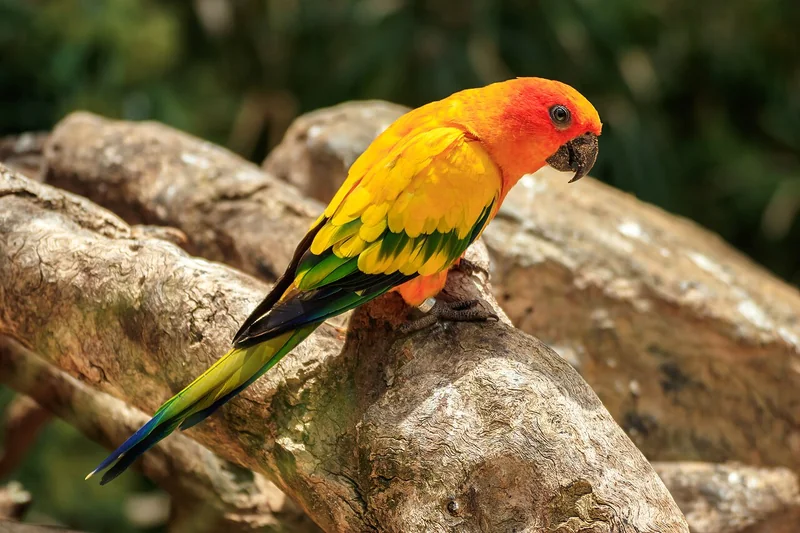
Aratinga solstitialis, the sun parakeet (also called sun conure), is a medium-sized parakeet of the family Psittacidae, native to a small region of northeastern South America. Adults are 30 cm long with a wingspan of about 45 cm and weigh 100 to 130 g. The plumage is brilliant golden-yellow with orange face and breast and green wings. The IUCN lists the species as Endangered, reflecting major population declines from the live-bird trade. The species' wild population is now estimated at fewer than 4,000 mature individuals, restricted to a small area of Roraima (Brazil) and southern Guyana.
Quick facts
- Habitat
- Tropical lowland savanna and forest edge with palm-rich gallery forest. The species depends on intact savanna-forest mosaic with palms for both food and nesting cavities.
- Range
- A small region of northeastern South America — northern Roraima (Brazil), southern Guyana, and southern Suriname. The total range is small relative to most parakeets.
- Size
- 30 cm body · 45 cm wingspan · 100–130 g
- Plumage
- Adults show brilliant golden-yellow body plumage with bright orange wash across the face, breast, and belly, plus green and blue flight feathers and a bright orange crown. The bill is grey-black; the eye-ring is white. Both sexes look alike. Juveniles are duller olive-green with reduced orange and yellow; the adult plumage develops over the first one to two years.
- Song
- Loud raucous chattering and screeching calls similar to other Aratinga parakeets. Pairs and family groups maintain near-constant contact calls when foraging together.
- Migration
- Sedentary across the small breeding range. Some local seasonal movements between forest patches occur but no regular migration.
- Conservation
- Endangered (EN)
Overview
Aratinga solstitialis is one of about a dozen Aratinga parakeet species across the Neotropics. The species' brilliant orange-and-yellow plumage and small range have made it one of the most-targeted parrots for the international live-bird trade — the basis of its current Endangered IUCN listing. Wild populations have declined by approximately 80-90 per cent over recent decades, with most individuals now restricted to a few protected areas.
Conservation crisis
Wild sun parakeet populations have collapsed since the 1970s, primarily through trapping for the international live-bird trade. The total wild population is now estimated at fewer than 4,000 mature individuals, restricted to a small area of Roraima (Brazil) and southern Guyana. International trade is regulated under CITES Appendix II since 2011. Local conservation efforts in Brazil and Guyana focus on community-based protection of remaining colonies and on disrupting illegal trapping operations along the Brazil-Guyana border.
Distribution
The native range is a small region of northeastern South America — northern Roraima (Brazil), southern Guyana, and southern Suriname. The total range is one of the smallest of any Neotropical parakeet. The species depends on tropical savanna with palm-rich gallery forest — a habitat type that is itself sensitive to habitat conversion and fire-regime changes across the small range. Population recovery requires both habitat protection and effective anti-trapping enforcement.
Sources & further reading (2)
- iucn-red-list — accessed 2026-04-30
- encyclopedia — accessed 2026-04-30
Frequently asked questions
Why is the sun parakeet Endangered?
Wild populations have collapsed by 80-90 per cent since the 1970s, primarily through trapping for the international live-bird trade. The total wild population is now estimated at fewer than 4,000 mature individuals, restricted to a small area of Roraima (Brazil) and southern Guyana. International trade is regulated under CITES Appendix II since 2011. The species' brilliant orange-and-yellow plumage made it a heavily targeted target for capture, and the small native range made the population especially vulnerable.
Where does the sun parakeet live in the wild?
The native range is a small region of northeastern South America — northern Roraima (Brazil), southern Guyana, and southern Suriname. The total range is one of the smallest of any Neotropical parakeet. The species depends on tropical savanna with palm-rich gallery forest, particularly Mauritia palm stands. Most remaining wild birds are concentrated in a few protected areas in Brazil and Guyana.
Are sun parakeet and sun conure the same bird?
Yes. 'Sun parakeet' is the standard ornithological English name; 'sun conure' is an older name still common in aviculture and pet-keeping literature. The two refer to the same species — Aratinga solstitialis. Modern bird-conservation literature uses 'sun parakeet' to align with broader IOC English-name conventions for the genus Aratinga.