Psittacus erithacus
African Grey Parrot (Psittacus erithacus)
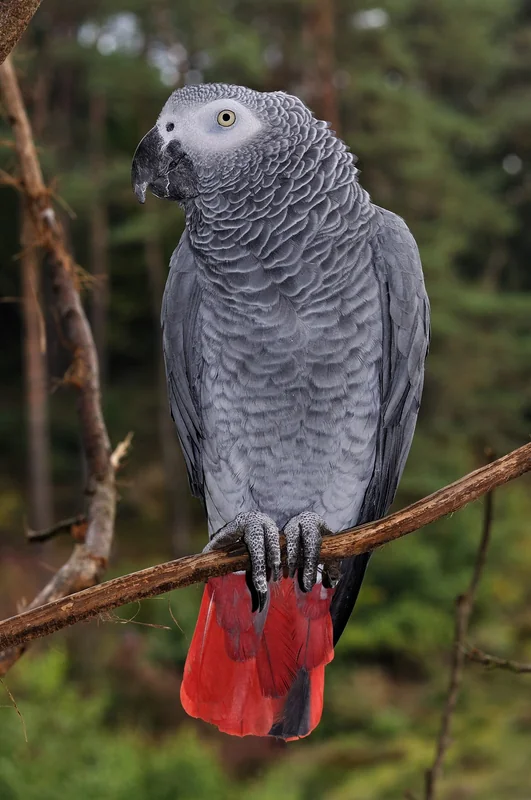 Featured photoafrican-grey-parrot.jpg
Psittacus erithacus, the African grey parrot, is a medium-sized parrot of the family Psittacidae, native to the equatorial forests of Africa. Adults are 30 to 40 cm long with a wingspan of 46 to 52 cm and weigh 400 to 490 g. The plumage is uniformly silver-grey with a bright red tail, white facial skin, and a black bill. The IUCN lists the species as Endangered, reflecting major population declines from the live-bird trade and habitat loss. The species is among the most cognitively studied of all birds, with documented vocabulary acquisition and abstract reasoning rivalling that of great apes.
Quick facts
- Habitat
- Equatorial lowland and lower-montane rainforest, gallery forest, and forest edges. The species favours mature forest with abundant fruit-bearing trees and tall hollow trees for nesting.
- Range
- Equatorial Africa from southeastern Côte d'Ivoire and Ghana east through Nigeria, Cameroon, Gabon, the Republic of the Congo, the Democratic Republic of the Congo, Uganda, and into western Kenya. Two named subspecies were historically recognized; the Timneh grey (formerly P. e. timneh) was split as a separate species P. timneh in 2012.
- Size
- 30–40 cm body · 46–52 cm wingspan · 400–490 g
- Plumage
- Adults show uniformly silver-grey plumage across body and wings, with darker grey wing primaries, a bright scarlet-red tail, and a contrasting white bare facial skin patch around the eye. The bill is heavy and entirely black. Juveniles resemble adults but with a darker grey iris (yellow in adults) and slightly duller plumage. Both sexes look alike — the species is one of the few large parrots without sexual plumage dimorphism.
- Song
- Vocalizations are highly variable and include whistles, screeches, and chattering. The species is one of the most accomplished vocal mimics among birds, capable of reproducing complex human speech, mechanical sounds, and other species' calls. Wild African greys use the same vocal flexibility to mimic neighbouring forest birds and may form regional 'dialects'.
- Migration
- Largely sedentary. Local seasonal movements track fruit availability but no long-distance migration.
- Conservation
- Endangered (EN)
Overview
Psittacus erithacus is the type and only living species of the genus Psittacus following the 2012 split of the Timneh grey parrot (P. timneh) as a separate species. The species is widely regarded as one of the most cognitively complex non-human animals studied — a cognitive performance not predicted by mammal-centred animal-cognition theory before the late twentieth century. The bird's small forebrain volume relative to mammals masks a dense neural circuitry that supports the observed cognitive feats.
Conservation status
African grey populations have declined by approximately ninety per cent across much of the historical range over the last fifty years. The drivers are habitat loss to forest clearance and intensive trapping for the international live-bird trade — the species was for decades the world's most-traded wild parrot. Trade restrictions under CITES Appendix I (since 2017) and concerted national conservation efforts have slowed but not reversed the trend; the IUCN listing was uplisted from Vulnerable to Endangered in 2016.
Cognition
African grey parrots are among the most cognitively studied of all birds. The most famous research subject — Alex, an African grey trained by Irene Pepperberg from 1977 to 2007 — demonstrated comprehension of over 100 spoken English words, abstract concepts including same/different, larger/smaller, colour, shape, and rudimentary number, plus apparent intent in his vocalizations. The cognitive performance is comparable to that documented in great apes and dolphins, and has reshaped understanding of avian cognition more broadly. Wild greys appear to use similar cognitive flexibility for social coordination and foraging.
Sources & further reading (2)
- iucn-red-list — accessed 2026-04-30
- encyclopedia — accessed 2026-04-30
Frequently asked questions
Why is the African grey such a famous cognitive study subject?
The species combines exceptional vocal-mimicry ability with what appears to be genuine comprehension of the words mimicked. Irene Pepperberg's three-decade study of the African grey Alex demonstrated comprehension of over 100 English words plus abstract concepts including same/different, larger/smaller, and rudimentary number. The performance reshaped twentieth-century understanding of avian cognition and is now a cornerstone of comparative cognition research.
Why is the African grey listed as Endangered?
Wild populations have declined by approximately ninety per cent over the last fifty years. The drivers are habitat loss to logging and forest clearance plus intensive trapping for the international live-bird trade — the species was historically the most-traded wild parrot in the world. International trade was restricted to commercial-zero levels under CITES Appendix I in 2017. The IUCN listing was uplisted from Vulnerable to Endangered in 2016.
Are Timneh and Congo greys the same species?
No, not since 2012. The Timneh grey parrot (Psittacus timneh) of Sierra Leone, Liberia, Côte d'Ivoire, Guinea, and Guinea-Bissau was split from the larger Congo grey (P. erithacus) on molecular and morphological grounds. The two were historically lumped under P. erithacus with the Timneh as a subspecies. They are now treated as full sister species; the Timneh grey has its own IUCN Endangered listing.